18 min readupdated
Tattoo by placement
Arm tattoo — Wrocław
An arm is not one placement but three very different ones. The upper arm, the forearm and the hand are separated by more than they share: touch-ups run at 9%, 10% and 60% of pieces respectively, pain ranges from 3 to 9 out of 10, and the ability to cover the work drops from 4 out of 5 to 1 out of 5. All on one limb, within forty centimetres.
This page exists to put those three sections side by side before you choose one. If you already know where you want your tattoo, go straight to the right page. If you are thinking about a sleeve, or torn between sections — start here, because the order of decisions matters more here than the design does.
- 5/10
- Pain
- 14–30 days
- Healing
- 15% of pieces
- Touch-up rate
- 1–8 h
- Typical session
The first touch-up after healing is included in the price.
over 200 tattoos done5 on Google (40 reviews)
Our work: arm
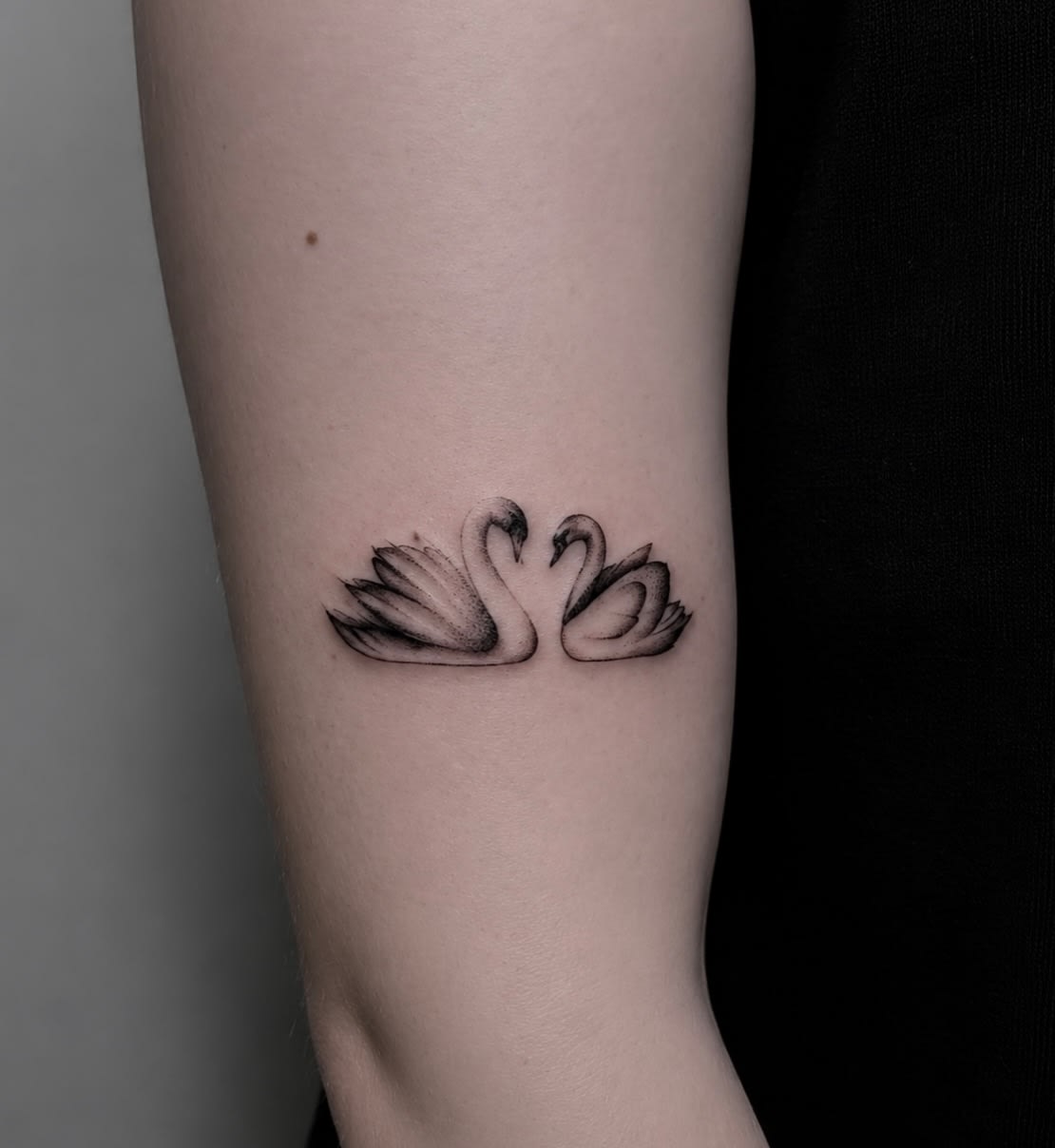
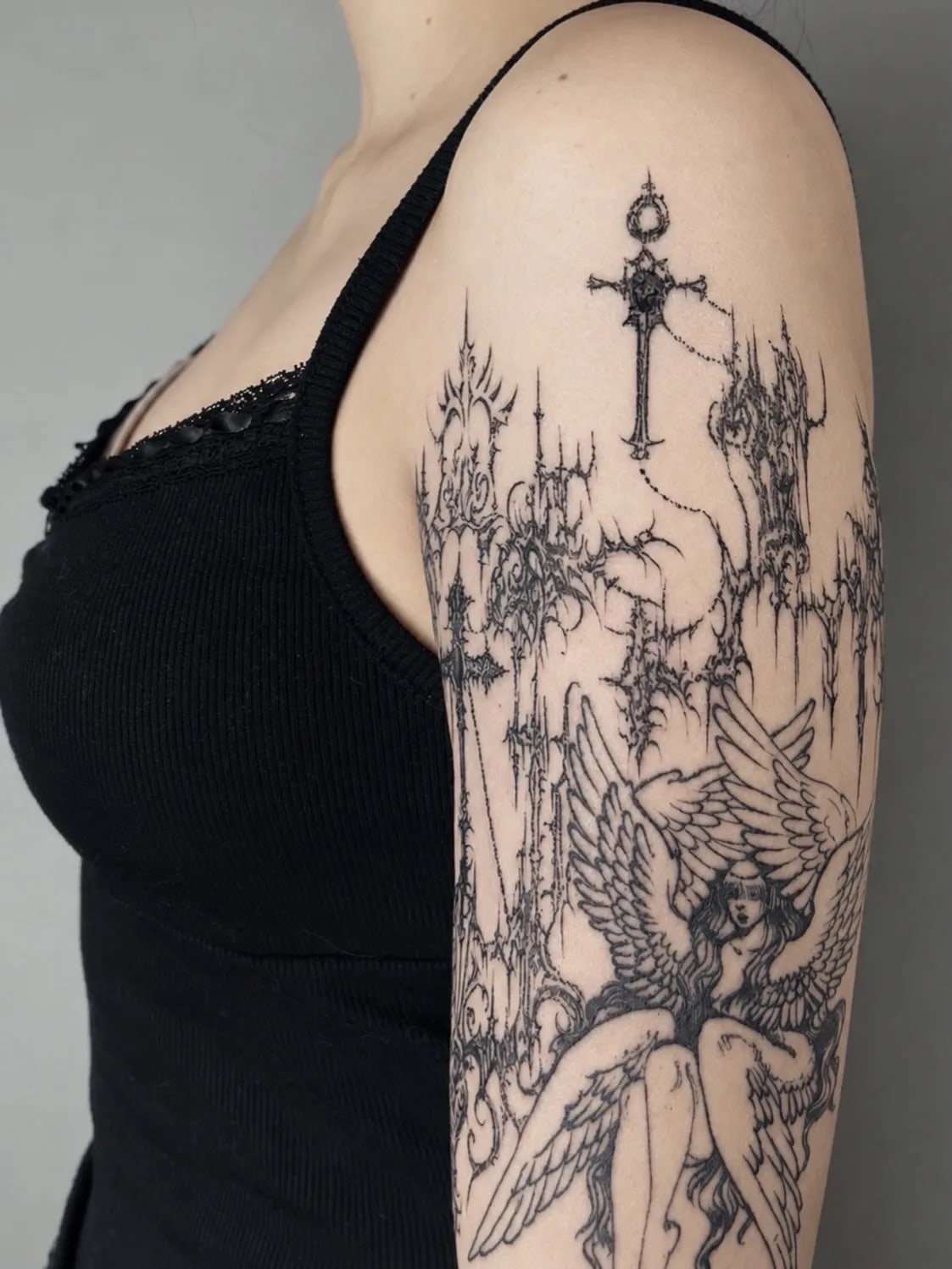

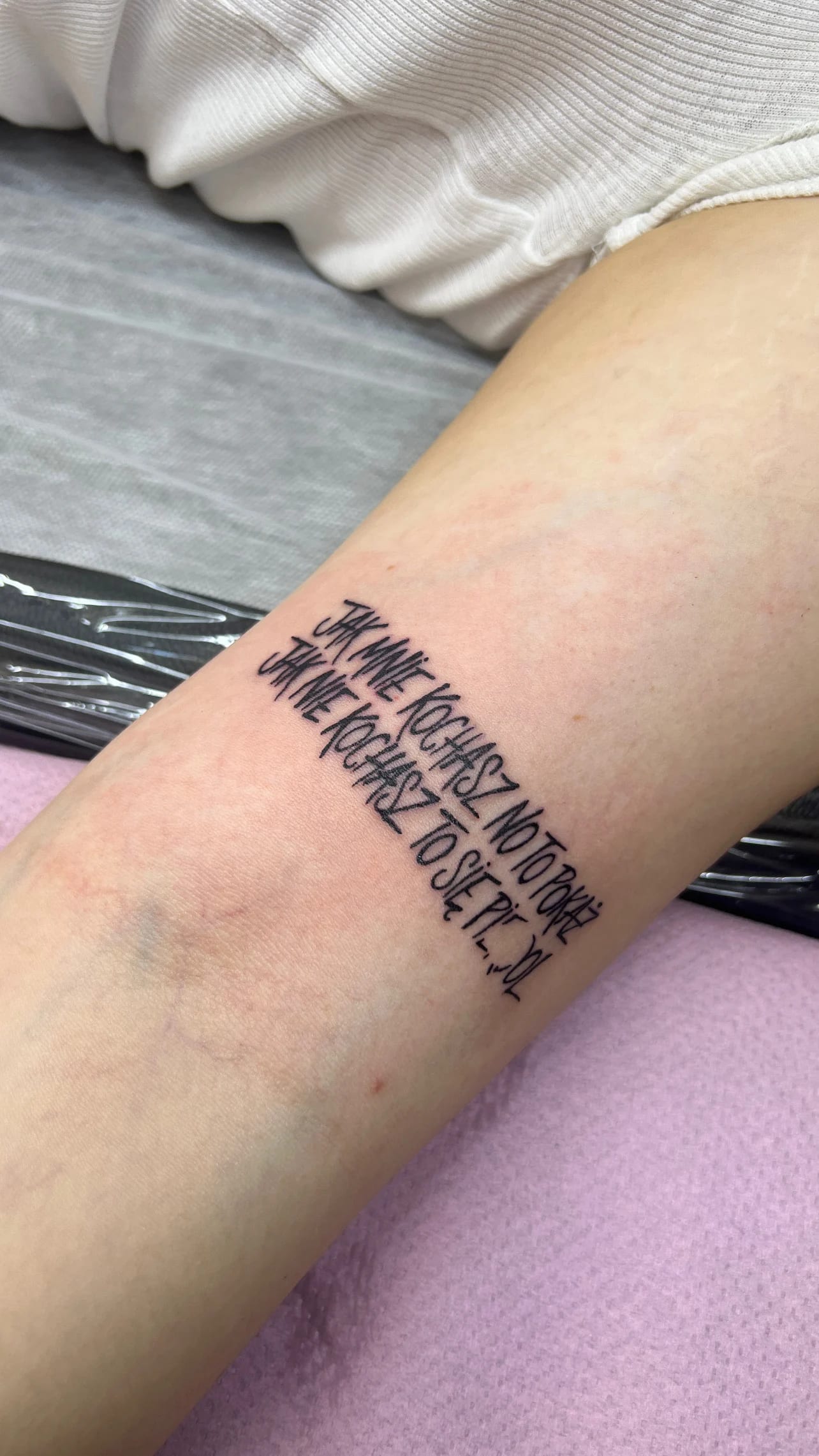
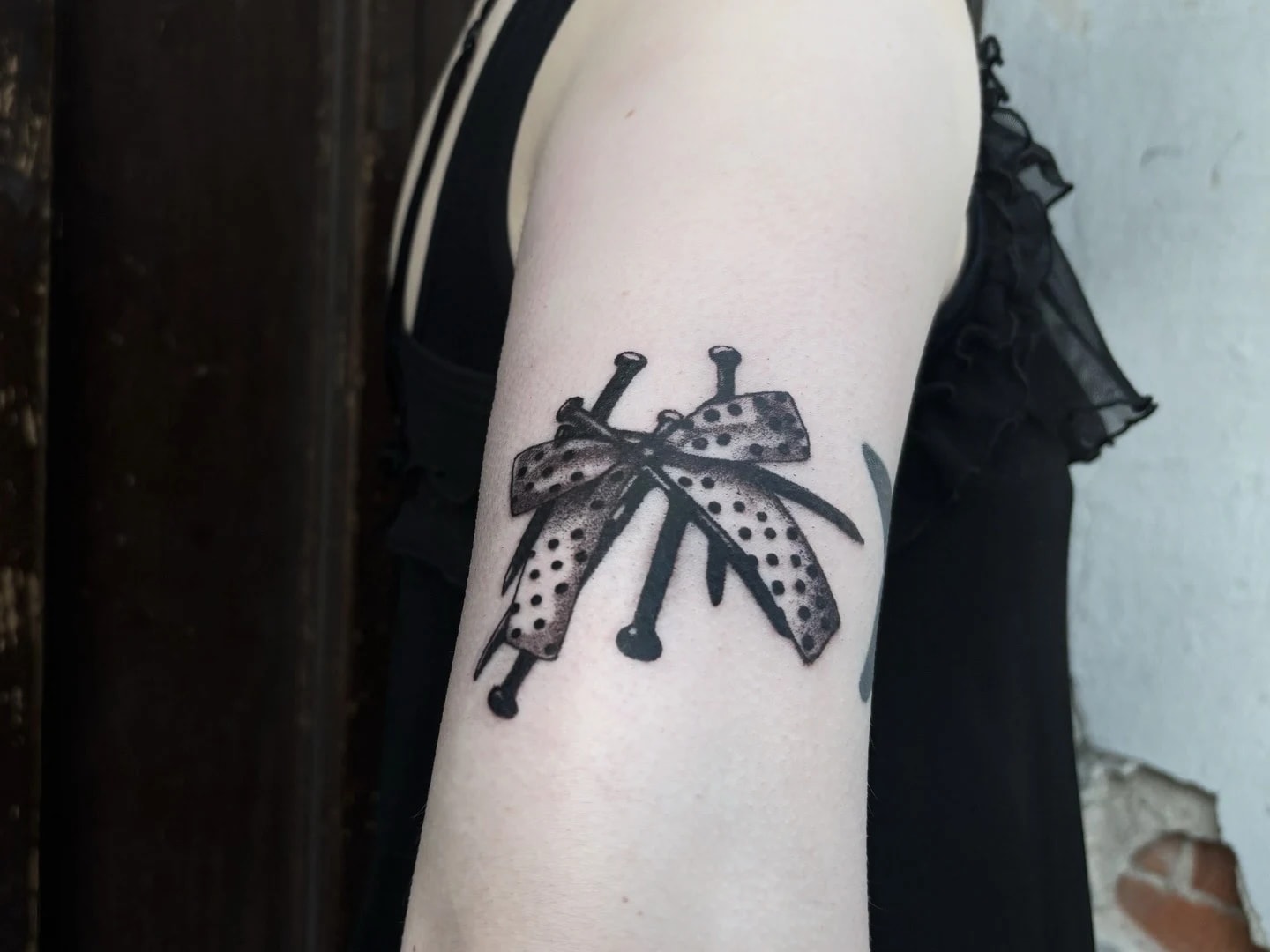
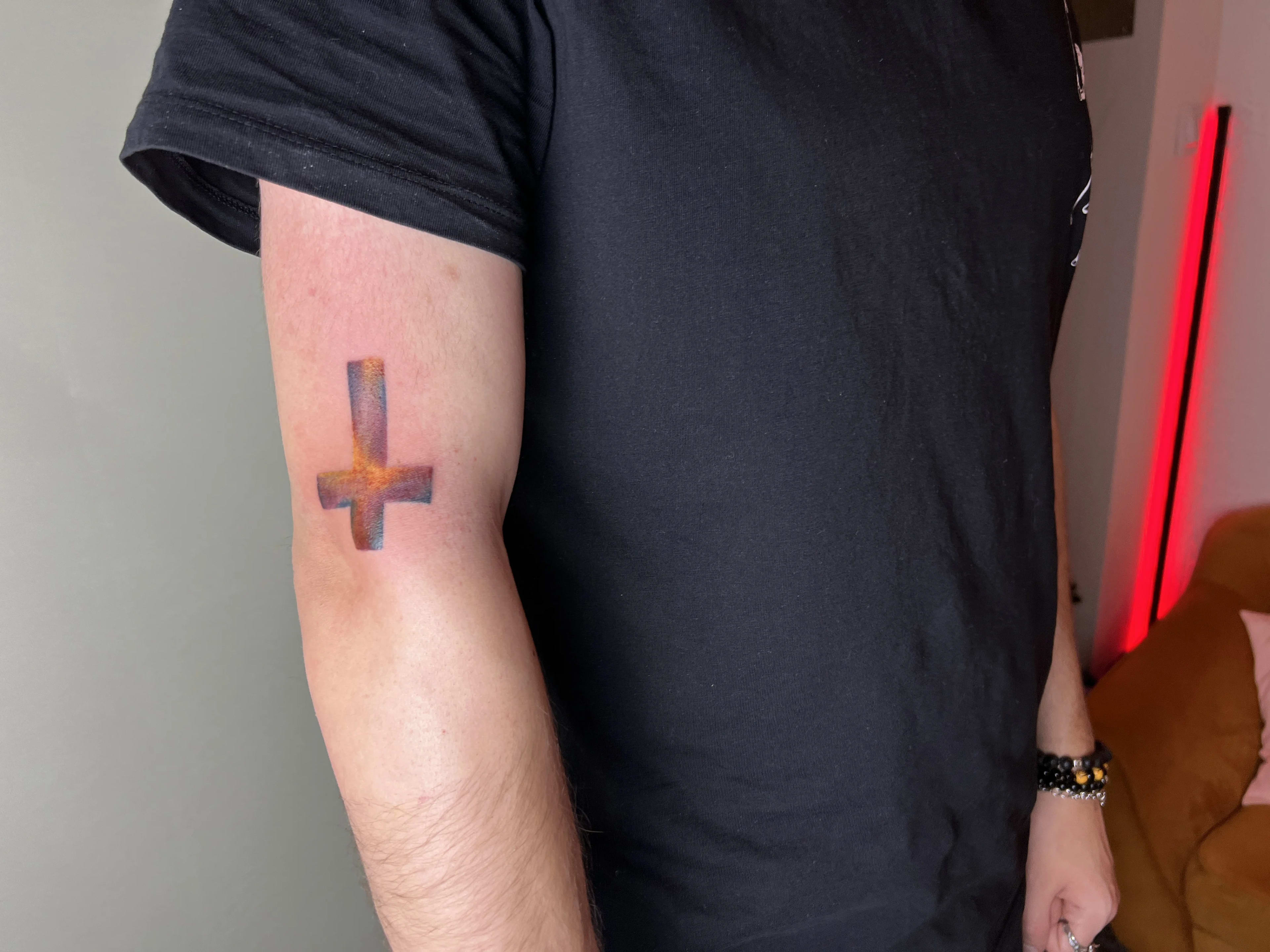
01Anatomy
Three sections, four boundaries
- moderate
- Skin thickness
- moderate
- Bone proximity
- yes
- Movement zone
We divide the arm into the upper arm (shoulder to elbow), the forearm (elbow to wrist) and the hand. Three joints separate them, and each is both an anatomical and a compositional boundary: shoulder, elbow and wrist. The fourth boundary is the line of a shirt sleeve — invisible on the body, and decisive for what you show.
Averaged across the whole arm, skin thickness is 3 out of 5, but that figure describes nothing real. On the upper arm and forearm it is 4 out of 5, on the hand 2 out of 5. The same goes for bone proximity: tucked deep on the upper arm, moderate on the forearm, at its maximum on the hand.
Joints behave differently from the surfaces between them. The skin over the elbow and wrist folds, stretches and returns to shape dozens of times a day. Those are the only genuinely mobile parts of the arm — which is why, when designing, we treat them as breaks in the composition rather than as places for detail.
The practical conclusion for the whole arm runs like this: the further from the torso, the thinner the skin, the closer the bone and the harder durability becomes. That gradient explains virtually every difference described below.
02Pain
A map of pain along the arm
- 5/10
- Pain
- moderate
- Nerve endings
- moderate
- Bone proximity
The averaged value for the arm is 5 out of 10, but the spread is enormous and only that has practical meaning. The upper arm and forearm each score 3 out of 10 — the lowest values on the entire price list. The hand scores 9 out of 10, the maximum we record.
The jump happens at the wrist and it is abrupt. Within a few centimetres thick skin over muscle ends and a thin layer over bone and tendons begins, at the highest nerve ending density on the body. People with a calmly healed forearm are sometimes taken aback by it — this is not a difference of degree but of kind.
Between the upper arm and the forearm there is practically no difference at all. Both carry the same value and a similar character of sensation, so the choice between them should never rest on pain.
Within each section there is further variation of its own: inner sides are distinctly more sensitive than outer ones, and the areas around joints more than the middle. We describe that in detail on the individual placement pages, because that is where it translates directly into how a session runs.
03Composition
A sleeve is one piece, not three side by side
- along the limb
- Design flow
- yes
- Movement zone
The most common mistake we see on arms tattooed in stages does not concern the quality of the individual designs. It concerns the fact that they came into being separately. Three good tattoos made years apart with no shared plan produce an arm that looks like a noticeboard.
A sleeve calls for decisions taken before the first element exists: where the main axis runs, where the points of weight sit, what stays empty and how the design crosses the elbow. That last question is the hardest — the elbow is both a narrowing and a movement zone, so either the design deliberately breaks there, or it has to be built so the transition looks natural in both arm positions.
Direction has to be chosen early too, because the sections have different geometry. The upper arm wraps around, the forearm runs straight, the hand radiates outwards from the wrist. A motif that works well on one of them needs redesigning rather than rescaling on its neighbour.
So with a sleeve the first consultation covers the whole arm, even if the first session will touch only one section. The skeleton of the composition is made once; the sessions carry it out piece by piece.
04Healing
The order of sessions depends on healing, not on the design
- 14–30 days
- Healing
- ~26 days
- Epidermis turnover
- moderate
- Friction
The three sections heal at different rates, and that should decide the order of work on a larger project. The upper arm and forearm need two to four weeks at a friction level of 1–2 out of 5. The hand formally closes faster, in ten to twenty-one days, but at friction of 5 out of 5 it demands incomparably more attention.
From that comes a practical rule we apply to sleeves: start at the top and work down. Upper arm first, forearm next, hand last — if it enters the plan at all. The reverse order means the part that is hardest to care for heals while enthusiasm is at its highest and experience at its lowest.
There is a purely practical reason too: a fresh hand tattoo interferes with ordinary functioning far more than a fresh upper-arm piece, so it is better that it falls when you already know exactly what to expect.
- Between sessions on adjacent sections we usually leave three to four weeks — fresh work at the border of the previous piece makes it harder to lay the stencil evenly.
- We avoid splitting one session across two sections of the arm where possible; the difference in sensation between an upper arm and a hand within a single appointment is very tiring.
- On work reaching the elbow, avoid fully bending the arm for the first week — it is the most common cause of splits in freshly healed skin.
- A shirt sleeve and a watch strap are the two objects that get in the way on every section of the arm. Both are worth setting aside while it heals, wherever the design sits.
05Longevity
From nine to sixty percent — the durability gradient
- 15% of pieces
- Touch-up rate
- high
- Sun exposure
- ~26 days
- Epidermis turnover
This is the most useful table we can show you before you pick a section. Touch-ups after healing come out at 9% of upper-arm pieces, 10% of forearm pieces and 60% of hand pieces. The averaged figure for the whole arm, 15%, describes no real case — it is only the effect of one of the three sections being an outlier.
The cause lies in the rate of skin renewal. The epidermis on the upper arm and forearm renews in about 28 days, on the hand in 14. The skin of the hand simply removes what it treats as foreign faster, and friction at 5 out of 5 comes on top of that.
The second factor is the sun, and here the arrangement is different. The forearm has the highest exposure on the entire price list, 5 out of 5; the hand 4 out of 5; the upper arm only 3 out of 5, because any longer sleeve hides it. That means the section most at risk of fading is the one that actually holds pigment very well — sunscreen solves it completely, but it has to be a habit rather than a holiday exercise.
The conclusion for anyone planning a sleeve: treat the upper arm and forearm as durable and predictable. The hand is a separate decision, worth making deliberately and with the knowledge that it requires upkeep.
06Risks
The biggest risk is a mismatch between sections
- moderate
- Blowout risk
- moderate
- Skin thickness
- yes
- Movement zone
Technical risks are distributed predictably: blowout is low on the upper arm and forearm (2 out of 5) and at its highest possible on the hand (5 out of 5). We describe those in detail on each placement page, because that is where they matter for execution.
At the level of the whole arm, though, a risk appears that no individual page can show: stylistic drift. Pieces made years apart, by different people, in different techniques, sit next to one another on a single limb and compare themselves mercilessly. A difference in stroke weight or in the temperature of the black, invisible on its own, jumps out immediately on one arm.
The second risk concerns the joints. The elbow and wrist work constantly, so detail placed exactly on a bend loses its sharpness faster than the same detail a few centimetres higher. Compositions crossing a joint we design so the place of greatest movement holds either a gap or the least precise element.
The third thing is the wrist as a psychological boundary. A piece stopped above it is fully coverable by a shirt; a piece running onto the hand stops being coverable at all. It is the correction clients make most often at the sketch stage — and rightly, because after the session it is irreversible.
07Styles
What holds where along a single limb
- moderate
- Skin thickness
- along the limb
- Design flow
With one composition spread across three sections, the choice of technique cannot be uniform along its whole length, because the base changes.
The upper arm and forearm take practically everything: realism, blackwork, ornament, fine line, lettering. They differ mainly in shape, so the same motif calls for a different layout — wrapping on the upper arm, lengthwise on the forearm.
The hand narrows the list distinctly. A strong line, blackwork and ornament with wide gaps hold there; delicate techniques lose legibility within a few years. On a sleeve that means a design running down onto the hand usually has to simplify along the way — and that simplification needs planning, so it reads as a decision rather than as fatigue.
If you want a uniform character across the whole arm, the safest choice is techniques built on a clear outline. They hold well on all three sections, so they force no compromise anywhere.
08Everyday life
How much of it shows — from a shirt to a handshake
- moderate
- Coverability
- high
- Sun exposure
Coverability falls along the arm as distinctly as durability does. The upper arm is 4 out of 5, the forearm 2 out of 5, the hand 1 out of 5 — the lowest on the entire price list. The averaged figure for the arm, 3 out of 5, again describes no real case.
In practice that means three different decisions about your life. A tattoo on the upper arm is invisible at work and you show it when you want. A tattoo on the forearm is on view for half the year, with short sleeves and through summer. A tattoo on the hand is always on view, including the moment you put it out for a handshake.
So with a sleeve we ask not only about the design but about the boundary. A very common solution is work reaching the wrist and deliberately stopped there — it gives the full visual effect while keeping the option of covering up with a long-sleeved shirt.
If your job has a dress code, or you work with clients in a sector that reacts to this, that boundary is the most important decision in the whole project. It is worth making calmly, before the first session rather than mid-expansion.
09First tattoo
Where on the arm to start
- 5/10
- Pain
- 15% of pieces
- Touch-up rate
- moderate
- Coverability
If this is your first tattoo and all you know is that it should be on your arm, the answer is simple: the forearm or the upper arm. Both have the lowest pain on the price list, predictable healing and very good durability.
Choosing between them comes down to two questions. Do you want to see your tattoo every day — then the forearm, because it is in front of you all the time and that helps a great deal through the first weeks. Do you want to be able to hide it at work — then the upper arm, because a short sleeve covers it almost completely.
We do not propose the hand for a first tattoo and we say so plainly. It is not about testing resolve, but about the fact that at the highest pain level and sixty percent touch-ups it is the worst possible place to gather your first experiences of your own skin.
If you are thinking about a sleeve from the outset, the order is simpler still: the upper arm first. It is the largest single module, it sets the direction of the whole composition, and it gives the gentlest start into the bargain.
10Nearby placements
Where to go from here
- 15% of pieces
- Touch-up rate
- moderate
- Coverability
This page is a starting point rather than a destination. Below are the three sections of the arm described in detail, plus one direction beyond the limb itself.
The upper arm covers wrapping composition and the situation where a large piece is meant to stay invisible at work. The forearm — the placement with the highest sun exposure on the entire price list, on view every day including to you. The hand — the only page that opens with a warning, because honesty there requires giving the numbers before the encouragement.
The fourth direction is the back. A sleeve very often begins not on the upper arm proper but on the shoulder, and from there it is only a step to the shoulder blade. Pieces crossing from the arm onto the back we plan as one composition from the first sketch — adding a back to a finished sleeve almost always requires a compromise.
If you have not settled on a section yet, read about the forearm and the upper arm first. Those two account for most successful first decisions.
11Price
How the cost of a whole arm is worked out
- 1–8 h
- Typical session
- 15% of pieces
- Touch-up rate
For a single motif the pricing is ordinary and we describe it on the individual placement pages. This section concerns the situation where you are thinking about the whole arm — because then something else counts.
We price a sleeve by sessions rather than as one figure, for a simple reason: a project of that scale matures as it goes. Its scope, density and what stays empty settle across the first appointments. Quoting a fixed sum at the start would mean either inflating it as a safety margin or asking for more later — and we would rather skip both.
What we do give is the expected number of sessions for each section, so you know the scale before the first touch of the needle. Sessions on the arm run from one to eight hours depending on the section: the hand is shortest, while the upper arm and forearm allow longer work.
It is worth factoring in one more cost, spread over time, that few people think about at the start. The upper arm and forearm, at 9–10% touch-ups, generate practically no expense after healing. The hand, at 60%, calls for top-up visits, and it is better to build that into the plan from the beginning than to discover it after a year.
Nearby placements
- upper armThe largest module of the arm and the most common start of a sleeve: wrapping composition, coverability 4 out of 5 and pain 3 out of 10. Start here if you want a large piece that disappears under a t-shirt.
- forearmThe section with the highest sun exposure on the entire price list (5 out of 5) and the only one you see yourself all day. The most common choice for a first tattoo.
- handThe end of the arm and a separate decision: 60% touch-ups, an epidermis renewing twice as fast and no possibility of covering it. Worth knowing those numbers before a sleeve goes below the wrist.
- backA sleeve often begins at the shoulder, and from there it is close to the shoulder blade. We plan the crossing from arm to back from the first sketch — adding a back to a finished sleeve almost always ends in compromise.
Styles that look great in this spot

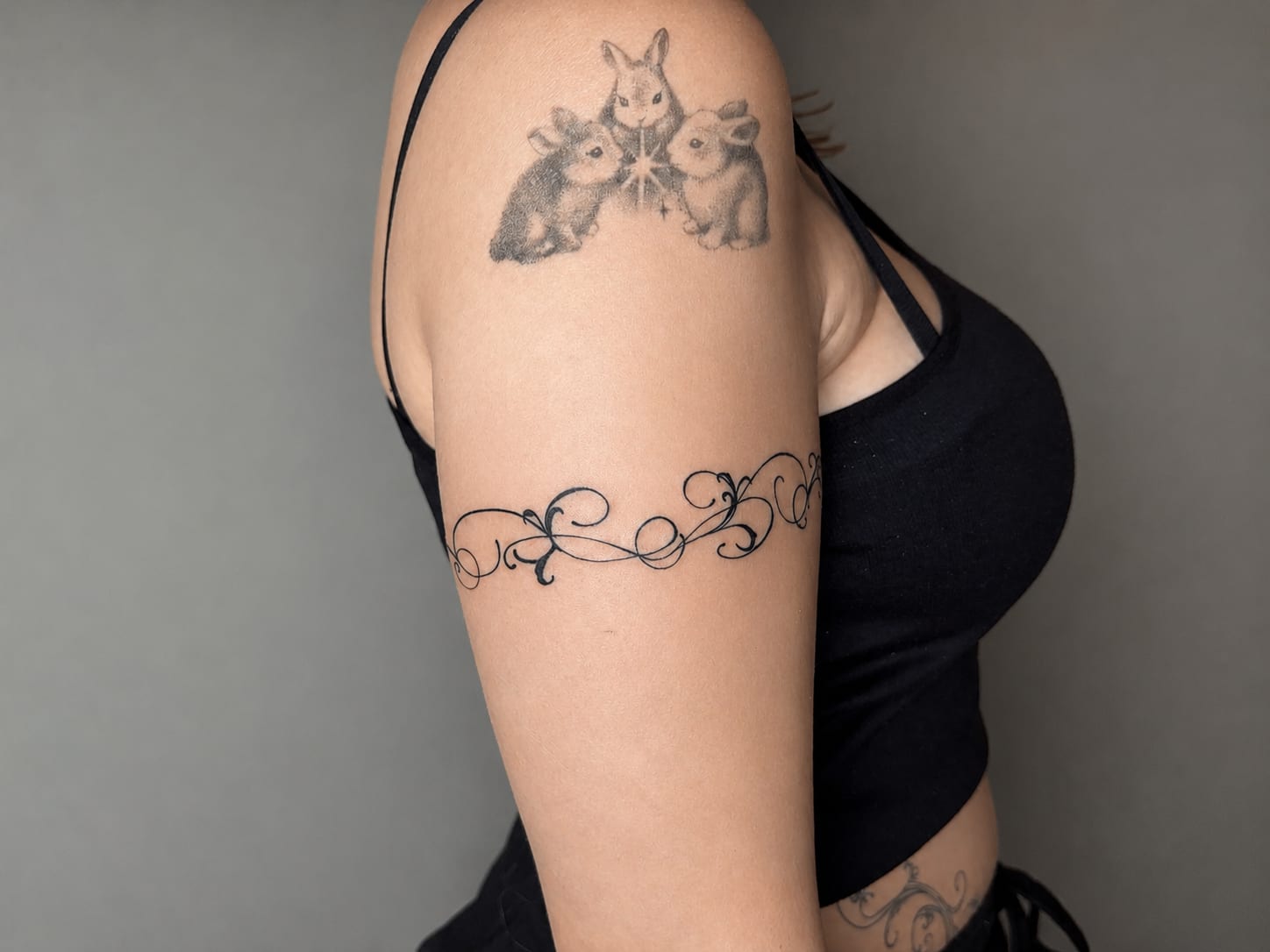


Frequently asked questions
On the forearm or the upper arm — both have the lowest pain level on the Parvata Tattoo price list, 3 out of 10, predictable healing and very good durability, with touch-ups at 10% and 9% of pieces respectively. Choosing between them comes down to two questions. If you want to see your tattoo every day, choose the forearm: it is in front of you all day, which helps a great deal through the first weeks of healing when the skin looks different from how it will end up. If being able to hide the piece at work matters, choose the upper arm, because a short sleeve covers it almost completely. We do not propose the hand for a first tattoo — at 9 out of 10 for pain and 60% touch-ups it is the worst place for first experiences.
In sensation and durability, almost not at all: both sections score 3 out of 10 for pain, have thick skin and a similar touch-up rate, 9% on the upper arm against 10% on the forearm. Two things separate them, both practical. The first is visibility — we rate upper-arm coverability at 4 on a five-point scale and the forearm at only 2, so the upper arm hides under a short sleeve while a forearm is on view for half the year. The second is shape: the upper arm is a cylinder and the design wraps around it, so it is never seen whole from one angle, whereas the forearm runs straight and has a clear vertical axis. The same motif on both is in practice two different projects, not one rescaled.
With the upper arm, and with a design for the whole rather than with the first motif. The upper arm is the largest single module of the arm, it sets the direction of the composition and gives the gentlest start. More important, though, is the rule Parvata Tattoo applies to every sleeve: the first consultation covers the whole arm, even if the first session will touch only one section. The skeleton of the composition, the points of weight and the places deliberately left empty have to be made once, before anything reaches the skin. Three good tattoos made years apart with no shared plan produce an arm that looks like a noticeboard — and that is the most common thing we repair for people arriving with work from other studios.
The rate of skin renewal and friction decide it. The epidermis on the forearm renews in about 28 days and on the hand in 14 — twice as fast. The skin of the hand removes pigment particles faster than it can hold them, and on top of that comes friction, which we rate there at 5 on a five-point scale against 2 on the forearm: hand washing, gripping, pockets and work all abrade exactly the surface the design sits on. In numbers it looks like this: touch-ups after healing affect about 10% of forearm pieces and about 60% of hand pieces at Parvata Tattoo. One joint separates these two placements, and everything that decides how a tattoo looks years later separates them too.
To the wrist — and it is the most important boundary in the whole project if coverability matters to you. Coverability falls very distinctly along the arm: the upper arm is 4 on a five-point scale, the forearm 2 and the hand 1, the lowest on the entire Parvata Tattoo price list. A piece stopped above the wrist stays fully coverable by a long-sleeved shirt, while a piece running onto the hand stops being coverable at all, including the moment you put it out for a handshake. A very common and sound solution is a sleeve reaching the wrist and deliberately stopped there. Make that decision before the first session, because afterwards it is irreversible.
Top down: upper arm, then forearm, and the hand last if it enters the plan at all. Healing decides that, not the design. The upper arm and forearm need two to four weeks at very low friction, whereas the hand formally closes faster, in ten to twenty-one days, but at friction of 5 out of 5 it demands incomparably more discipline in aftercare. The reverse order would mean the hardest area heals when you have the least experience. Between sessions on adjacent sections we usually leave three to four weeks, because fresh work at the border of the previous piece makes it harder to lay the stencil evenly.
More about the studio
Have an idea for a tattoo in this spot?
Book a free, no-obligation consultation — we will match an artist and design the motif for your body.