18 min readupdated
Tattoo by placement
Upper-arm tattoo — Wrocław
The upper arm is a cylinder, and that one property explains most of the decisions we make about it. The design cannot be seen whole from any single angle — you always see a fragment while the rest hides behind the curve. A project that ignores this looks good on the sketch and average on the body.
The second thing is coverability at 4 out of 5. A short sleeve covers the upper arm almost completely, so you can have a large, striking piece here and still show it when you choose to. Combining a decent surface area with low pain, 3 out of 10, makes the upper arm the most common starting point for a sleeve — and the most common second tattoo of all.
- 3/10
- Pain
- 14–28 days
- Healing
- 9% of pieces
- Touch-up rate
- 2–5 h
- Typical session
The first touch-up after healing is included in the price.
over 200 tattoos done5 on Google (40 reviews)
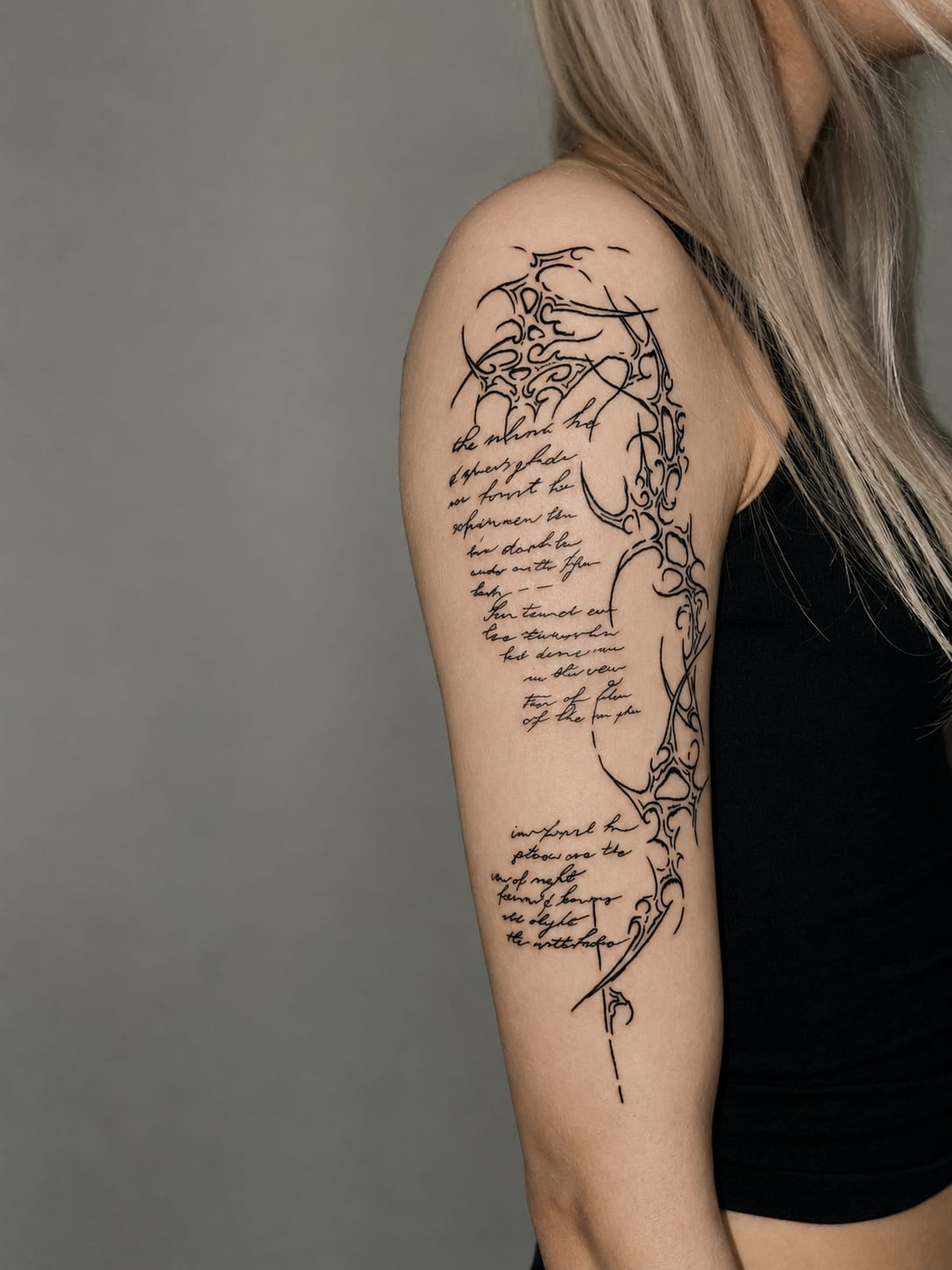
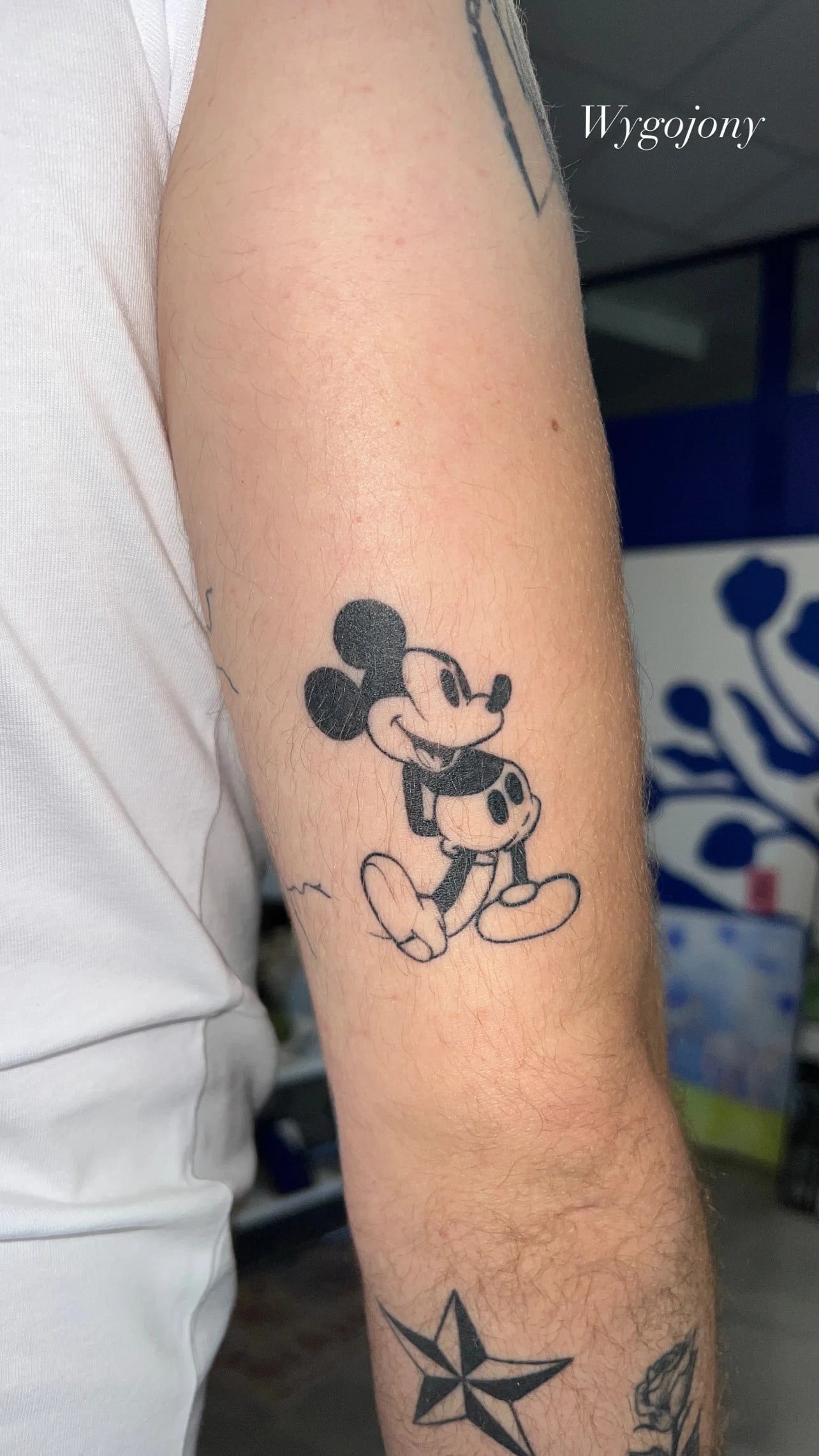
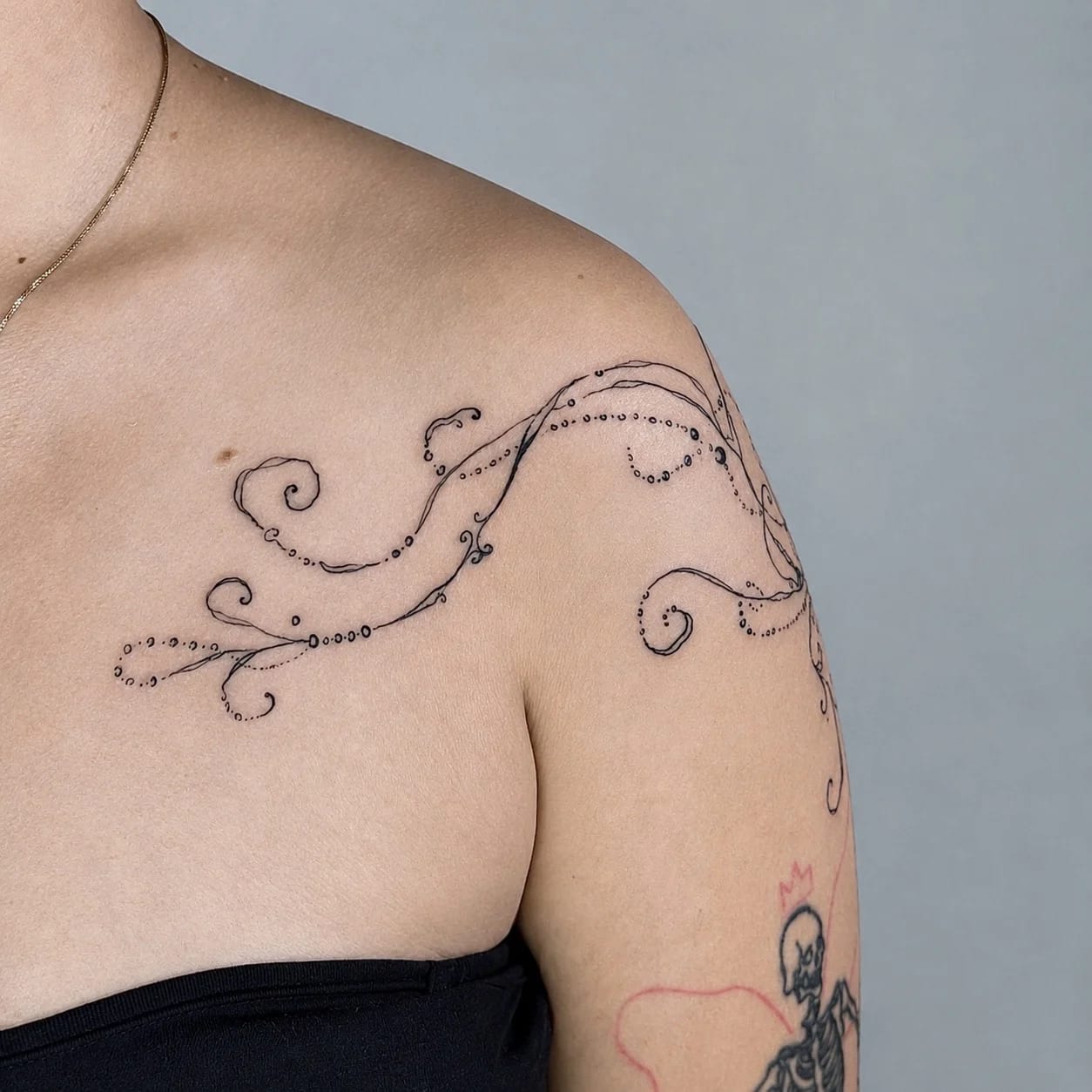
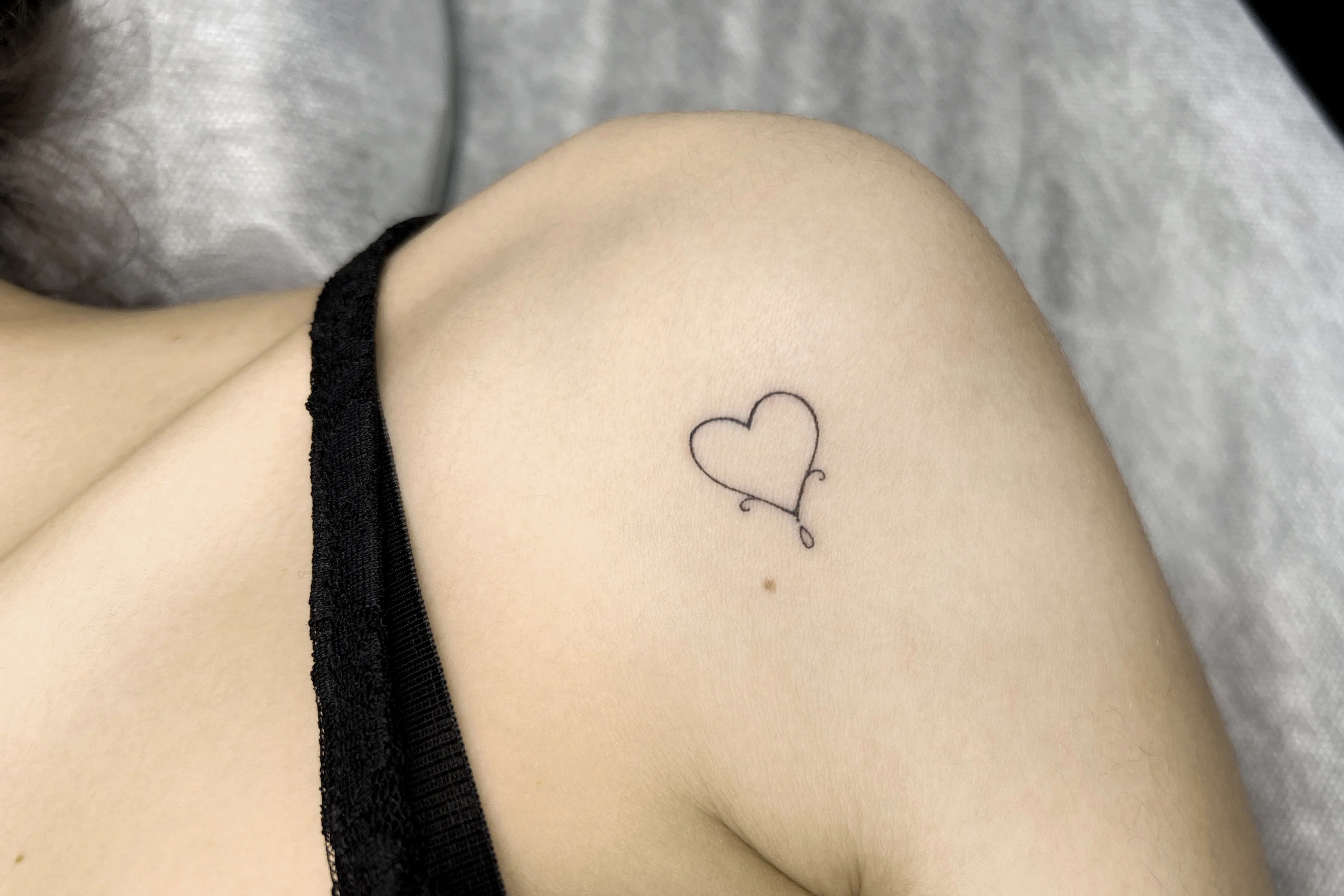
Our work: upper arm




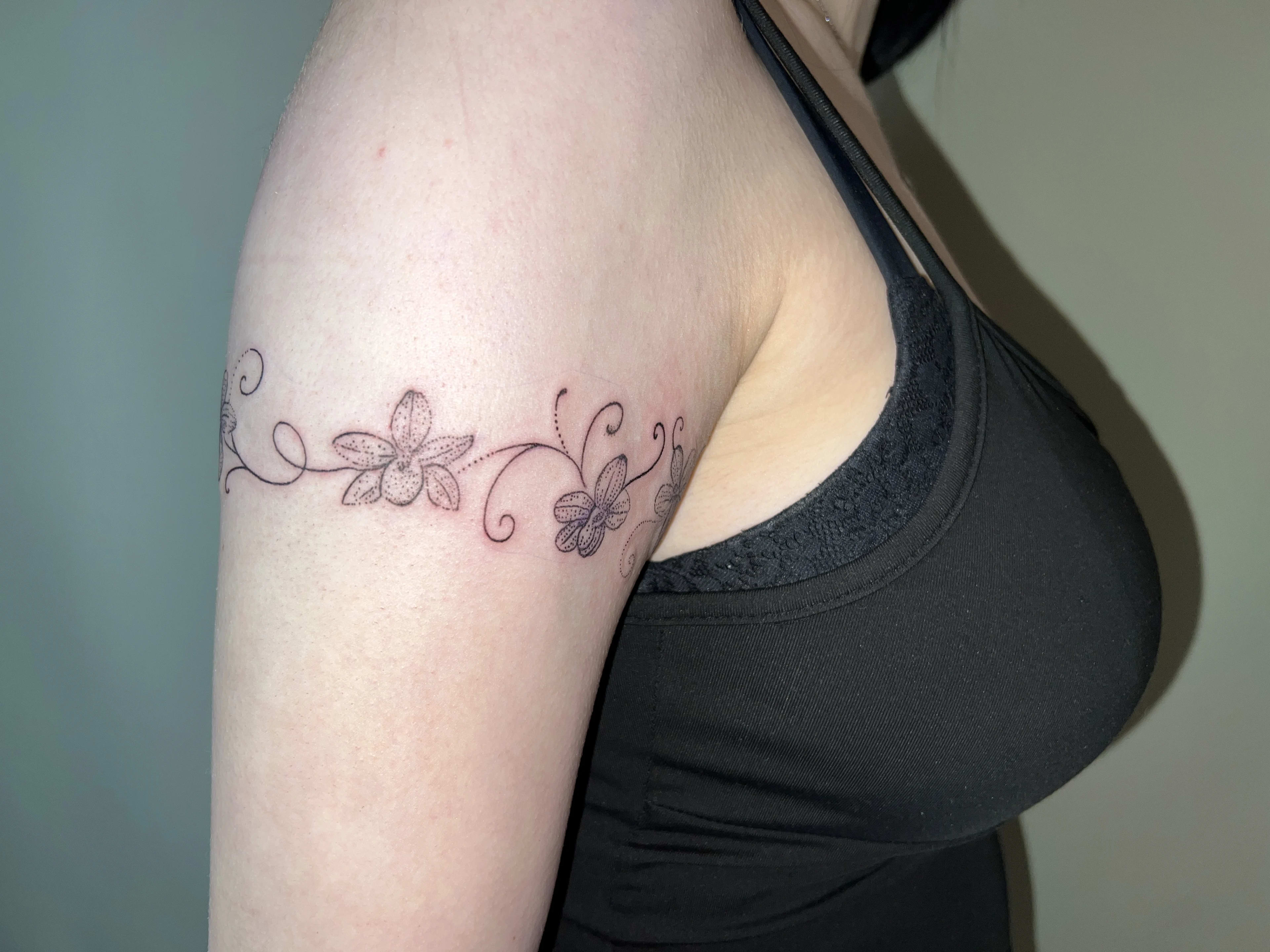
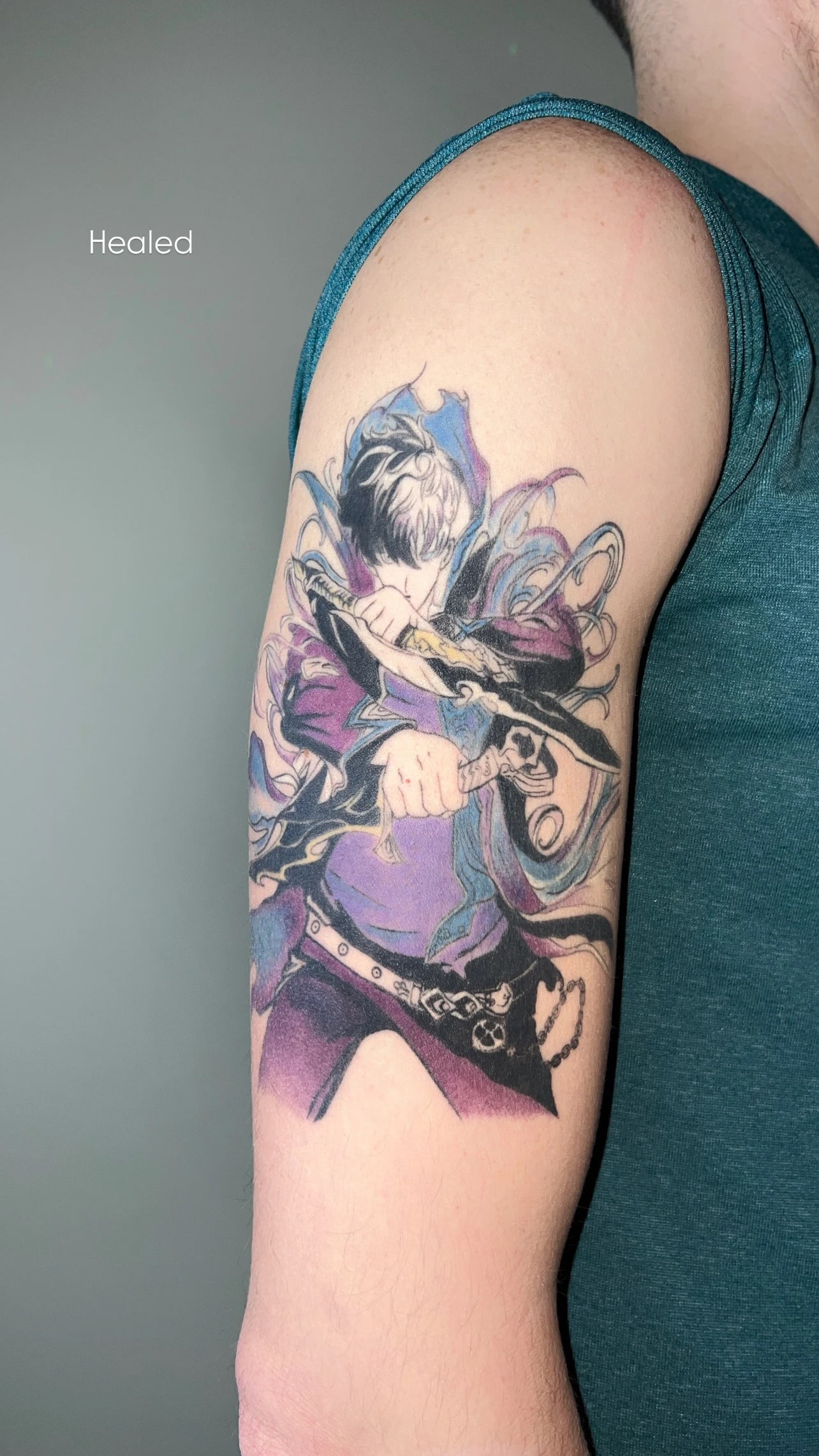
01Anatomy
The deltoid, a cushion over the bone
- high
- Skin thickness
- very low
- Bone proximity
- low
- Nerve endings
We rate bone proximity on the upper arm at 1 out of 5 — the lowest, together with the thigh. The humerus lies deep beneath the deltoid and biceps, so the needle never works over a hard base. That is why the sensation here is so calm despite the considerable surface area.
The skin has a thickness of 4 out of 5, much like the forearm, but it is distributed differently. The outer part of the upper arm, over the deltoid, is the most forgiving: thick, even, well supplied with blood. Everything works there.
The inner side of the upper arm is another matter entirely and we treat it as a separate placement. The skin there is thin and pale, a plexus of nerves and vessels runs beneath it, and the sensation can be distinctly sharper than on the outer side of the same arm. In exchange it is one of the best areas for delicate, pale detail — the contrast there is at its cleanest.
The third zone is the area near the armpit and the transition onto the side of the torso. The skin there is mobile and soft, and with the arm raised it settles quite differently from how it does with the arm down. Designs reaching that high we always plan with the arm in a natural position, not lifted.
02Pain
Three out of ten — mild, but not everywhere alike
- 3/10
- Pain
- very low
- Bone proximity
- low
- Nerve endings
The upper arm scores 3 out of 10, the same as the forearm, though for a different reason. On the forearm the result comes from thick skin with a moderate number of nerves. On the upper arm it comes above all from muscle: the layer of tissue between needle and bone absorbs the vibration that cannot be avoided on ribs or an elbow.
Most people describe the sensation on the outer side as mild and monotonous — more tiring than painful during a long session. That is good news for pieces running several hours, because there is no moment here where you have to grit your teeth.
Two fragments are distinctly harder. The inner side of the upper arm, where the skin thins and the nerves run closer to the surface. And the area near the armpit, one of the most sensitive spots on the whole limb. If a project reaches there, we say so before the session and plan that area for when your patience is at its greatest.
A session usually runs two to five hours here. On pieces wrapping the whole upper arm we split the work more often, but the reason is the comfort of the position rather than pain — the arm has to be rotated during the work, and after a few hours holding it still is more tiring than the needle.
03Composition
A design in the round, not on the flat
- wrapping
- Design flow
- no
- Movement zone
This is the most important section on this page. The upper arm wraps around, so at any moment at most half the design is visible — and considerably less at a normal glance from the side. The composition therefore has to work in every rotation rather than in one "correct" position.
In practice that means three things. First, the design should not have a single central point, because that point will be visible from one side only. Second, it needs continuity — motifs run spirally or wrapping around the arm read well from any angle. Third, it must have planned "seams", the places where the design passes behind the curve; if those fall at random, the piece looks cut off.
So we position a stencil for the upper arm differently from anywhere else: we apply it in stages, rotating the arm, and check it from four sides before starting. That stage takes longer than on flat placements and it is time well spent.
A separate decision concerns the lower boundary. The upper arm ends at the elbow, and the elbow is a natural break — a piece stopped just above it looks finished, while a piece running onto the joint itself calls for a deliberate decision about continuing onto the forearm. We settle that at the design stage, because later it means reworking the composition rather than adding an element.

04Healing
Two to four weeks with few restrictions
- 14–28 days
- Healing
- ~28 days
- Epidermis turnover
- very low
- Friction
The epidermis on the upper arm renews in about 28 days, and full healing usually takes two to four weeks. We rate friction at 1 out of 5 — an upper arm does not work at gripping and does not rub against anything continuously.
Healing goes calmly and asks for less discipline than most placements. Three things can get in the way, and all are predictable: a sleeve rubbing exactly against fresh work, a backpack or bag strap crossing the arm, and sleeping on the same side all night.
On pieces reaching the armpit there is one more factor: sweat and skin rubbing against skin while walking — the only fragment that can be troublesome on an upper arm.
- T-shirts with a loose sleeve for the first week, ideally ones whose hem does not fall exactly on the fresh work.
- A backpack and a shoulder bag are out while it heals — the strap usually crosses the most commonly tattooed area.
- With a design reaching the armpit, stop using deodorant there until it has fully healed; the alcohol in it can irritate badly.
- Upper-body training returns after about a week; before that, flexing the muscle stretches fresh skin.
- Sleep on the opposite side for the first few nights if the piece covers the outer part of the arm.
05Longevity
Nine percent touch-ups and moderate sun
- 9% of pieces
- Touch-up rate
- moderate
- Sun exposure
- low
- Blowout risk
Touch-ups affect about 9% of upper-arm pieces — a very good result, practically level with the forearm. Thick skin, no friction and low blowout risk (2 out of 5) all contribute.
Sun exposure is 3 out of 5, the middle of the scale. An upper arm is uncovered less often than a forearm, because any longer sleeve hides it, but more often than a back or a thigh — a t-shirt leaves it exposed all summer. In practice that means sunscreen is needed, but it does not have to become a daily habit as it does on the forearm.
There is a phenomenon specific to the upper arm worth knowing about: the upper, outer part tans more strongly than the rest, because it faces upwards. On wrapping pieces that means the top can be slightly more faded than the underside of the same design after a few years. Sunscreen applied to the whole arm, rather than only the part visible from the front, solves that completely.
We rate skin stretching at 3 out of 5. An upper arm responds to building muscle mass more visibly than a forearm — with a large gain in circumference a wrapping composition stretches evenly and usually still looks right, but designs built on regular geometry can lose their precision.
06Risks
Curvature as the main source of error
- low
- Blowout risk
- moderate
- Skin stretching
- high
- Skin thickness
Technically the upper arm is a safe placement. Blowout risk is 2 out of 5, mainly thanks to thick skin over muscle. It rises noticeably only on the inner side, where the layer is thinner — and there we work more slowly.
The real risk with this placement is compositional and follows directly from the curvature. A design drawn flat and then "applied" to the arm suffers foreshortening: elements near the edge become narrower, circles turn into ellipses, and even spacing stops being even. That only shows on the body, not on a printout.
So more depends on the fitting stage on an upper arm than anywhere else. We correct the stencil in place, sometimes several times, and that is a normal part of the work rather than a sign something has gone wrong. If somebody arrives with a finished design made elsewhere, it almost always needs adapting to the curve.
The second risk concerns expansion. An upper arm very often becomes the first element of a sleeve, but it is also often closed as a complete piece. Those two roads call for different decisions from the outset — a closed composition with a clear frame is hard to extend, while an open one with no plan can stay open forever. We ask about it at the consultation, because it is a question about the coming years rather than about this one design.

07Styles
Techniques that like a curved surface
- high
- Skin thickness
- wrapping
- Design flow
An upper arm will carry practically any technique, but some benefit from its shape while others have to fight it — and that is the proper criterion for choosing.
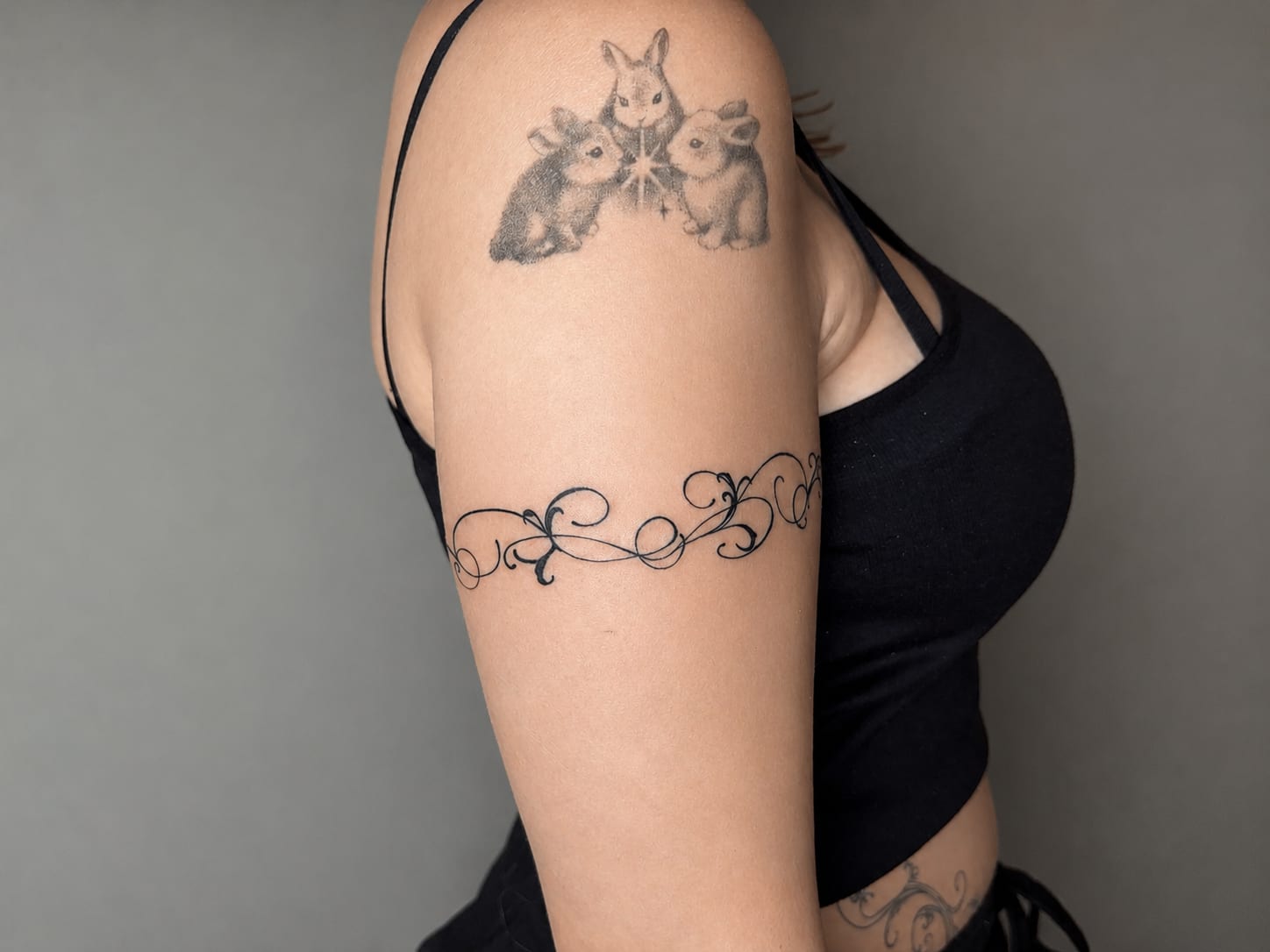
Motifs with a continuous run do best: ornament, tribal designs, botanical compositions wrapping spirally, blackwork built in bands. All share the quality of having no single "front" and looking right from any angle. Neo-traditional motifs with a clear outline also hold their own here, because a strong line does not get lost on a curve.
Realism and portraits call for more thought. They can be done and they come out well, but a face or a scene with clear perspective has one correct viewpoint — and on an upper arm that viewpoint is visible from one side only. For such projects we either choose the flat outer part of the arm and treat it as a panel, or suggest the thigh or the back.
Delicate fine line comes out best on the inner side, where pale skin gives contrast. On the outer, more tanned side a thin pale stroke loses visibility faster — and that is a technical argument, not an aesthetic one.
08Everyday life
A large tattoo that disappears under a shirt
- high
- Coverability
- moderate
- Sun exposure
Coverability on the upper arm is 4 out of 5 and it is its greatest practical advantage. A short sleeve covers it almost completely, a long one without exception. In most professions an upper-arm tattoo simply does not exist in the context of work.
That makes the upper arm a middle path between the forearm and fully hidden placements. You can have a large, elaborate and striking piece while still deciding when it is visible — a change of t-shirt is enough, not a change of plans.
One thing is worth checking before the design, though: where the sleeves of your shirts end. The boundary varies by a few centimetres, and if full coverage matters to you we plan the extent of the design to sit under that particular line. It is a correction we make in minutes at the sketch stage and one that is irreversible after the session.
In daily life a healed upper-arm piece asks for nothing beyond sunscreen in summer. It does not interfere with sport, does not rub against equipment and changes no habits.
09First tattoo
The most common second tattoo — and a good first
- 3/10
- Pain
- 9% of pieces
- Touch-up rate
- high
- Coverability
The upper arm is a good placement for a first tattoo and a very common choice for a second. Pain at 3 out of 10, touch-ups on 9% of pieces, calm healing and full coverability add up to a start with no risk factor at all.
The difference against the forearm is subtle but real and worth knowing before deciding. You see a forearm constantly, which helps a great deal through the first weeks of healing and gives you daily contact with the tattoo. An upper arm you cannot examine well in a mirror — especially its back — so the experience is less direct.
In exchange the upper arm gives more room at the same level of pain, and it hides under clothing, which a forearm cannot do. If you are torn between them, it is usually a choice between "I want to see this every day" and "I want to be able to hide it".
A separate scenario is a first tattoo as the start of something larger. If you are thinking about a sleeve, beginning with the upper arm is natural — it is the largest single module and it sets the direction of the whole. The first session is then not a test but a foundation, and we design it as one.
10Nearby placements
The upper arm as the middle section of the arm
- high
- Coverability
- 9% of pieces
- Touch-up rate
The upper arm borders directly on the forearm and on the shoulder, and through the shoulder on the back and the chest. That makes it the most connected section of the whole limb — and why decisions taken here carry further than anywhere else.
Against the forearm the difference is mainly one of exposure. Pain and skin thickness are nearly identical, and touch-ups come out similarly: 9% against 10%. Two things diverge — coverability, 4 out of 5 against 2 out of 5, and shape: the upper arm wraps, the forearm runs straight. The same motif on both is in practice two different projects.
Towards the back the transition is natural and common. Pieces crossing from the shoulder onto the shoulder blade we plan as one composition, because the seam between two separately designed tattoos always shows, even years later.
If you are thinking about the whole arm rather than a single design, it is worth starting by comparing all three sections at once — they differ more than the shared name suggests.
11Price
How to price something that has no end yet
- 2–5 h
- Typical session
- 9% of pieces
- Touch-up rate
With an upper arm, pricing splits into two quite different scenarios and it helps to know straight away which one you are in.
The first is a closed piece: a specific motif with settled boundaries. Pricing is then ordinary, based on surface area and density of detail, and the whole usually fits into one session of two to five hours.
The second is the first module of a sleeve, and here the question "what does an upper-arm tattoo cost" is essentially a question about something else. We price the stage rather than the whole, because the whole has no boundaries yet. We do say plainly how many sessions we expect for the upper arm itself and what genuinely falls within that first scope — so the decision about continuing is made with a sense of the scale rather than after the fact.
In both variants a custom design is included, and on an upper arm that also covers the stage of fitting the stencil to the curve, which takes longer than on flat placements. The post-healing check-up is included. We give a range after a free consultation, once we know which of the two scenarios is yours.
Nearby placements
- forearmPain and skin almost identical, touch-ups 9% against 10% — what separates them is coverability (4 out of 5 against 2) and shape. Choosing between them is usually a choice between "I want to see this" and "I want to be able to hide it".
- armThe upper arm is the middle of three sections of the arm and the most common start of a sleeve. For anything larger, begin by comparing all three at once.
- backCrossing from the shoulder onto the shoulder blade is common and natural, but it has to be designed as one composition — the seam between separately made pieces shows even years later.
Styles that look great in this spot


Frequently asked questions
Not much — on the scale used at Parvata Tattoo the upper arm scores 3 out of 10, the same as the forearm, though for a different reason. What decides here is above all muscle: we rate bone proximity at 1 on a five-point scale, the lowest together with the thigh, because the humerus lies deep beneath the deltoid and biceps. The layer of tissue absorbs vibrations that are unavoidable on ribs or an elbow. Most people describe the sensation on the outer side as mild and rather monotonous instead of painful. Two fragments are distinctly harder: the inner side of the upper arm, where the skin thins and nerves run closer to the surface, and the area near the armpit. If a project reaches there, we give warning and plan that area for the start of the session.
One thing is crucial: the upper arm is a cylinder, so at any moment at most half the design is visible. The composition has to work in every rotation rather than in one correct position. In practice that means the design should not have a single central point, because it would be visible from one side only; that it needs continuity, so spiral or wrapping motifs read best; and that it must have planned places where it passes behind the curve. If those "seams" fall at random, the piece looks cut off. That is why at Parvata Tattoo we apply an upper-arm stencil in stages, rotating the arm and checking the design from four sides before starting. That stage takes longer than on flat placements.
Yes, and it is its greatest practical advantage. We rate upper-arm coverability at Parvata Tattoo at 4 on a five-point scale — a short sleeve covers it almost completely and a long one without exception. In most professions an upper-arm tattoo simply does not exist in the context of work. That makes this placement a middle path: you can have a large, striking piece while still deciding when it is visible, because a change of t-shirt is enough. It is worth checking one thing before the design, though — where the sleeves of your own shirts end. The boundary varies by a few centimetres, and if full coverage matters we plan the extent of the design to sit under that particular line. After the session it is irreversible.
Two to four weeks, and the epidermis in this area renews in about 28 days. Healing goes calmly and asks for less discipline than most placements, because we rate friction here at 1 on a five-point scale — an upper arm does not work at gripping and does not rub against anything continuously. Three predictable things can get in the way: a t-shirt sleeve falling exactly on the fresh work, a backpack or bag strap crossing the arm, and sleeping on the same side all night. On designs reaching the armpit there is sweat and skin rubbing against skin while walking, plus deodorant, which is worth stopping in that area until it has healed. Upper-body training returns after about a week.
Yes, and it is the most common start we see. The upper arm is the largest single module of the arm, has the lowest pain level in that area and full coverability, so a first session is neither a test of endurance nor a decision about visibility. There is one question, though, that Parvata Tattoo always asks before a sketch: is this to be a closed piece or the beginning of a larger whole. Those two roads call for different decisions from the outset — a closed composition with a clear frame is hard to extend, while an open one with no plan can stay open forever. We separately settle the boundary at the elbow: a piece stopped just above it looks finished, while one running onto the joint calls for a deliberate decision about continuing onto the forearm.
To a moderate degree. We rate sun exposure on the upper arm at 3 on a five-point scale, the middle of the range: any longer sleeve hides it, but a t-shirt leaves it exposed all summer. Sunscreen is therefore needed, though it does not have to become a daily habit as it does on the forearm, where exposure is 5 out of 5. There is, however, a phenomenon specific to the upper arm worth knowing: the upper, outer part tans more strongly than the rest because it faces upwards. On wrapping pieces that means the top can be slightly more faded than the underside of the same design after a few years. Sunscreen applied to the whole arm, not only the part visible from the front, solves that completely.
More about the studio
Have an idea for a tattoo in this spot?
Book a free, no-obligation consultation — we will match an artist and design the motif for your body.