18 min readupdated
Tattoo by placement
Back tattoo — Wrocław
The back is the largest continuous surface the body has — and the only placement where a composition built up over years fits without simplification and without compromise in scale. Sessions run three to eight hours here, the longest on the whole price list, and touch-ups affect a mere 8% of pieces.
There is another side to that surface, worth knowing before the first session: you will not see your own back. Never in person, always in a mirror or a photograph. That changes how a project like this gets planned and how healing feels — which is why we give it its own part of this page.
- 5/10
- Pain
- 21–35 days
- Healing
- 8% of pieces
- Touch-up rate
- 3–8 h
- Typical session
The first touch-up after healing is included in the price.
over 200 tattoos done5 on Google (40 reviews)
Our work: back


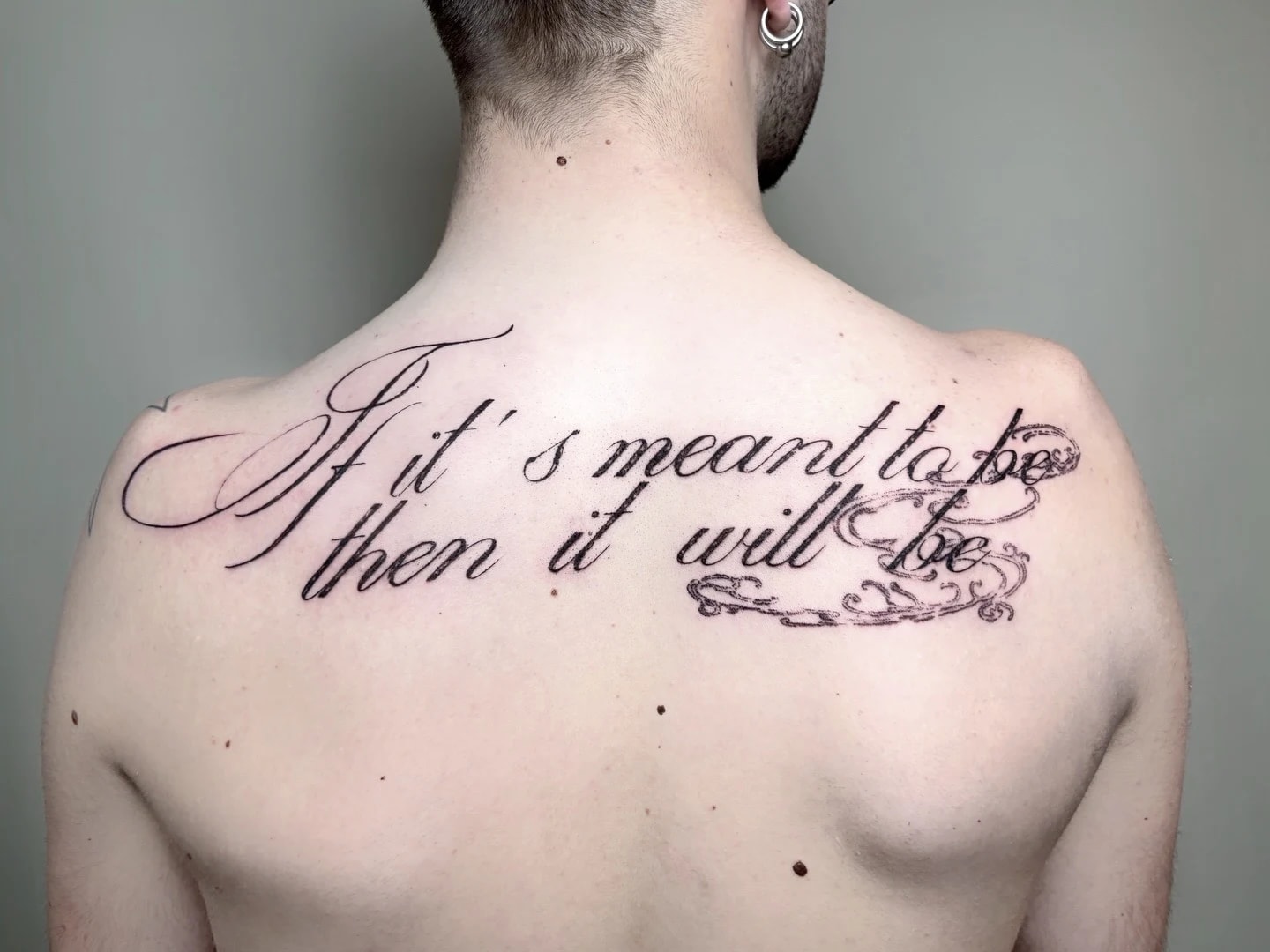
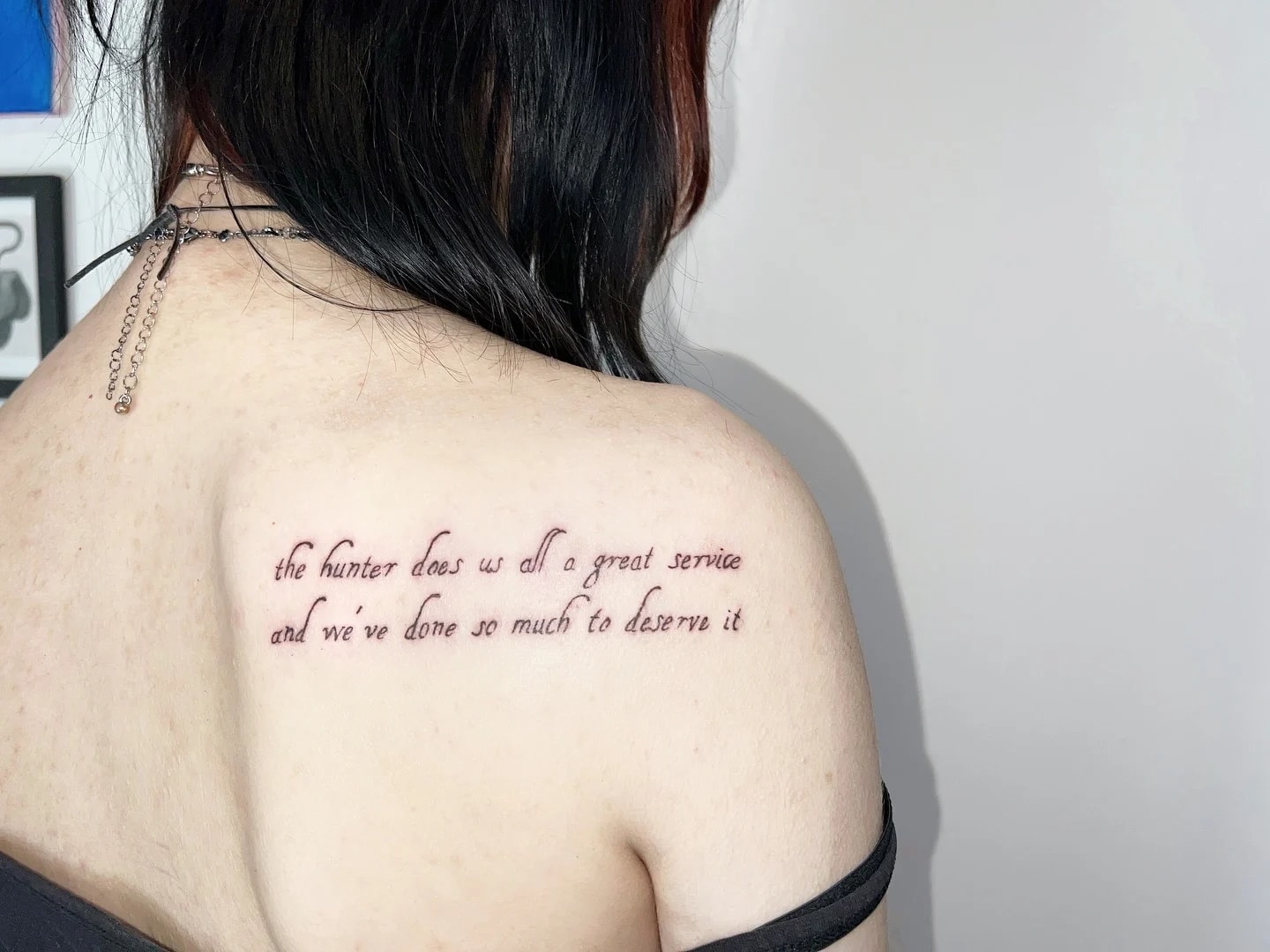
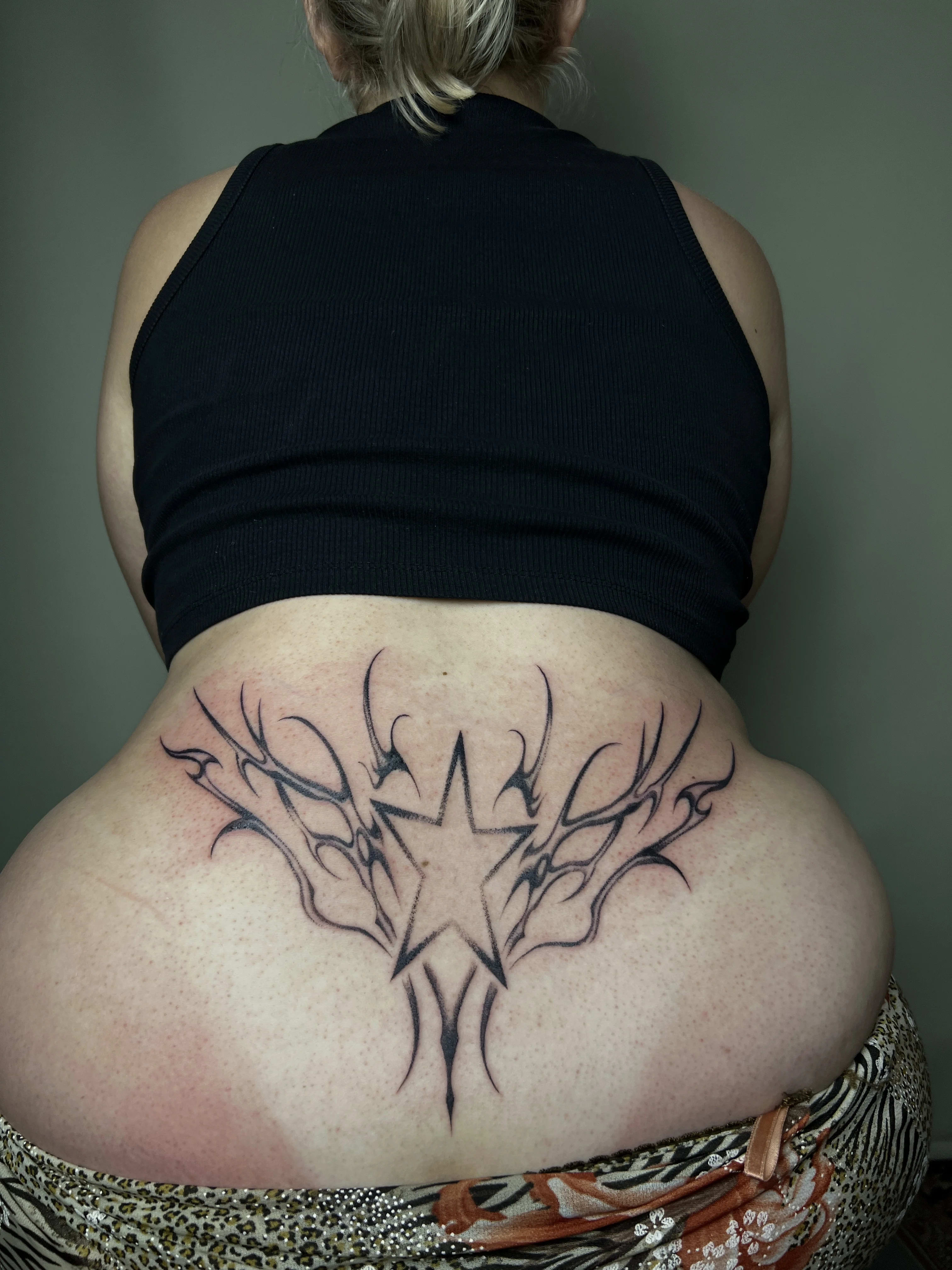
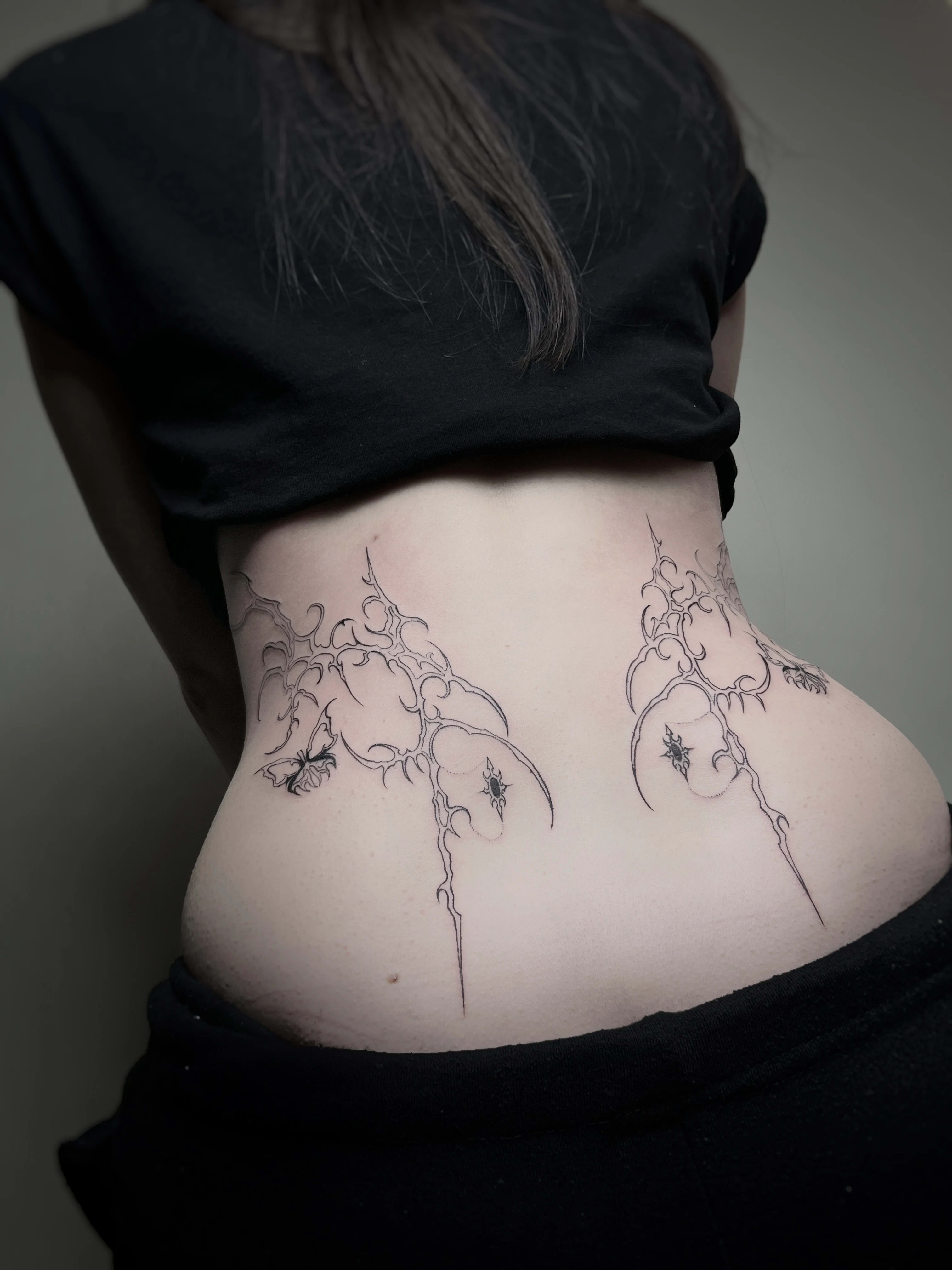
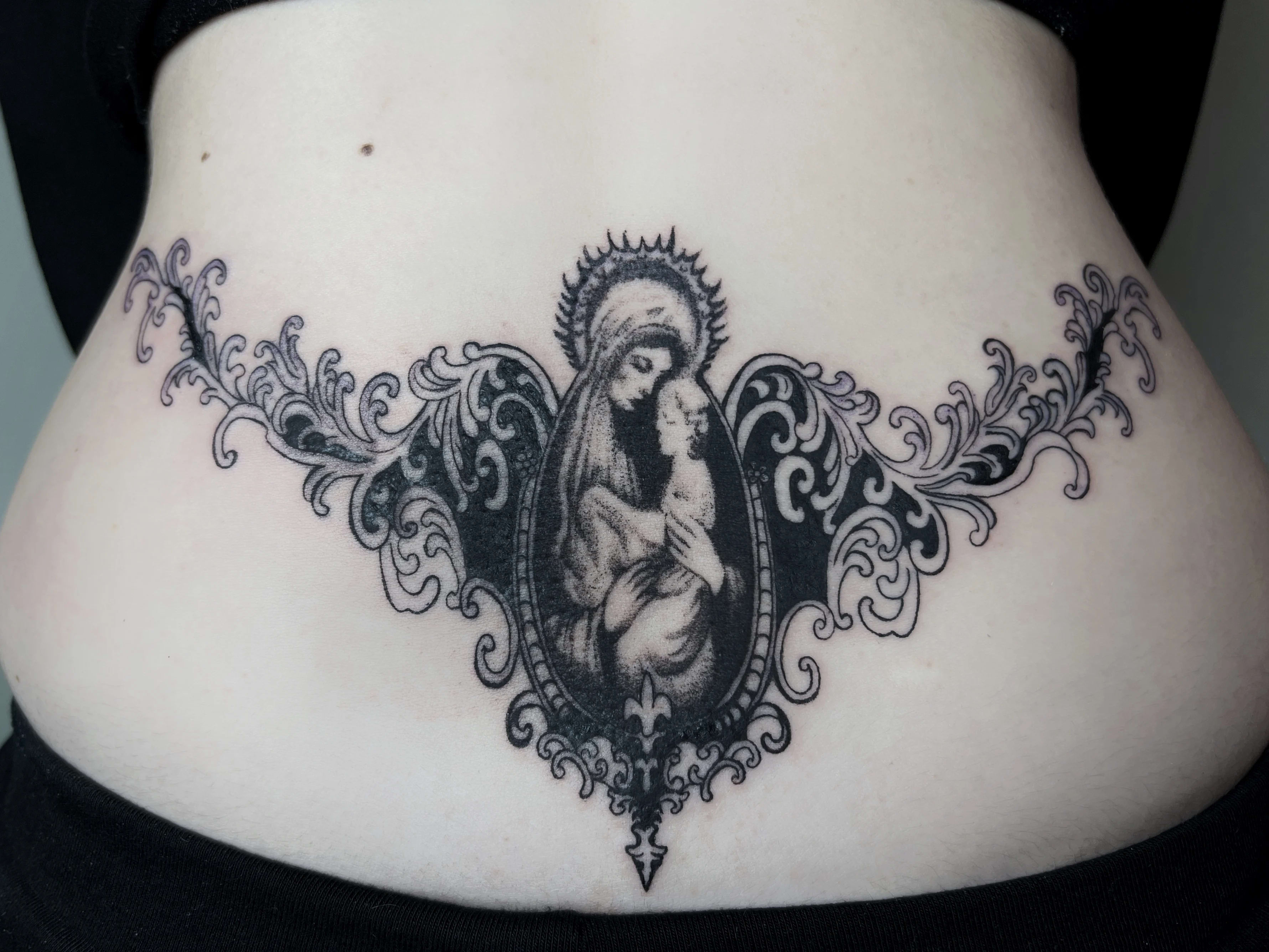

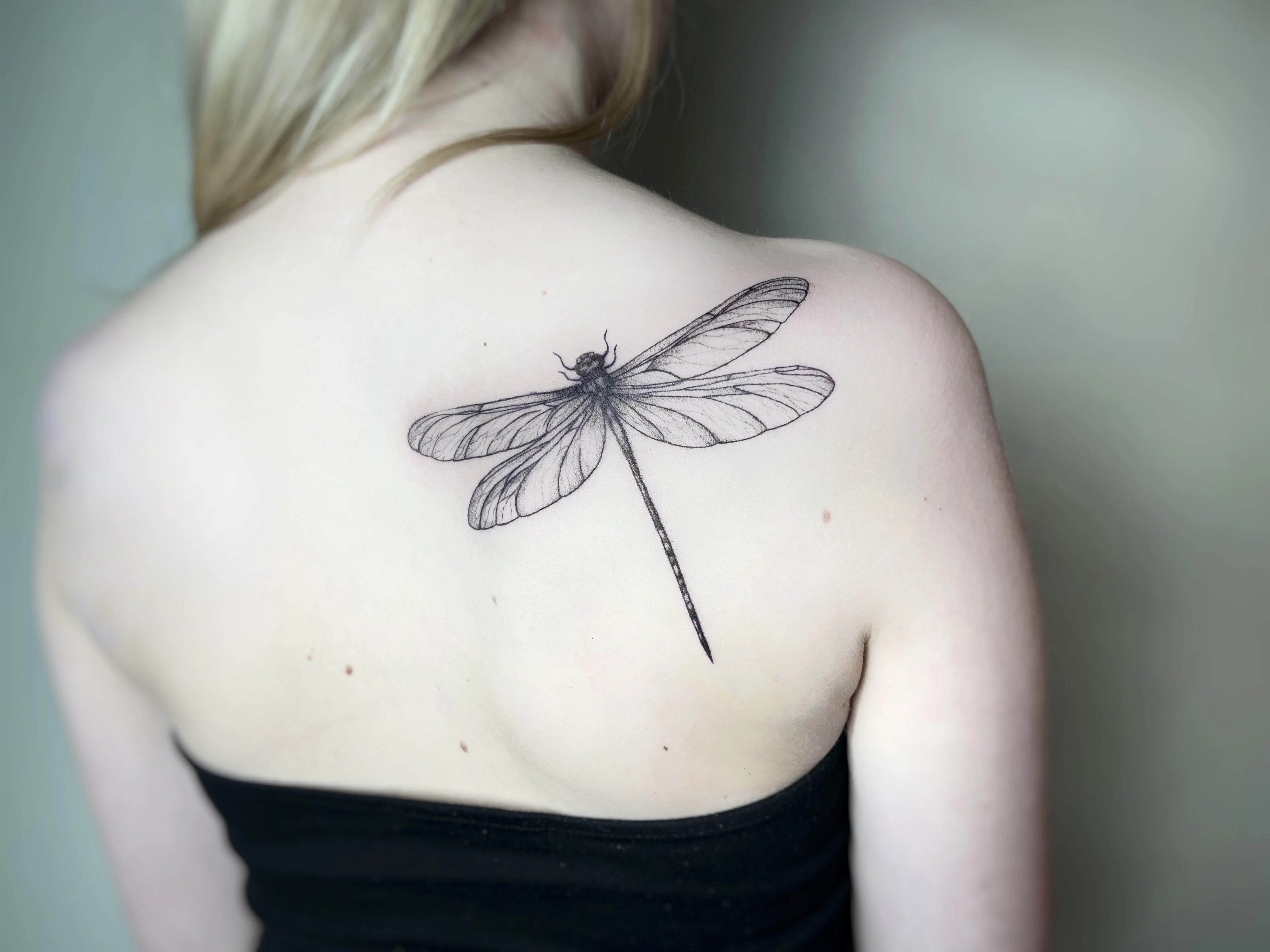
01Anatomy
Three zones with completely different characters
- very high
- Skin thickness
- moderate
- Bone proximity
- low
- Nerve endings
We rate skin thickness on the back at 5 out of 5 — as high as the thigh. Beneath it lie large, flat muscles: the trapezius across the upper part and the latissimus dorsi along the sides. That is a stable, forgiving base on which the needle works evenly.
The back is not uniform, though. The shoulder blades are hard bone just under the skin and a distinctly different sensation from the muscle beside them — and a moving area besides, since the blade shifts with every arm movement. A composition crossing a shoulder blade looks different with your arms down and raised, so we check the stencil in both positions.
The spine is its own zone. The spinous processes protrude directly beneath thin skin, so a band a few centimetres wide down the middle of the back is noticeably more sensitive than everything around it. Bone proximity averaged across the whole back is 3 out of 5, but on the spine itself it is effectively the maximum.
The lower part, around the lumbar area, is the softest and best supplied with blood. Work goes most easily there, though the skin can be a little more mobile and changes tension when you bend deeply.
02Pain
Five out of ten, but what counts is time, not the number
- 5/10
- Pain
- 3–8 h
- Typical session
- moderate
- Bone proximity
The back scores 5 out of 10 — the middle of the scale. On the flat muscular areas the sensation is bearable and comparable to an upper arm; across the shoulder blades and along the spine it rises noticeably.
With this placement, though, time matters more than the level of pain. A back session runs three to eight hours, and it is the length rather than the intensity that decides how you get through it. The fifth hour of a moderate sensation can be harder than one hour of a sharp one — and that is something no table shows.
There is an element few people think about before a first large session: position. You lie face down, still, for many hours. After a few of them the discomfort more often comes from the neck and shoulders than from the needle itself. So we take longer breaks than on smaller pieces and ask you to get up and stretch from time to time — that is not politeness, it is the condition for a good second half of the session.
The practical conclusion: plan your first back session for a day with nothing important after it. Not because of pain, but because of fatigue.
03Composition
The only surface where nothing has to be simplified
- flat panel
- Design flow
- no
- Movement zone
The back is symmetrical about the spine and has clear borders: shoulders above, sides on both flanks, waist below. That is a frame no other placement provides — and the only one on which a composition at the scale of a painting can be built.
Symmetry is both the greatest asset and the greatest trap here. Designs built around the axis of the spine — wings, mandalas, scenes with a central point, ornament spreading outwards — look stronger on a back than anywhere else. But any deviation from the axis is spotted instantly, so positioning the stencil takes longer here than starting the work does.
The second option is an asymmetric composition, run diagonally from one shoulder to the opposite hip. It is often more interesting visually and much easier to extend, because it does not close itself off the way a symmetrical layout does.
The most important decision, though, is made at the start and concerns not the design but the extent. A back is almost always built in stages, so the first element should assume where this is heading. Work begun as a single motif on a shoulder blade, with no plan for the whole, usually forces a compromise two years later — and it is the most common thing we repair for people arriving with finished work from another studio.
04Healing
Three to five weeks and one problem that returns every night
- 21–35 days
- Healing
- ~30 days
- Epidermis turnover
- very low
- Friction
Healing takes three to five weeks, and the epidermis on the back renews in about 30 days. We rate friction from outside at 1 out of 5 — a back does not work at gripping and does not rub against equipment.
The whole problem comes down to sleep and to the reach of your own arms. Through the first nights fresh work is in contact with bedding for eight hours at a stretch, and on large compositions you cannot simply sleep on the other side, because the tattoo covers the whole back. Add something banal and genuinely awkward: you cannot reach the middle of your own back, so aftercare needs a second person, or a mirror and a great deal of patience.
Book the session so that somebody can help you through the first week. It is the only placement where we ask for that — and the only one where the absence of such a person genuinely affects the result.
- Clean cotton bedding changed more often than usual for the first week; on a large piece it is the main contact fresh skin has with the world.
- Sleep on your stomach if you can — and if you cannot, a loose cotton t-shirt protects the work better than nothing.
- Ask someone to help with washing and moisturising the middle section; twisting your own arm to reach it usually ends in scratching it open.
- Put your backpack aside for the whole healing period — the straps run exactly across the most commonly tattooed areas.
- On large pieces the first days can feel like sunburn; that is normal at this surface area and passes within a few days.
05Longevity
Eight percent touch-ups and a minimum of sun
- 8% of pieces
- Touch-up rate
- low
- Sun exposure
- very low
- Blowout risk
Touch-ups affect about 8% of back pieces — the second-best result on the Parvata Tattoo price list, right after the thigh. Thick skin, no friction and very low blowout risk (1 out of 5) all contribute.
Sun exposure is 2 out of 5. A back stays covered most of the year and you uncover it mainly in summer, near water — rarely, then, but in conditions of the strongest radiation. That is the only moment to think about it: a freshly healed large back piece can lose more contrast over one weekend at the seaside than across the following two years.
In practice that gives a simple rule: factor 50 on your back whenever you go without a shirt, and no sun at all on fresh work for the first four weeks. Beyond that, a back tattoo asks for nothing.
One more thing worth adding: with multi-session work, the fragments done earlier will have healed and settled before the next ones arrive. So when the whole piece is finished we review all the areas together — sometimes the oldest fragment needs refreshing for the whole to read evenly.
06Risks
The biggest risk is not technical but a matter of planning
- very low
- Blowout risk
- low
- Skin stretching
- very high
- Skin thickness
Technically the back is among the safest placements. Blowout risk is 1 out of 5, because thick skin over a large muscle gives a wide depth window. We rate stretching at 2 out of 5 — a back changes with weight swings considerably less than a stomach or a thigh.
The real risk lies elsewhere and is specific to this placement: it is compositional. A large piece comes into being in stages across months or years, so between sessions everything changes — your taste, your references, sometimes your build. A project with no established structure for the whole starts, by the third session, to look like a collection of separate tattoos on a shared background.
That is why with backs we spend more time on the design than at any other placement. We settle the skeleton of the whole, the points of weight and what stays empty — and only then split the work into sessions. Empty space here is an element of the composition rather than an absence, and it is most often what rescues a project during expansion.
A separate question is working on someone else’s foundation. If there is already an older tattoo on the back, folding it into a larger whole is sometimes possible, but it always narrows the field. We say so plainly at the consultation, before there is a sketch — a limitation is easier to accept at the start than after the first session.
07Styles
Formats that exist only here
- very high
- Skin thickness
- 3–8 h
- Typical session
The back fits projects that cannot be executed at full scale anywhere else — and that is the proper reason to choose this placement.
Realism and elaborate narrative scenes use the surface best: there is room for a foreground, a background, depth and tonal transitions without cramping. Large-scale portraits too, because only on a back can a face reach a size that allows full detail.
Blackwork and large areas of solid black work exceptionally strongly here, and age well into the bargain — dense black on thick skin at 8% touch-ups is one of the most durable combinations we have. Ornament and geometry built around the axis of the spine benefit from a symmetry no other placement offers.
Delicate fine line will hold on a back as well, but it is worth asking whether it wastes the surface. A small motif in the middle of a large back more often looks lost than minimal — if subtlety is what you want, the forearm or the side is usually the better home.
08Everyday life
The tattoo you do not see yourself
- very high
- Coverability
- low
- Sun exposure
Coverability on the back is 5 out of 5. Every t-shirt covers this placement completely, so the question of work and of first impressions does not arise at all.
More important is something rarely mentioned before a first session: you do not look at your own back. You see it in a mirror, reversed, or in a photograph somebody else took. For some people that is an advantage — the tattoo then belongs entirely to them, with no daily familiarisation. For others it is a disappointment, because after months of work they have no contact with it.
That has one practical consequence during healing: you cannot see what is happening. On a forearm you watch every stage and it is reassuring. On a back you either ask somebody for a photograph every few days, or you simply trust the process. We document the finished piece from several angles precisely so you have a reference point.
In daily life a healed piece asks for nothing beyond sunscreen in summer. It does not interfere with sport, does not change how you dress and has no contact with anything that might abrade it.
09First tattoo
Rarely a first tattoo, often a first large one
- 3–8 h
- Typical session
- 5/10
- Pain
- 8% of pieces
- Touch-up rate
For a first tattoo we rarely propose the back, but the reason is quite different from the hand. Technically this is a safe and forgiving placement — the problem is the scale of the experience.
A first session lasting several hours, face down, on work you cannot see, is a lot at once. Add healing that needs another person’s help. None of it is difficult, but it is more than you need in order to learn how you respond to being tattooed.
It looks entirely different for a first large project. If you already have one or two pieces and know how your skin heals, the back is the natural next step — and the best place to do something there was never surface area for before.
If you want to start here regardless, we suggest a staged approach: the first session covers a fragment of the intended composition, in a muscular area, away from the spine and the shoulder blade. You then test everything at once — sensation, healing and how you cope with lying still for a long time — without closing off any route.
10Nearby placements
The back and what borders it
- 8% of pieces
- Touch-up rate
- 5/10
- Pain
The back borders almost everything we tattoo on the torso, and on large projects that border is often notional. It helps to know how the neighbours behave, because a composition frequently extends beyond the plane of the back itself.
The ribs are the most common extension of a back piece and simultaneously the biggest jump in difficulty. Crossing from a muscular area onto the side of the torso means going from skin at 5 out of 5 to skin at 1 out of 5, and from pain at 5 out of 10 to 9 out of 10 — within a single session. We always warn about it, because the difference is felt literally from one minute to the next.
The upper arm and shoulder are the second natural extension, this time far gentler. Pieces crossing from the back onto the arm are common and usually mark the beginning of a larger whole covering the limb. We then plan them as one composition, because the seam between two separately designed tattoos always shows.
The thigh, by contrast, is an alternative rather than a neighbour: a similarly large surface and an even lower touch-up rate, but within the owner’s field of view. Anyone hesitating mainly because a back cannot be seen should compare the two before deciding.
11Price
Work spread across sessions and across months
- 3–8 h
- Typical session
- 8% of pieces
- Touch-up rate
With a back, the question "what does it cost" almost never has a single answer, and that is not evasion. A large composition comes into being across many appointments, and its final extent is often settled along the way — which is why we talk about a number of sessions rather than a price per piece.
For you that carries a practical advantage rarely considered when choosing a placement: the cost spreads itself over time. Between appointments we leave several weeks for the previous area to heal, so a large project naturally stretches across months and payment follows it in stages rather than as one sum at the start. Nowhere else is that relationship as pronounced, because nowhere else does the work take so long.
The largest input, invisible on an invoice, falls before the needle. The structure of the whole, the points of weight and the places deliberately left empty have to exist before we begin — otherwise the project starts to drift by the third session. That stage is included in the price at Parvata Tattoo and on a back it is the most labour-intensive of any placement.
A smaller, closed motif is of course also possible, and then we return to ordinary per-piece pricing. The boundary runs roughly where one session ends. We give the number of sessions and a range after a free consultation, at which we settle the extent of the composition — without that, any figure would be guesswork.
Nearby placements
- ribsThe most common extension of a back piece and the biggest jump in difficulty: within one session we go from skin at 5 out of 5 to 1 out of 5, and from pain at 5 out of 10 to 9. We always give warning.
- upper armThe second natural extension, far gentler — usually the beginning of a larger whole covering the limb. We plan them as one composition, because the seam between separately made pieces always shows, even years later.
- thighAn alternative at the same scale: a similarly large surface and even fewer touch-ups, but within your field of view. If what holds you back is mainly that a back cannot be seen, look at the thigh.
Styles that look great in this spot


Frequently asked questions
A single back session runs three to eight hours at Parvata Tattoo, the longest range on the whole price list. Large compositions covering most of the surface, however, come into being across many appointments, with several weeks left between them for the previous area to heal — in practice an elaborate project stretches across months, sometimes over a year. That is not a delay but a condition: work on freshly healed skin cannot be rushed without a loss in quality. With this placement the duration of a single session matters more than the level of pain. You lie face down, still, for many hours, so after a few of them the discomfort more often comes from the neck and shoulders than from the needle itself.
Moderately — on the scale used at Parvata Tattoo the back scores 5 out of 10, exactly the middle. On the flat muscular areas, where we rate skin thickness at 5 on a five-point scale, the sensation is bearable and comparable to an upper arm. It rises noticeably in two zones: across the shoulder blades, where bone sits just under the skin, and along the spine, where the spinous processes protrude directly beneath a thin layer of tissue. A band a few centimetres wide down the middle of the back is therefore distinctly more sensitive than everything around it. Work goes most easily in the lumbar area, the softest and best supplied with blood. On long sessions we take longer breaks than usual and ask you to get up and stretch.
Healing takes three to five weeks, and the epidermis in this area renews in about 30 days. We rate friction from outside at 1 on a five-point scale, the lowest figure, so a back does not abrade the way a hand does. The whole problem comes down to two things. The first is sleep: fresh work is in contact with bedding for eight hours at a stretch, and on a large composition you cannot simply sleep on the other side. The second is banal and genuinely awkward — you cannot reach the middle of your own back, so washing and moisturising need a second person. It is the only placement where Parvata Tattoo asks you to book the session for a week when somebody can help. Put your backpack aside for the whole healing period.
Those that cannot be executed at full scale anywhere else — and that is the proper reason to choose this placement. Realism and elaborate narrative scenes use the surface best, because there is room for a foreground, a background and depth without cramping the composition. Large-scale portraits too, since only on a back can a face reach a size that allows full detail. Blackwork and large areas of solid black work exceptionally strongly and, at 8% touch-ups on thick skin, age very well. Ornament and geometry built around the axis of the spine benefit from a symmetry no other placement offers — with the caveat that any deviation from that axis is spotted instantly, so positioning the stencil takes longer than starting the work.
Rarely and slowly. Touch-ups affect about 8% of back pieces — the second-best result on the Parvata Tattoo price list, right after the thigh. Thick skin, the absence of friction and very low blowout risk, which we rate at 1 on a five-point scale, all contribute. Sun exposure is 2 out of 5: a back stays covered most of the year, but you uncover it in summer near water, rarely and precisely in conditions of the strongest radiation. That is the only moment to think about it — a freshly healed large piece can lose more contrast over one weekend at the seaside than across the following two years. The rule is simple: factor 50 whenever you go without a shirt, and no sun for the first four weeks.
We rarely propose it for a first tattoo, though for a quite different reason than with the hand — technically the back is a safe and forgiving placement. The problem is the scale of a first experience: a session lasting several hours, face down, on work you cannot see, plus healing that needs another person’s help, is a lot at once. It looks entirely different for a first large project: if you already have one or two pieces and know how your skin heals, the back is the natural next step. If you want to start here regardless, we suggest a staged approach — the first session covers a fragment of the intended composition in a muscular area, away from the spine and the shoulder blade.
More about the studio
Have an idea for a tattoo in this spot?
Book a free, no-obligation consultation — we will match an artist and design the motif for your body.