17 min readupdated
Tattoo by placement
Foot tattoo — Wrocław
A foot carries a decision no other placement does: when. The best time is autumn or winter, because healing needs several weeks in loose footwear, and a foot is only on show in sandal season anyway. A session in June means healing in the heat and in a shoe — exactly when you would want to be showing the tattoo off.
The second thing is a number and we give it straight away: 65% of foot pieces come back for a top-up, the most on the entire price list. A foot carries the whole weight of the body, spends the day shut in a shoe and renews its epidermis in a fortnight. That is not an insurmountable obstacle — it is a condition to know before you book a date.
- 9/10
- Pain
- 14–28 days
- Healing
- 65% of pieces
- Touch-up rate
- 1–3 h
- Typical session
The first touch-up after healing is included in the price.
over 200 tattoos done5 on Google (43 reviews)
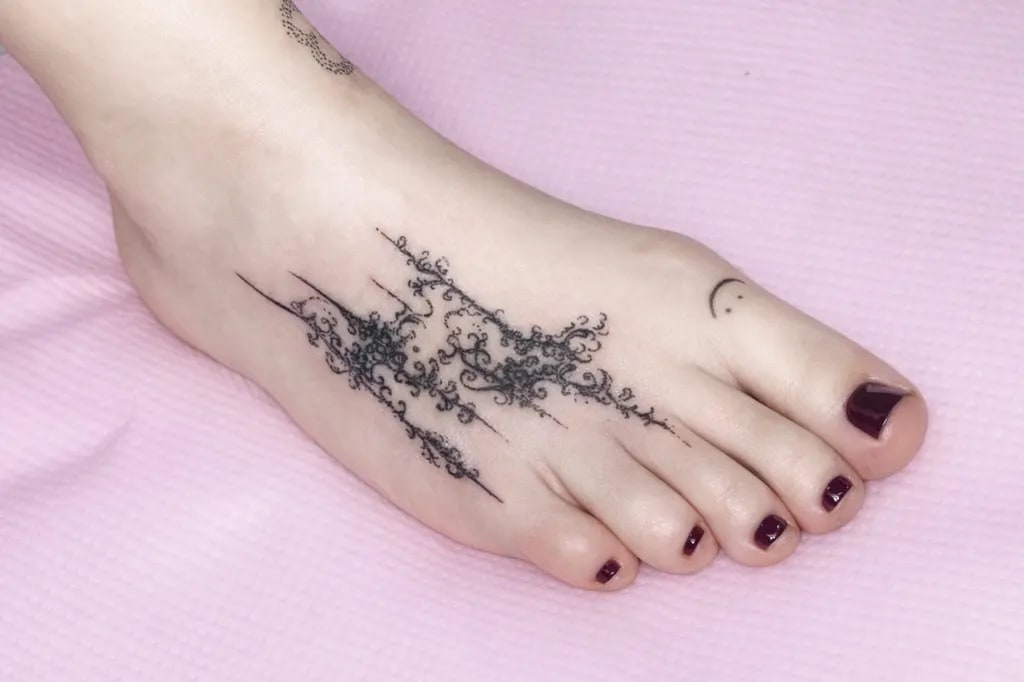
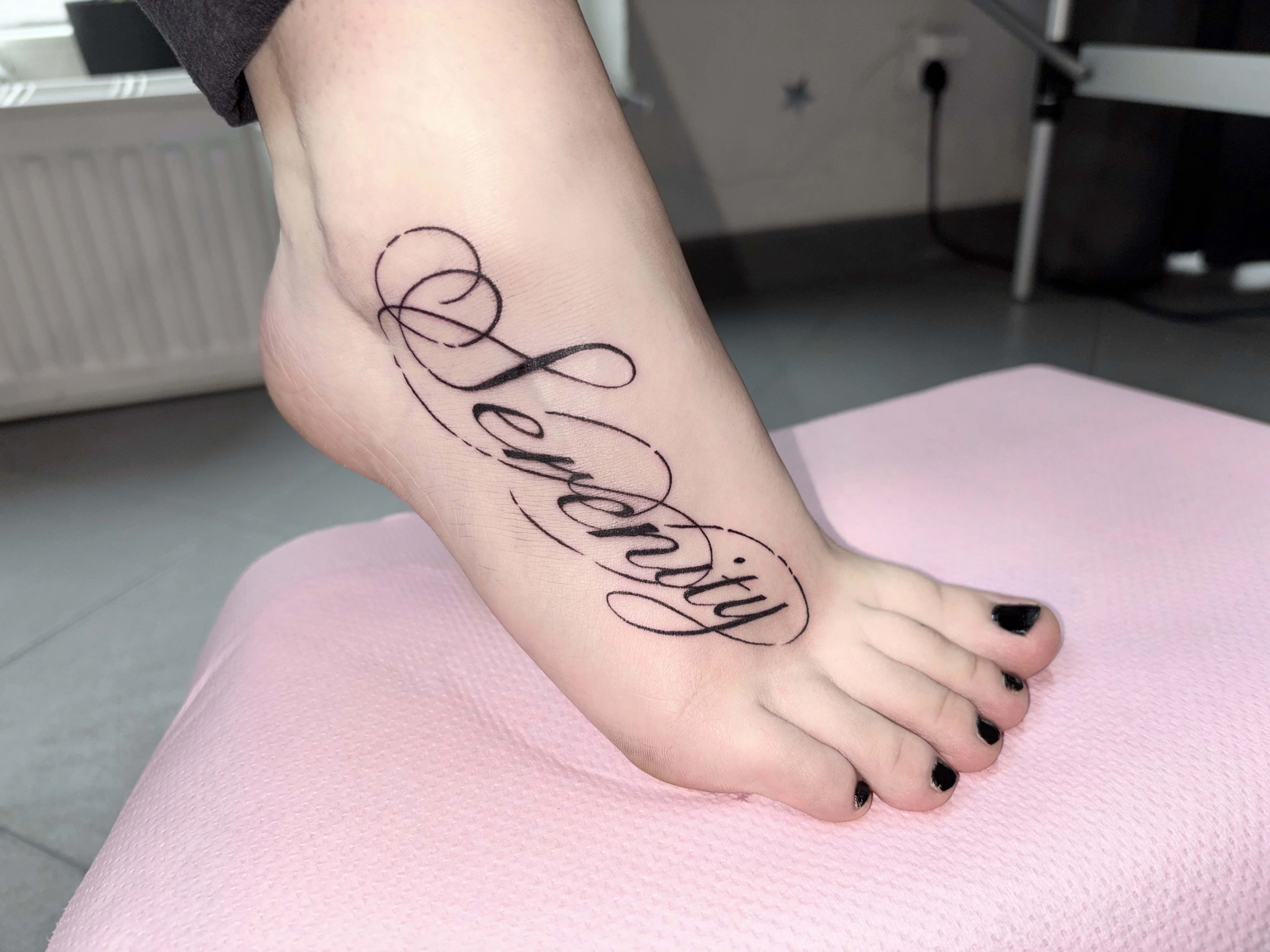
Our work: foot

01Anatomy
A load-bearing structure that changes shape during the day
- very high
- Bone proximity
- low
- Skin thickness
- very high
- Nerve endings
A foot is first of all a load-bearing structure. Twenty-six bones tied into an arch transfer the entire weight of the body to the ground, and with every step that arch flexes and returns. It is the only placement we tattoo that works mechanically under load — and that single property explains most of what happens to the tattoo later.
The skin on the top of the foot is 2 out of 5 in thickness and we rate bone proximity at 5 out of 5. The structure is visible to the naked eye here: the extensor tendons run just beneath the surface and lift it every time you move your toes. A design placed across the tendons moves with them.
Something worth knowing before the fitting: a foot does not have one shape. In the morning it is narrower than in the evening, standing up the arch flattens and the whole upper surface lengthens, and after a full day of walking the circumference grows enough to feel it in a shoe. That is why we always apply the stencil standing, and why we warn against designs requiring perfectly even spacing.
We do not tattoo the sole, for the same reason as the palm: that skin is built differently, sheds constantly and does not hold pigment, and you walk on it all day besides. Toes hold ink for the shortest time of anywhere on the foot, combining a narrow surface with a joint and constant contact with a shoe.
02Pain
Nine out of ten — tendons and bone with no cushioning
- 9/10
- Pain
- very high
- Nerve endings
- very high
- Bone proximity
The foot scores 9 out of 10 and shares the highest value on the price list with the hand and the ribs. Nerve endings are at 5 out of 5 here, the bone lies directly beneath the skin, and there is no cushioning layer at any point on the upper surface.
What is characteristic of the foot is that the sensation changes every few centimetres. Over a tendon it is sharp and penetrating, in the space between tendons distinctly gentler, and over bone it rises again. A session therefore resembles a drive along an uneven road rather than a steady load.
The second thing is reflex. A foot pulls away by itself, because it is used to responding to touch by escaping — a reflex harder to control than on a hand, which is easier to position and hold still. So we ask for a stable support and take breaks when the calf muscles begin to tense.
Sessions run one to three hours and rarely benefit from being extended. On larger designs we split the work, though on a foot that also means two separate healing periods, so we plan it deliberately rather than automatically.
03Composition
A narrow band between ankle and toes
- across
- Design flow
- yes
- Movement zone
The top of the foot is a horizontal surface with clear limits: the ankle marks the border above, the line of the toes below, and the sides fall away steeply. In practice you have a band a dozen or so centimetres high to work with.
So we run compositions here across or diagonally, along the natural line of the tendons. A vertical design running from ankle to toes looks squeezed, because it fights the shape instead of using it.
Motifs with a clear horizontal rhythm work best: ornament running across the foot, a branch laid diagonally, a design wrapping gently towards the side. Closed compositions with a frame and a centre have too little room here.
Movement has to be accounted for from the start. A foot bends at the ankle and at the toe joints with every step, and the skin on top creases with every bend. Detail placed exactly on a line of flexion loses sharpness soonest, so we design so that gaps or the least precise elements of the pattern fall there.
We always apply the stencil with the foot set naturally, standing. With the foot extended and raised the skin settles quite differently.
04Healing
Two to four weeks in a shoe and under load
- 14–28 days
- Healing
- very high
- Friction
- ~14 days
- Epidermis turnover
The epidermis on the foot renews in about 14 days, and full healing takes two to four weeks. We rate friction at 5 out of 5 — the highest, together with the hand.
The difference against the hand, though, is that a foot cannot be taken out of use. A hand can be spared for a few days; on a foot you stand. Add swelling: blood gathers low down, so fresh work swells towards evening more than it does on a calf, because a foot is lowest of all.
The biggest problem, however, is the shoe. The shaft, the tongue and the lacing run exactly across the top of the foot — where almost every design sits — and press on it with every step all day long. It is the single cause that raises the touch-up rate here most.
- Plan a few days in flip-flops or barefoot — at this placement that is not comfort, it is the condition for healing well.
- If you must wear shoes, choose the loosest and softest you own and avoid lacing over fresh work.
- Raise your foot in the evening for half an hour or so; swelling is stronger here than at any other placement.
- Socks only in loose cotton; an elastic crossing the design guarantees a worn patch.
- No pools, saunas or long walks until it has fully healed — sweat in a shoe is as much of a problem as friction.
05Longevity
Sixty-five percent — the highest number on the price list
- 65% of pieces
- Touch-up rate
- very high
- Friction
- ~14 days
- Epidermis turnover
Touch-ups affect about 65% of foot pieces. It is the highest value we record — above the hand (60%), the head (30%) and the neck (25%). We give it plainly, because without it a conversation about this placement is incomplete.
There are three causes and they act simultaneously. The epidermis renews in 14 days, twice as fast as on the forearm. Friction is at 5 out of 5 and comes from the shoe, the sock and walking. And the whole foot carries the weight of the body with every step, with the skin over the metatarsal bones being constantly tensed and released.
The outer areas give way soonest: toes, the sides of the foot and the region near the ankle. The middle of the upper surface holds best, and that is where we steer a design when maximum durability matters.
Sun exposure is 3 out of 5 — feet are uncovered seasonally, in sandals and by the water. In summer a foot tans strongly, because it faces upwards, so sunscreen in season genuinely matters here, though it is not the main problem of this placement.
The practical conclusion: with a foot we plan a touch-up visit from the outset, as an element of the project — and the first touch-up after healing is included in the tattoo price.
06Risks
The highest blowout risk we have
- very high
- Blowout risk
- low
- Skin thickness
- very high
- Bone proximity
We rate blowout risk on the foot at 5 out of 5 — the same as the hand and the highest on the price list. Thin skin stretched over bones and tendons leaves a minimal depth margin; a fraction too deep means pigment spreading along the tissue and a bluish halo around the line.
Most exposed are the areas near the ankles and the sides of the foot, where the skin is thinnest and most mobile. We work slowest there, and it is there that we most often give up very fine detail.
The second risk concerns the durability of detail and is a direct consequence of 65% touch-ups. Designs with a dense mesh of thin lines or small lettering lose legibility on a foot faster than anywhere else. So we design more strongly and more simply than would seem necessary, and increase the gaps more than at any other placement.
The third risk is organisational and most often underestimated. A foot tattoo genuinely restricts footwear for two to four weeks. If you work in safety boots, walk a great deal or have travel planned, that is not a detail — it is a condition to write into the calendar before booking a session.
07Styles
What takes a shoe, walking and a narrow band
- low
- Skin thickness
- across
- Design flow
We choose techniques here against two constraints at once: a horizontal, narrow format and the shortest line lifespan on the whole price list.
Best are ornaments running across, plant motifs laid diagonally along the tendons, and designs built on a repeating rhythm — the kind that do not lose their sense when one fragment softens with time. Blackwork with clear areas also holds well and is the safest choice if the longest possible legibility matters to you.
Delicate fine line and small lettering are the most common request at this placement and simultaneously the technique that performs worst here. We do not refuse, but we say before the sketch what it means in practice: at 65% touch-ups and friction of 5 out of 5, such work will require a return, probably more than once. If you want a subtle design meant to look the same in five years, the inner ankle or the calf will give an entirely different result.
Colour fades faster than black on a foot, and pale pigments fastest of all — on colour work we treat refreshing as the rule rather than the exception.
Small-scale realism we advise against plainly: it needs dense detail, and dense detail is the one thing this placement will not hold.
08Everyday life
Visible three months a year
- moderate
- Coverability
- moderate
- Sun exposure
We rate foot coverability at 3 out of 5, and it is a strongly seasonal figure. Closed footwear covers the tattoo completely, so for most of the year it simply is not seen. In sandals, flip-flops and barefoot it is fully exposed.
In practice that makes the foot the most seasonal placement we tattoo — more so even than the leg, because shoes are worn longer than long trousers. In a professional context a foot tattoo practically does not exist, unless you work in open footwear.
That seasonality has another side worth considering, though: for most of the year you do not see it either. If you are after a tattoo you want daily contact with, a foot will not provide it.
A healed piece needs no special care beyond sunscreen in summer. Shoes, sport and walking return without restriction — the problems concern the healing period alone, but during it they are real.
09First tattoo
Decidedly not for a first tattoo
- 9/10
- Pain
- 65% of pieces
- Touch-up rate
- very high
- Friction
Alongside the hand, the foot is a placement we do not propose for a first tattoo in any variant.
The reason is the same as with the hand, only in a stronger version. Pain at 9 out of 10, touch-ups on 65% of pieces, and healing that cannot be carried through without changing footwear for a few weeks — three things at once, each of which would be demanding on its own for someone without experience.
On top of that comes the argument we repeat at every difficult placement: with a first tattoo you do not yet know how your skin takes pigment or how the work looks once healed. A foot is the worst possible place to gather that information, because there even well-executed work changes the most.
If you like this area, the sensible route is to start higher — on the calf or the inner ankle, where conditions are considerably better and a composition can later be led downwards. You gain experience and keep every option open.
10Nearby placements
The foot against the leg and the hand
- 65% of pieces
- Touch-up rate
- 9/10
- Pain
The foot borders one area and shares a twin profile with another, on the opposite side of the body. Both comparisons are useful before a decision.
The leg above the ankle offers entirely different conditions despite a few centimetres of separation: touch-ups at 12% instead of 65%, pain at 3 out of 10 instead of 9, and no constant contact with a shoe. Crossing from the ankle onto the foot looks minor and means entering the hardest durability conditions we have. If a design is to run that low, it is worth considering stopping it just above the ankle.
The hand is the foot’s counterpart on the upper limb, and the difference between them is smaller than the resemblance: the same 9 out of 10 for pain, the same epidermis renewing in 14 days, the same maximum blowout risk. The foot comes out slightly worse on touch-ups — 65% against 60%. Anyone weighing one of these placements should read about both, because the conclusions are nearly identical.
What separates them is visibility: a hand is seen always and everywhere, a foot only for a few months a year. For some people that is what settles the choice.
11Price
When to book so you are not fighting your own calendar
- 1–3 h
- Typical session
- 65% of pieces
- Touch-up rate
With a foot the most important cost decision concerns the date, in a way found at no other placement.
The best moment is autumn and winter. There are several reasons and all are practical: there is no heat, so the foot swells less and sweats less in a shoe; there is no sandal season, so you lose nothing by having the tattoo mid-healing for a few weeks; and by summer the work will have healed and possibly been topped up. A session in June gives exactly the opposite arrangement — healing in the worst conditions, and in the only period when you would want to show the tattoo.
The pricing itself is ordinary and based on time: a session runs one to three hours here, and the foot carries a difficulty surcharge, because the pace of work here is slower than on a calf.
It has to be said honestly, though, that at 65% touch-ups the first session is rarely the last. We treat the top-up as part of the project, not an extra cost: the first touch-up after healing is included in the tattoo price, and we arrange it at the post-healing check-up — so the cost of the whole is known from the outset.
Nearby placements
- legA few centimetres higher and the conditions change radically: 12% touch-ups instead of 65%, pain 3 instead of 9 and no constant contact with a shoe. If a design is to run low, consider stopping it just above the ankle.
- handThe foot’s counterpart on the upper limb: the same 9 out of 10 for pain, the same fourteen-day epidermis and the same maximum blowout risk. What separates them is visibility — a hand is always seen, a foot a few months a year.
- thighThe other pole of the same limb and the best result on the price list: 7% touch-ups instead of 65%. If you want work that needs no upkeep, that is where the conversation should start.
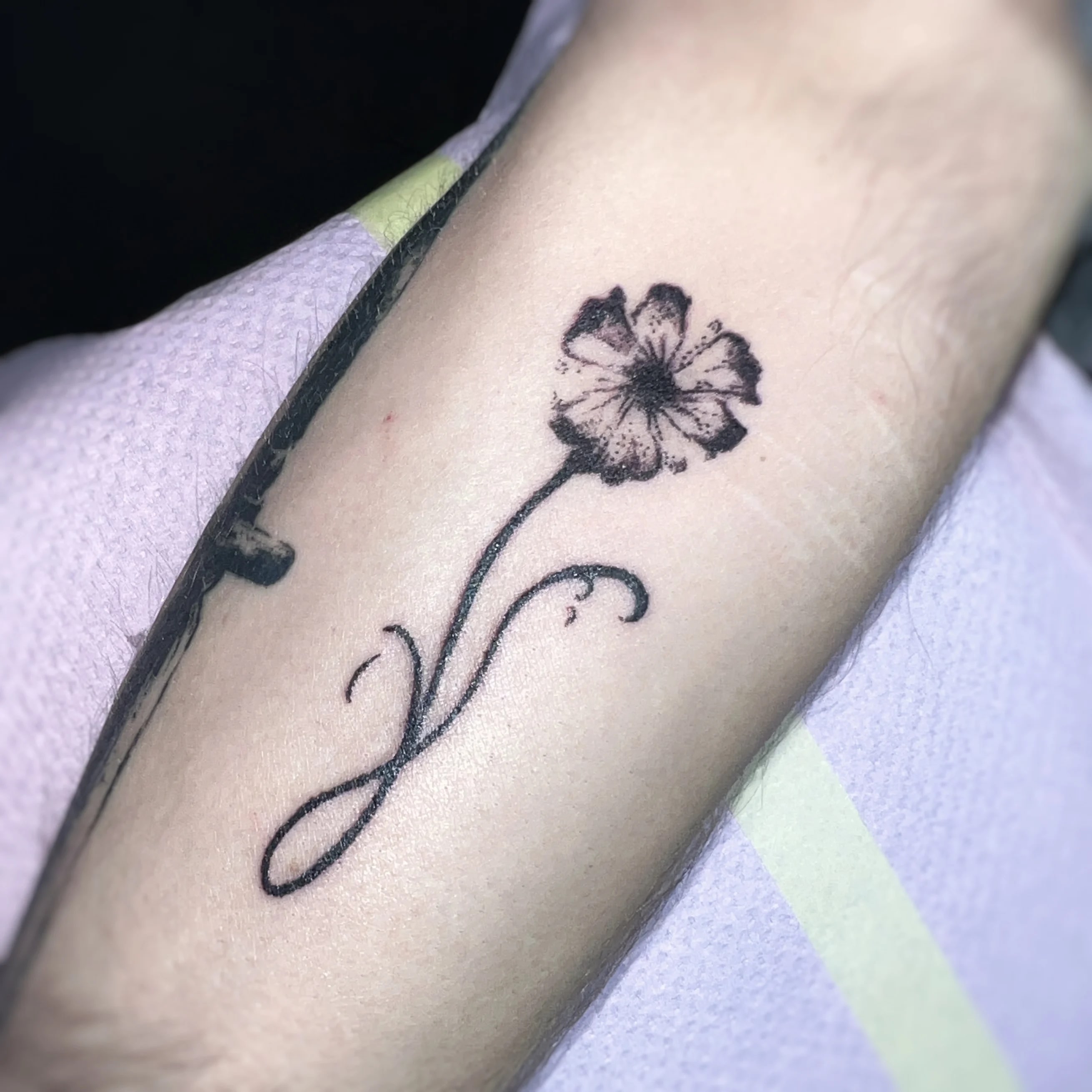
Styles that look great in this spot



Frequently asked questions
Yes, and it is the most important thing to know before deciding. Touch-ups affect about 65% of foot pieces at Parvata Tattoo — the highest value on the entire price list, above the hand at 60%, the head at 30% and the neck at 25%. Three causes act at once: the epidermis renews here in about 14 days, twice as fast as on the forearm; friction we rate at 5 on a five-point scale and it comes from the shoe, the sock and walking; and the whole foot carries the weight of the body with every step, which keeps the skin over the metatarsal bones constantly tensed. The outer areas give way soonest — toes, the sides of the foot and the region near the ankle — while the middle of the upper surface holds best.
Yes — on the Parvata Tattoo scale the foot scores 9 out of 10 and shares the highest value with the hand and the ribs. Nerve endings are at 5 on a five-point scale here, the bone lies directly beneath the skin, and there is no cushioning layer at any point on the upper surface. What is characteristic of this placement is that the sensation changes every few centimetres: over a tendon it is sharp and penetrating, between tendons distinctly gentler, and over bone it rises again. There is also a withdrawal reflex — a foot is used to responding to touch by escaping, and that is harder to control than on a hand, which is easier to hold still. So we plan sessions short, one to three hours.
In autumn or winter, and it is the only placement where we advise on timing this firmly. There are several reasons, all practical. There is no heat, so the foot swells less and sweats less in a shoe. There is no sandal season, so you lose nothing by having the tattoo mid-healing for a few weeks. And by summer the work will have healed and possibly been topped up, meaning it looks its best exactly when you start showing it. A session in June gives the reverse: healing in the worst possible conditions, and in the only period of the year when this tattoo is visible.
Above all you have to solve the shoe problem. The shaft, the tongue and the lacing run exactly across the top of the foot — where almost every design sits — and press on it with every step all day long; it is the single cause that raises the touch-up rate here most. So we ask you to plan a few days in flip-flops or barefoot; at this placement that is not a matter of comfort but the condition for healing well. If shoes are unavoidable, choose the loosest and softest you own, without lacing over fresh work. Swelling comes on top: a foot is lowest of all, so it swells more than a calf and in the evening it is worth raising for half an hour or so.
Horizontal ones with a clear rhythm. The top of the foot is a bounded surface: the ankle marks the border above, the line of the toes below, and the sides fall away steeply, so in practice you have a band a dozen or so centimetres high. A vertical design running from ankle to toes looks squeezed, because it fights the shape. Best are ornaments running across, plant motifs laid diagonally along the tendons and blackwork with clear areas — designs that do not lose their sense when one fragment softens with time. Fine line and small lettering are the most common request at this placement and simultaneously the technique that performs worst here.
No — alongside the hand it is a placement we do not propose for a first tattoo in any variant. The reason is the same as with the hand, only stronger: pain at 9 out of 10, touch-ups on 65% of pieces, and healing that cannot be carried through without changing footwear for two to four weeks. Each of those things alone would be demanding for someone without experience, and they occur together. On top comes the simplest argument: with a first tattoo you do not yet know how your skin takes pigment or how the work looks once healed, and a foot is the worst place to gather that information. The sensible route is to start higher — on the calf or the inner ankle.
More about the studio
Have an idea for a tattoo in this spot?
Book a free, no-obligation consultation — we will match an artist and design the motif for your body.