17 min readupdated
Tattoo by placement
Leg tattoo — Wrocław
The leg below the knee is in practice two different placements sharing one name. The calf is a thick muscle and takes a needle as calmly as an upper arm. The shin is the tibia under thin skin, with no muscle in between — the same limb, an entirely different sensation and an entirely different way of working.
There is a second thing no upper limb has: gravity. A fresh leg tattoo heals longer, eighteen to thirty days, because blood and fluid gather low down while you spend the day upright. That is not a complication, it is a fact to build into the plan for your first week.
- 3/10
- Pain
- 18–30 days
- Healing
- 12% of pieces
- Touch-up rate
- 2–5 h
- Typical session
The first touch-up after healing is included in the price.
over 200 tattoos done5 on Google (40 reviews)
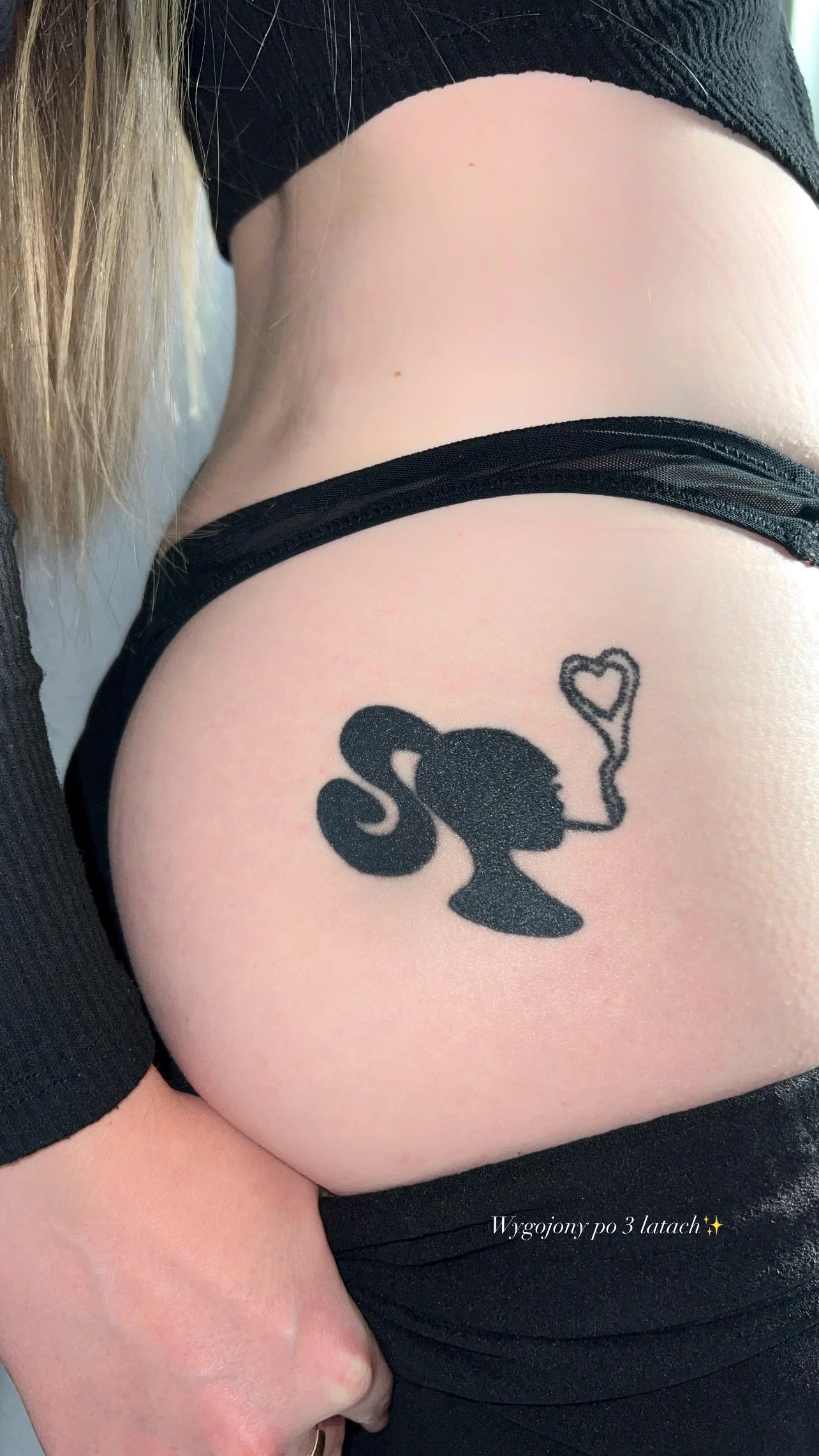
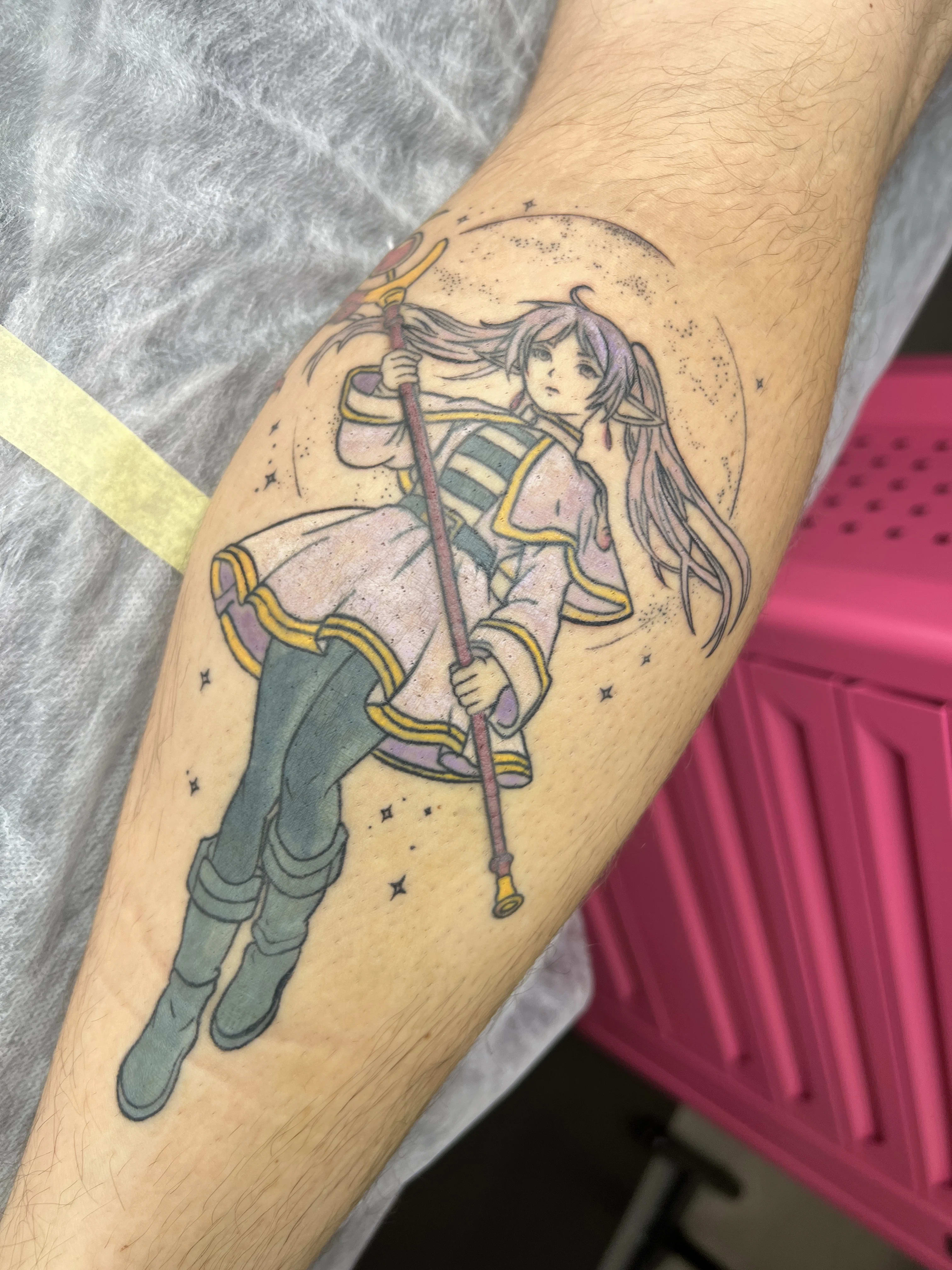
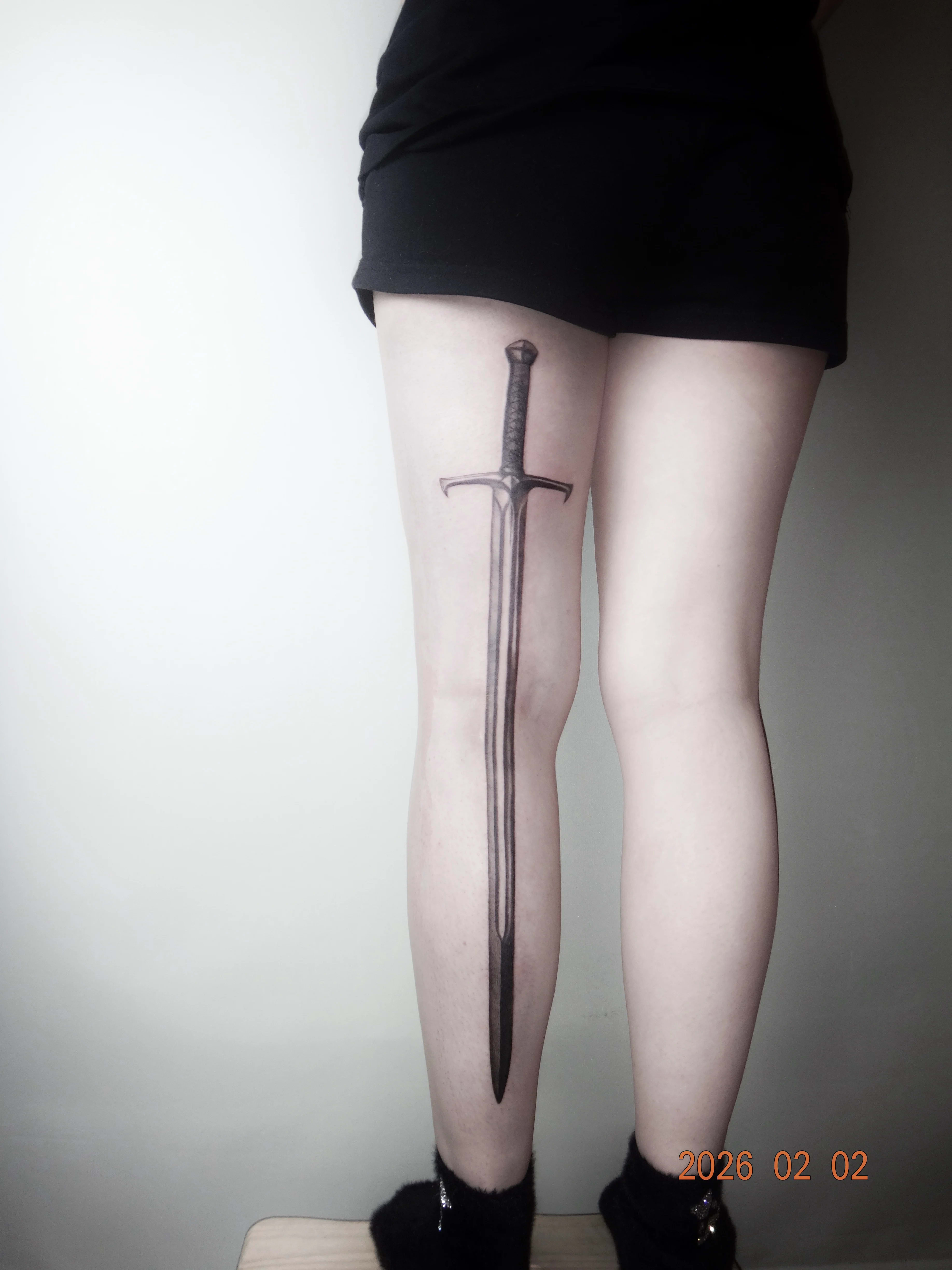
Our work: leg

01Anatomy
Calf and shin — one leg, two worlds
- high
- Skin thickness
- moderate
- Bone proximity
- low
- Nerve endings
The calf is the triceps surae: a thick, convex mass under skin rated at 4 out of 5 for thickness. The needle works on a soft, springy base very similar to what an upper arm provides. It is the most comfortable part of the whole leg.
The shin is its opposite. The front edge of the tibia lies directly beneath the skin — there is no muscle there, only bone, periosteum and a thin layer of tissue. Averaged across the whole leg, bone proximity is 3 out of 5, but on the edge of the tibia itself it is effectively the maximum. The sensation changes there from one minute to the next, as soon as the design crosses the boundary of the muscle.
The sides of the shin, on either side of the tibia, are considerably gentler, and that is where we most often run designs meant to cover the front of the leg. The bone edge itself is narrow and can be avoided without any loss to the composition.
The fourth zone is the ankle. The skin there is thin, bone protrudes on both sides and the tendons run shallow. It is the most sensitive fragment of the whole leg and at the same time the one that works hardest when you walk — so we treat it separately both when designing and in aftercare.
02Pain
Three out of ten, but that is an average of two extremes
- 3/10
- Pain
- moderate
- Bone proximity
- high
- Skin thickness
The leg scores 3 out of 10, and it is an averaged value that here says less than usual. On the calf the sensation is mild and comparable to an upper arm — a soft base, no vibration, a calm session.
On the edge of the tibia it becomes noticeably sharper. It is not at the level of ribs or a hand, but a distinctive, penetrating sense of working over bone appears that the calf does not have at all. People describe it as the difference between scratching and being scraped along the bone.
Hardest is the ankle and the transition onto the foot. The skin there is thinnest, and protruding bone makes every pass distinctly more noticeable. If a design runs that low, we plan that area for the start of the session.
We set aside two to five hours for a session here, but on pieces covering the whole calf the position itself is often more tiring than the needle. The leg has to lie stably and be rotated from time to time, so we take breaks to stretch more often than on an upper limb.
03Composition
A vertical axis that narrows towards the bottom
- along the limb
- Design flow
- no
- Movement zone
The leg below the knee is elongated and clearly tapered: wide at the knee, narrow at the ankle. The taper is stronger here than on the forearm, so vertically run designs have to account for it, or the lower part of the composition looks squeezed.
The calf has an additional trait: it is convex and mainly visible from behind and from the side. A motif placed exactly on its crest will show clearly when you stand, but disappear when viewed from the front. So for pieces meant to be noticed we run them further round the side than intuition suggests.
The classic solution for this surface is a composition running diagonally — from the inner side below the knee, across the calf, towards the outer side of the ankle. It then uses the full length and avoids the edge of the tibia instead of crossing it.
The boundaries here are clear and worth choosing deliberately. The knee above and the ankle below are natural breaks — a piece stopped above the ankle looks finished, while one running onto the foot calls for a decision about an entirely different level of difficulty and durability.
04Healing
Eighteen to thirty days, with swelling in the background
- 18–30 days
- Healing
- ~30 days
- Epidermis turnover
- low
- Friction
The epidermis on the leg renews in about 30 days, and full healing takes eighteen to thirty. That is longer than on an upper arm, and the reason is simple: gravity. Blood and fluid gather in the lower parts of the body while you spend the day upright.
In practice a fresh leg tattoo, especially a low one, can swell slightly towards evening in the first few days. It is not a complication and needs nothing beyond raising the leg for an hour — but it can be alarming if nobody mentions it in advance.
The second factor is clothing and footwear. We rate friction at 2 out of 5, which is low, but a sock elastic, a boot shaft and a narrow trouser leg all land exactly where designs most often reach.
- Raise your leg for half an hour or so in the evening for the first few days — it is the one thing that genuinely limits swelling.
- Socks with a loose elastic, or short ones, if the piece reaches below the calf; the elastic presses exactly along the healing line.
- Put high boots aside until it has healed when the design runs onto the ankle — the shaft rubs with every step.
- Postpone long walks and running by roughly ten days; not because of pain, but because of swelling and sweat.
- Trouser legs should be loose for the first week — jeans clinging to the calf are the most common cause of worn patches.
05Longevity
Twelve percent touch-ups and where they come from
- 12% of pieces
- Touch-up rate
- moderate
- Sun exposure
- low
- Blowout risk
Touch-ups affect about 12% of leg pieces. That is a good result, but noticeably weaker than the thigh (7%) or the back (8%) — and it is worth knowing where the difference comes from, because it is not accidental.
Three things make it up, all connected to the leg being low. First, swelling during healing stretches fresh skin slightly, which can show on very fine detail. Second, the lower areas are in contact with footwear and socks. Third, pieces running onto the ankle enter an area of considerably worse durability.
The calf itself comes out distinctly better than the average for the whole leg — it is a stable surface, without friction and without bone beneath. If maximum durability matters to you, keeping the design above the ankle solves most of the problem.
Sun exposure is 3 out of 5. We uncover our legs seasonally, in shorts and near water, so sunscreen is needed in summer but not all year round. Blowout risk is 2 out of 5 on the calf and rises over the tibia, where thin skin gives a narrower margin.
06Risks
Bone, ankle and fine detail placed low
- low
- Blowout risk
- high
- Skin thickness
- moderate
- Skin stretching
The greatest technical risk on the leg concentrates in two places and both are predictable. The first is the edge of the tibia: thin skin directly over bone narrows the depth window in which the needle works correctly, so the chance of a blowout rises there. We work more slowly in that spot or — more often — run the design round the side and avoid the edge itself.
The second is the ankle. Protruding bone, shallow tendons and constant movement while walking make it the hardest fragment of the whole leg both to execute and to maintain. We say so before the design, because a piece running onto the ankle behaves differently afterwards from the same work on a calf.
The third risk is compositional and follows from the taper. A design drawn at a uniform width along the whole length of the leg will look cramped at the bottom. When designing we scale elements gradually, and that only shows at the fitting rather than on a printout.
Skin stretching on the lower leg comes out at 3 out of 5. A calf responds to building muscle mass much as an upper arm does — the change is even and usually harmless to the composition, though designs built on a regular grid can lose their precision.
07Styles
What sits on a calf and what belongs higher up
- high
- Skin thickness
- along the limb
- Design flow
The calf is one of the better surfaces we have: thick skin, no friction, a decent area and comfortable access. Practically everything that works on an upper arm will work here too.
Vertical compositions with a clear axis use it best: botanical work run along the leg, ornament, blackwork built in bands, slender scenes. The shape suggests the direction, so the design does not have to fight it.
Realism comes out well on a calf, provided the composition is vertical. The convexity of the muscle gives a natural depth that can be exploited in shading — one of the few surfaces where the shape of the body helps a drawing instead of distorting it.
We approach very fine detail low on the leg, near the ankle, more cautiously. It is not a question of execution but of the fact that durability there is the lowest of the whole section, and a delicate stroke loses soonest. If a precise, subtle design matters to you, the calf or the thigh will give a far better result after years.
08Everyday life
Seasonal visibility — covered for half the year
- high
- Coverability
- moderate
- Sun exposure
Coverability on the leg is 4 out of 5. Any long trousers cover it completely, and for the greater part of the year those are what people wear. In the context of work a leg tattoo practically does not exist.
Visibility here is therefore seasonal, and that is a fairly unusual trait. For half the year nobody sees the piece, you included, and in summer it is fully on show. For many people that is a convenient arrangement: a large, striking design without daily exposure.
In daily use a healed leg tattoo asks for nothing in particular. The only habit that gets added is sunscreen in summer — and it is worth remembering that a calf tends to be missed when applying it, being harder to see than an arm.
One practical note about hair removal. If you shave your legs, it has no effect at all on a healed tattoo — a razor does not reach the pigment. During healing, though, it has to wait until the skin has closed completely.
09First tattoo
The calf as a calm start, the ankle decidedly not
- 3/10
- Pain
- 12% of pieces
- Touch-up rate
- 18–30 days
- Healing
For a first tattoo we separate these two more sharply than at any other placement, because the difference really is large.
The calf is a good first choice. Pain at the level of an upper arm, a decent surface area, simple aftercare and full coverability. The only difference against the forearm is that you will not see your own calf well — you have to turn round or use a mirror, so contact with the healing piece is less direct.
We do not propose the ankle or the tibia area for a first tattoo. Not because it hurts a great deal, but because it combines a harder sensation with worse durability and longer healing. Three things at once, and it is not worth learning all three simultaneously.
There is also the question of timing, worth considering for a first session on the leg: healing takes longer here than on an arm and falls more conveniently outside the summer, when long trousers are worn anyway. In summer it means a week or two without swimming and without full sun.
10Nearby placements
The leg between thigh and foot
- 12% of pieces
- Touch-up rate
- 3/10
- Pain
The section below the knee sits exactly between two extremes of the whole lower limb, and a comparison with them explains most of the decisions.
The thigh is distinctly easier in every technical respect: touch-ups at 7% against 12%, no bone under the skin, a flat surface instead of a taper. What separates them is geometry, though. A thigh is a board on which a closed scene fits; the section below the knee has an axis and a direction. When a piece is to cover the whole limb, we design it as a single whole from the first sketch, because the knee is a natural narrowing and it decides whether the design flows or breaks.
The foot is the other direction and an entirely different league: pain 9 out of 10, touch-ups 65% and an epidermis renewing twice as fast. Crossing from the ankle onto the foot looks small and means entering the hardest durability conditions we have. Anyone considering a design that runs that low should learn those numbers first.
It is also worth setting the calf against the forearm, because they are twin surfaces in shape and sensation. The biggest difference lies in exposure: a forearm you see and show every day, a calf is visible seasonally.
11Price
Predictable pricing and one factor that raises it
- 2–5 h
- Typical session
- 12% of pieces
- Touch-up rate
The calf is among the easiest placements to price, because the work proceeds at an even pace, without slowdowns and without extra fittings. Most projects close within a single session of two to five hours, so the estimate given at the consultation rarely shifts.
There is a factor that can lengthen the work, though, and we say so plainly when quoting: the lower the design runs, the slower the work goes. Over the tibia and on the ankle the pace drops, because thin skin over bone calls for more careful needle control. The same surface placed on a calf and on an ankle is genuinely a different number of hours — and since you pay for time, that translates into the figure.
The second factor is long-term. At 12% touch-ups the leg does well, but worse than the thigh or the back, and the difference concentrates precisely in the lower areas. A design kept above the ankle is therefore not only more durable but cheaper to maintain.
The price covers a custom design and a review after healing, exactly as at every other placement. With a leg, though, the consultation adds one decision made nowhere else: we settle whether the composition avoids the edge of the tibia or crosses it — and that changes both the course of the session and its length.
Nearby placements
- thighThe other half of the same limb, technically easier: 7% touch-ups instead of 12% and no bone under the skin. Geometry separates them — a thigh is a board, while the section below the knee returns to a lengthwise arrangement closer to the forearm.
- footA few centimetres lower and the conditions change radically: pain 9 out of 10 and touch-ups 65% instead of 12%. Learn those numbers before deciding on a design that runs from the ankle onto the foot.
- forearmA twin surface in shape and sensation, but the opposite in exposure: a forearm you see every day, a calf only in summer.
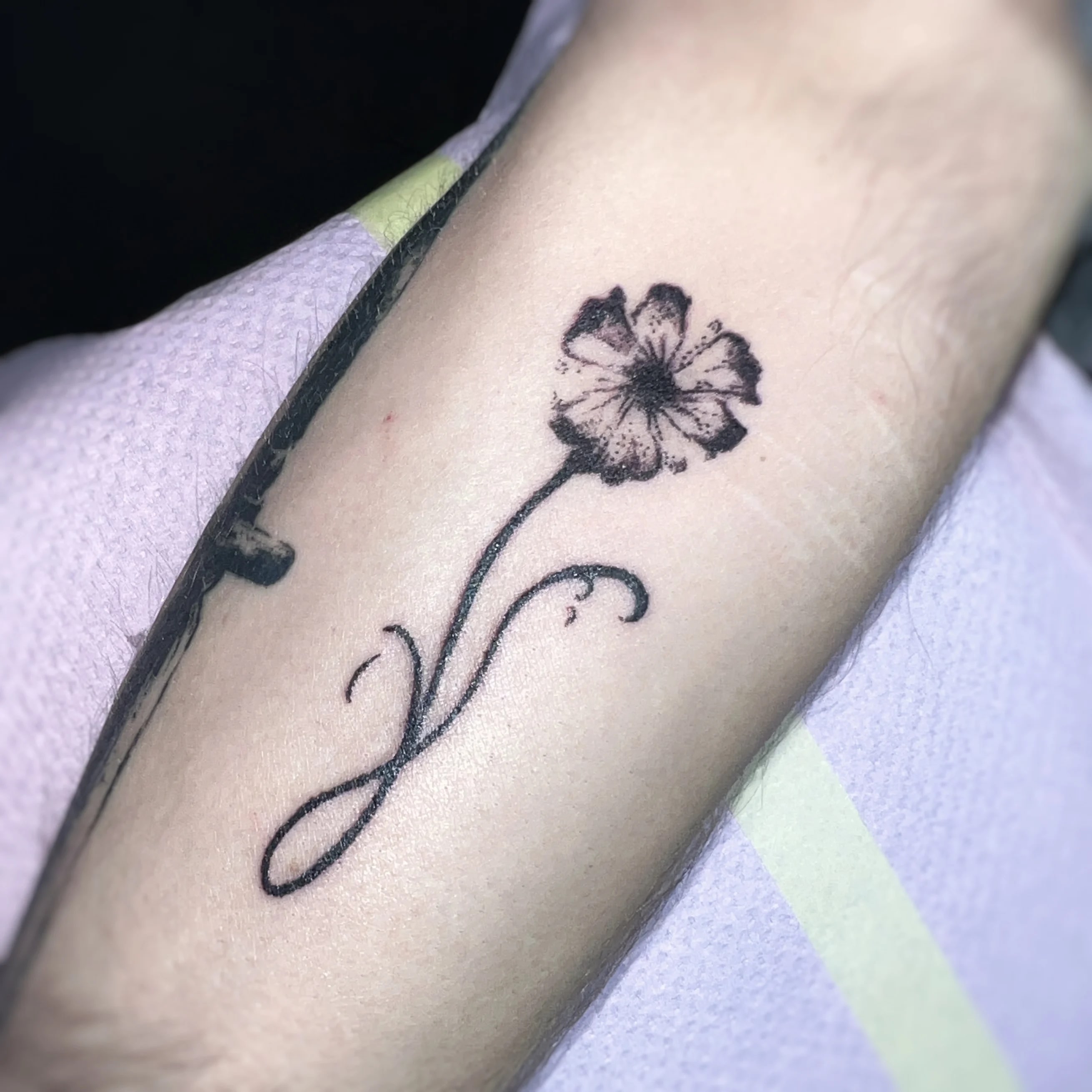
Styles that look great in this spot


Frequently asked questions
It depends which part of the leg, and the difference here is larger than anywhere else. On the Parvata Tattoo scale the leg scores 3 out of 10, but that is an average of two extremes. The calf is a thick triceps surae covered by skin rated 4 out of 5 for thickness — the sensation is mild and comparable to an upper arm. The shin is something else entirely: the front edge of the tibia lies directly beneath the skin, with no muscle in between, so a penetrating sense of working over bone appears. Hardest is the ankle, where the skin is thinnest and bone protrudes on both sides. That is why when designing we most often run the piece along the sides of the shin, avoiding the bone edge itself — it can be done without any loss to the composition.
Because of gravity, and it is the only placement where that factor matters. Full healing takes eighteen to thirty days, and the epidermis renews in about 30 — longer than on an upper arm. Blood and fluid gather in the lower parts of the body while you spend the day upright, so a fresh leg tattoo, especially a low one, can swell slightly towards evening in the first few days. That is not a complication and needs nothing beyond raising the leg for half an hour, but it can be alarming if nobody gives warning. The second factor is clothing: a sock elastic, a boot shaft and a narrow trouser leg all land exactly where designs most often reach.
The calf itself does — it is a stable surface, without friction and without bone beneath. The averaged touch-up figure for the whole leg is about 12% at Parvata Tattoo, but that number is inflated by the lower areas rather than by the calf. Three things make it up, all connected to the leg being low: swelling during healing stretches fresh skin slightly, the lower areas are in constant contact with footwear and socks, and pieces running onto the ankle enter an area of distinctly worse durability. The practical conclusion is that keeping the design above the ankle solves most of the problem. Sun exposure is 3 out of 5, so sunscreen is needed in summer but not all year.
One that uses the vertical axis and the taper towards the bottom. The leg below the knee is clearly conical — wide at the knee, narrow at the ankle — more so than a forearm, so a design drawn at a uniform width along its whole length will look cramped at the bottom. Vertical compositions with a clear axis work best: botanical work run along the leg, ornament, blackwork built in bands and slender scenes. Realism comes out very well on a calf, because the convexity of the muscle gives natural depth for shading. The classic solution is a composition running diagonally, from the inner side below the knee across the calf towards the outer side of the ankle — it uses the full length and avoids the edge of the tibia.
Yes, almost always. We rate leg coverability at Parvata Tattoo at 4 on a five-point scale — any long trousers cover it completely, and for the greater part of the year those are what people wear. In the context of work a leg tattoo practically does not exist. Visibility here is therefore seasonal, which is a fairly unusual trait: for half the year nobody sees the piece, you included, and in summer it is fully on show. For many people that is a convenient arrangement, allowing a large, striking design without daily exposure. If you shave your legs, it has no effect on a healed tattoo — a razor does not reach the pigment; it only has to wait while the skin heals.
The calf yes, the ankle and the tibia area decidedly not — and we separate the two more sharply than at any other placement. The calf gives pain at the level of an upper arm, a decent surface, simple aftercare and full coverability, so it is a calm first choice. The only difference against the forearm is that you will not see your own calf well, so contact with the healing piece is less direct. We do not propose the ankle for a first tattoo, because it combines a harder sensation with worse durability and longer healing — three things at once, and not worth learning simultaneously. Timing is worth thinking about too: healing on the leg falls more conveniently outside the summer.
More about the studio
Have an idea for a tattoo in this spot?
Book a free, no-obligation consultation — we will match an artist and design the motif for your body.