17 min readupdated
Tattoo by placement
Thigh tattoo — Wrocław
The thigh is the placement where skin cooperates most. We rate thickness at 5 out of 5, there are fewer nerve endings here than anywhere on the price list, blowout risk sits at 1 out of 5, and touch-ups affect a mere 7% of pieces. Four of the best results we have, meeting on one surface.
For the person drawing, that means comfort no other placement offers: a large flat area, a stable base and complete freedom in the density of detail. For you it means a calm session and a tattoo that usually needs no return visit. One caveat does exist, though, and we state it openly — this placement responds to changes in your silhouette more than any other.
- 4/10
- Pain
- 21–35 days
- Healing
- 7% of pieces
- Touch-up rate
- 2–6 h
- Typical session
The first touch-up after healing is included in the price.
over 200 tattoos done5 on Google (40 reviews)
Our work: thigh
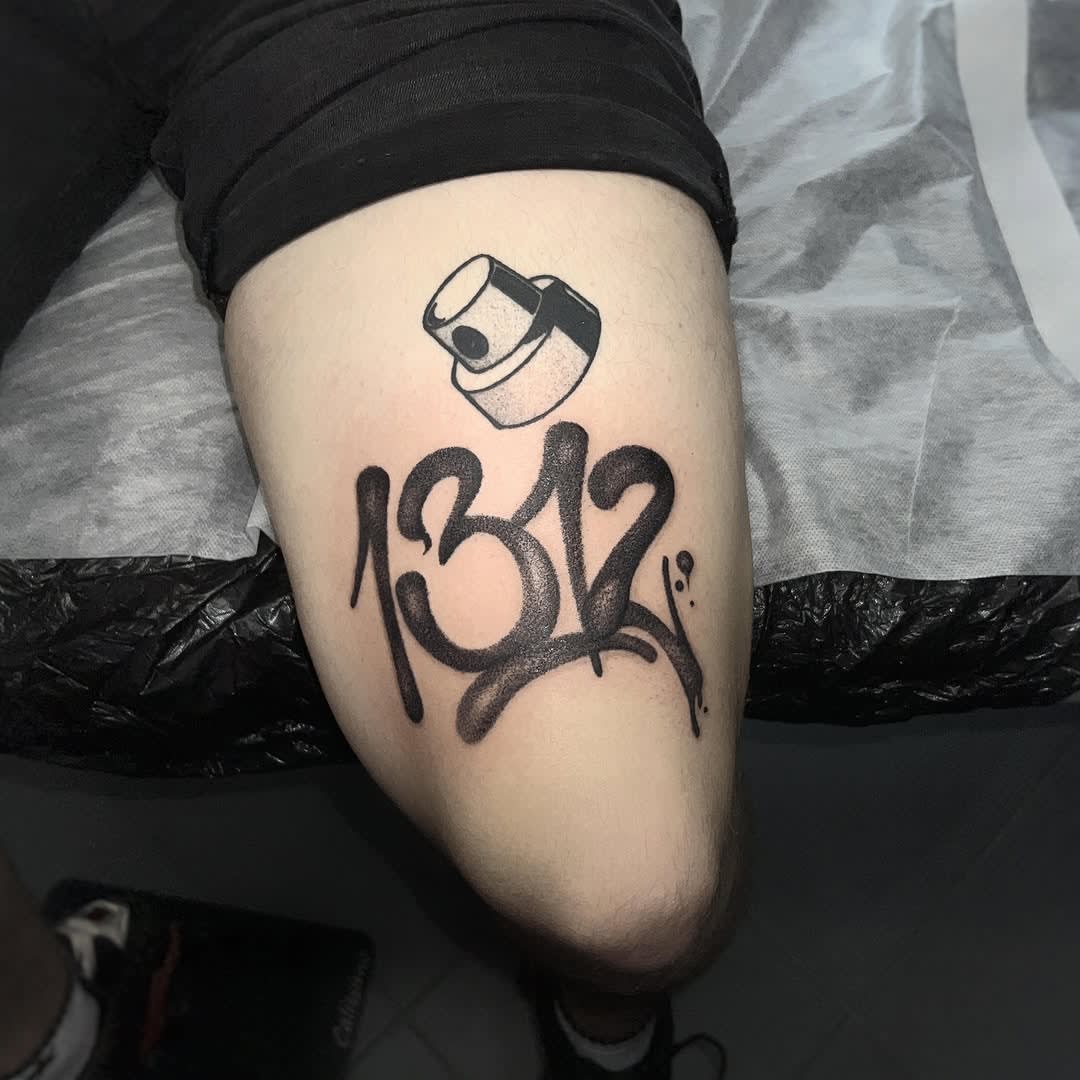

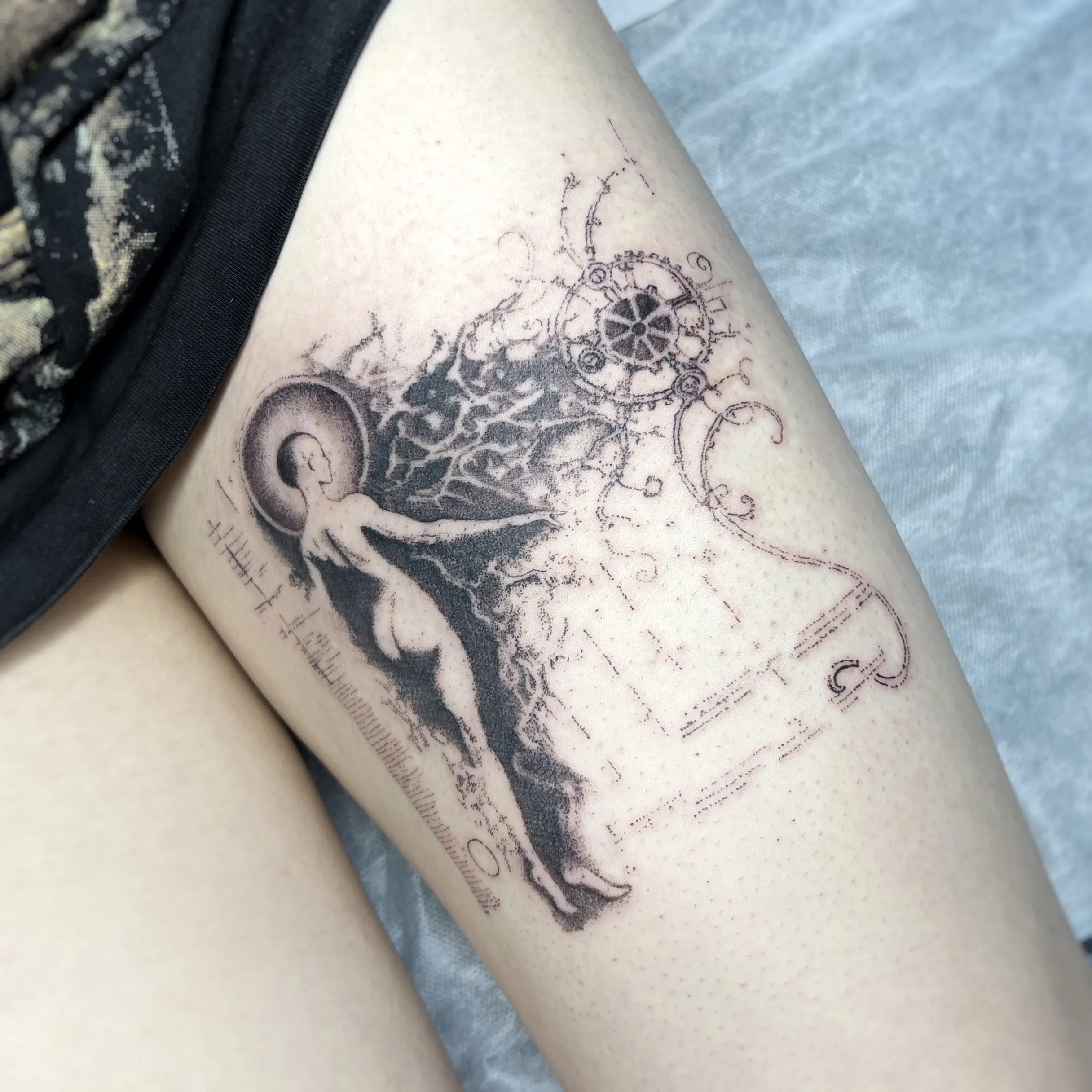
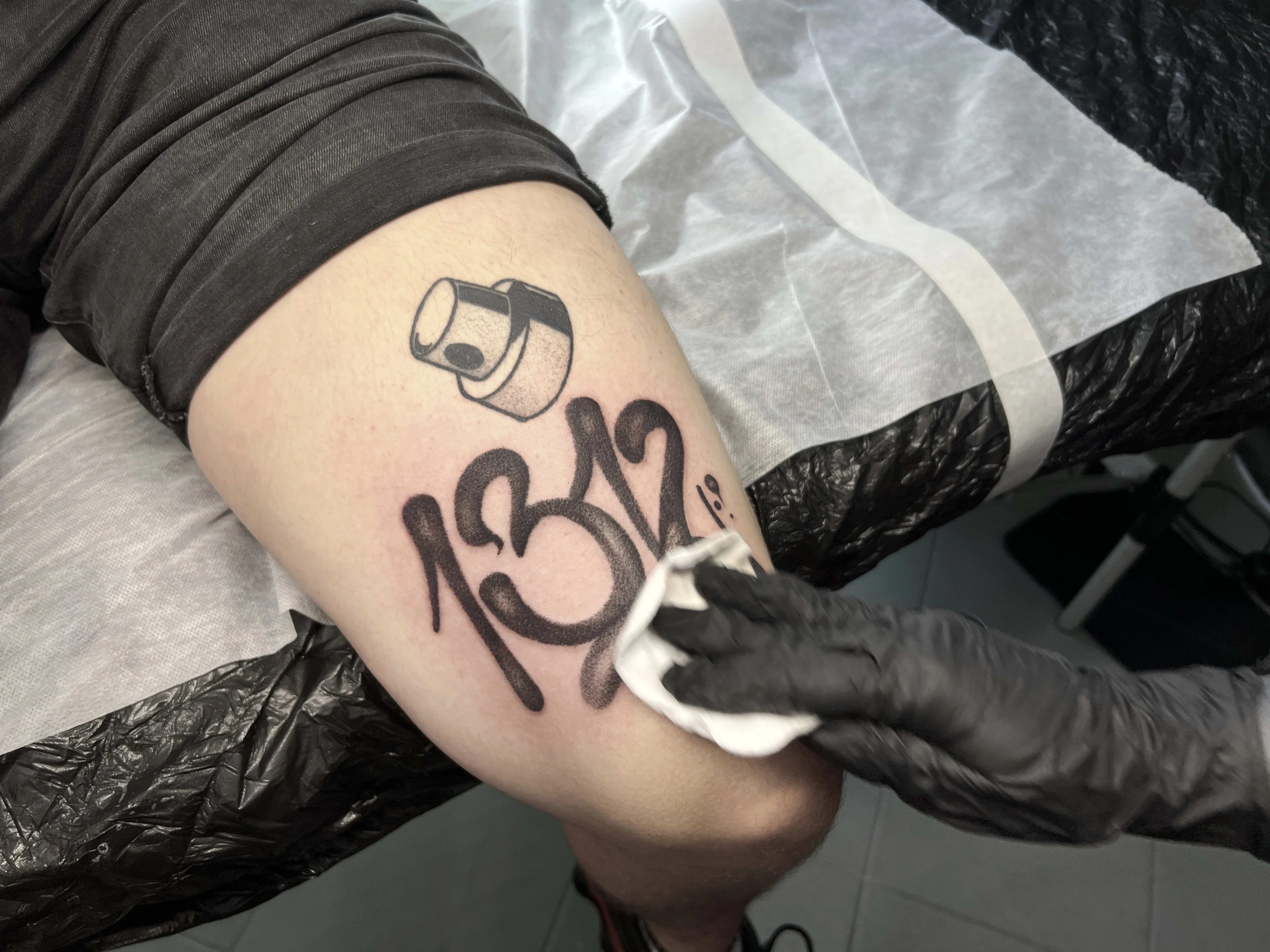


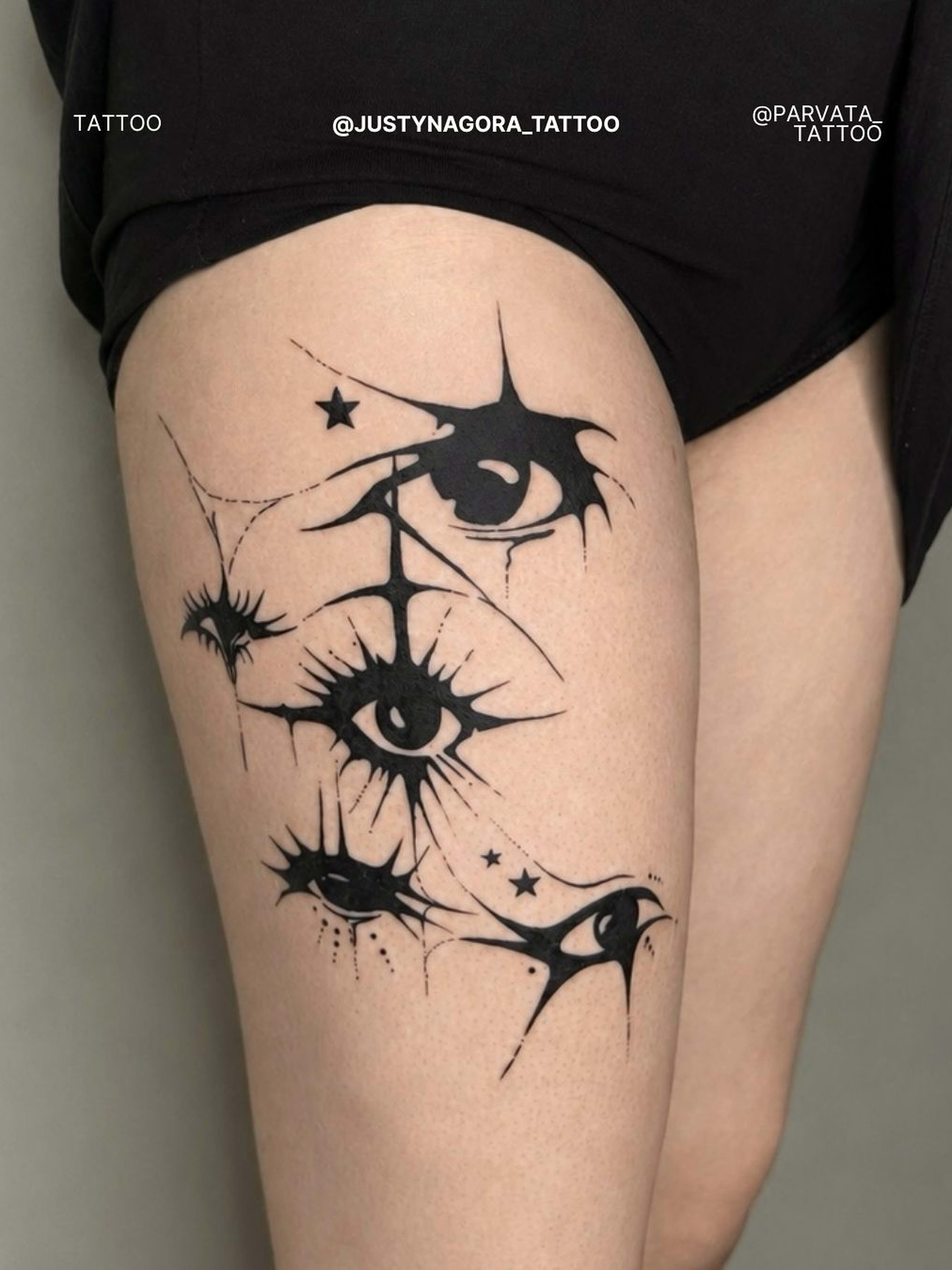
01Anatomy
The largest smooth surface the body has
- very high
- Skin thickness
- very low
- Nerve endings
- very low
- Bone proximity
The thigh is a thick quadriceps muscle covered by the thickest skin on the entire price list — 5 out of 5. The femur lies deep beneath layers of muscle and tissue, so we rate bone proximity at 1 out of 5, the lowest figure there is. The needle works on a base that transmits no vibration and does not change resistance every few centimetres.
There are fewer nerve endings here than at any placement we tattoo (1 out of 5). A thigh is not a precision instrument like a hand, and the body did not fit it with sensors — touch is registered coarsely here rather than pinpoint.
The front and outer thigh is practically flat across several dozen centimetres. That is a rarity: almost every other area of the body curves in at least one direction. Because of it, a design drawn on paper looks on the thigh exactly as it looked on the sketch, with no perspective correction.
The inner thigh behaves differently and we treat it separately: the skin there is noticeably thinner and more delicate, with more nerve endings. The sensation rises there appreciably, on the same thigh. If a project reaches the inner side, we plan that fragment deliberately rather than in passing.
02Pain
Four out of ten, with one exception
- 4/10
- Pain
- very low
- Nerve endings
- very high
- Skin thickness
The thigh scores 4 out of 10 — one of the lower values on the price list, though slightly higher than the forearm. The difference comes not from anatomy but from format: thigh pieces are usually large, and across several hours even a mild sensation accumulates.
The character itself is very bearable. Thick skin and no bone underneath mean there is neither the sharp burn familiar from the hand nor the resonance that appears on the ribs. Most people describe it as even warmth and light scratching that soon stops demanding attention.
The exception is the inner thigh. There the sensation can jump several levels, and it is the most common surprise we see with this placement — someone arrives for a calm session on the outer side, the design reaches inward, and suddenly it is a different conversation. That is why we always give warning before moving onto that area.
Because of the format, sessions here usually run two to six hours. On large projects we split the work, but more often because of size than endurance — the thigh is one of the few placements where a longer session is genuinely manageable.
03Composition
A flat board that fits a whole scene
- flat panel
- Design flow
- no
- Movement zone
A thigh works as a panel: a rectangular, flat field with clear borders. That is a completely different logic from the forearm, where a design runs along a narrow axis, and from the ribs, where it wraps the torso.
It means you can lay down a closed composition here — a scene with a foreground and a background, a portrait, an elaborate motif with a frame, a full illustration. The design does not have to adapt to anything or avoid anything, so the work starts from the drawing rather than from the shape of the surface.
The natural borders are convenient too: the hip above, the knee below, the line of the buttock behind. They frame the composition without needing to be drawn, and they let you plan where the piece ends so it does not look cut off when you sit down.
One thing to keep in mind when planning: a thigh looks different standing and sitting. A design positioned perfectly while lying down can crease unexpectedly with a bent knee. So we check the stencil in both positions before starting.
04Healing
Three to five weeks in very calm conditions
- 21–35 days
- Healing
- ~32 days
- Epidermis turnover
- very low
- Friction
Healing takes three to five weeks, and the epidermis on the thigh renews in about 32 days — the longest of any placement. The longer cycle is not a drawback: slower renewal is one of the reasons pigment holds so well here.
We rate friction at 1 out of 5, the lowest figure. A thigh does not work at gripping like a hand, does not rub against bedding like a back, and does not meet a shoe like a foot. The biggest challenge in aftercare is ordinary trousers, and mainly in the first week.
In practice, healing a thigh is among the simplest we see — provided the first few days fall in loose clothing.
- Loose trousers or shorts for the first week; jeans clinging to fresh work are the one real problem here.
- If you work sitting down, get up more often — long periods seated on the inner thigh make it harder for air to reach the healing skin.
- Put cycling and running aside for about ten days: that is movement where the thighs rub against each other and against fabric.
- Pools only after full healing, exactly as with every other placement.
- If the piece reaches the inner side, give up tight leggings while it heals — the skin is thinnest there and easiest to irritate.
05Longevity
Seven percent touch-ups — the best result on the list
- 7% of pieces
- Touch-up rate
- very low
- Sun exposure
- very low
- Blowout risk
Touch-ups after healing affect about 7% of thigh pieces. That is the lowest figure on the entire Parvata Tattoo price list — for comparison, the forearm sits at 10%, the ribs at 20% and the hand at 60%. Everything contributes at once: thick skin, no friction, a stable base and low blowout risk.
Sun exposure here is 1 out of 5, the same as the ribs. The thigh stays covered for most of the year, and sunscreen only needs applying in summer, with shorts and on the beach. Which means the main cause of tattoo fading has practically no room to act.
The conclusion is simple and worth stating plainly: if the only question is where a tattoo will age best with the least effort on your part, the thigh is the best answer we have.
There is one caveat, though, and it concerns your silhouette rather than the ink. We write about it in the next section, because it is the only genuine risk of this placement.
06Risks
Skin stretching — the one serious caveat
- very high
- Skin stretching
- very low
- Blowout risk
- very high
- Skin thickness
We rate skin stretching on the thigh at 5 out of 5, the highest of any placement. Thigh circumference changes with weight swings, with building muscle mass and in pregnancy more than any other tattooed surface. The skin stretches along with it, and the design stretches too.
In practice it looks like this: with moderate changes you will see nothing. With larger ones — a dozen or more kilograms either way — the composition can distort slightly, and it shows most on designs built from regular geometry and on circles. Organic motifs, botanical work and realism take it considerably better, because they have no perfect symmetry to betray a shift.
So on large projects we ask directly about plans. If a pregnancy or a serious change in silhouette is coming, it is sometimes worth waiting or choosing a motif less vulnerable to distortion. That is not a contraindication, it is information that ought to arrive before the design rather than two years after it.
Beyond that, the thigh is an exceptionally safe placement. Blowout risk is 1 out of 5 — the lowest on the list — because thick skin gives a wide depth window in which the needle works correctly. It is one of the few placements where very fine linework genuinely holds for years.
07Styles
A placement where technique has no limits
- very high
- Skin thickness
- very low
- Blowout risk
The thigh is the only placement where we do not have to advise against anything for technical reasons. A flat surface, thick skin and minimal blowout risk mean every technique performs here the way it was designed to.
Realism and portraiture come out better on the thigh than anywhere else. They need a large flat area and the ability to build soft tonal transitions, and both conditions are met at once. The same goes for elaborate scenes and illustrations with a background.
Fine line and micro-detail, which we advise against on the hand, hold very well on the thigh — thick skin does not spread the stroke and the absence of friction does not wear it away. If you have your heart set on a subtle, precise design meant to last a decade, this is the surface for it.
Blackwork, ornament and large areas of solid black also sit here without reservation, and benefit from the format along the way. The one thing worth thinking through is not technique but symmetry — because of stretching, regular geometry is a shade more demanding here than an organic form.
08Everyday life
Covered most of the year, revealed on your own terms
- very high
- Coverability
- very low
- Sun exposure
Coverability on the thigh is 5 out of 5. Trousers, a knee-length skirt, workwear — everything covers this placement completely. There is no conversation here about your job or about first impressions at a meeting.
At the same time the thigh gets revealed more often than the ribs: in summer, at the pool, on the beach, in shorts. That is a good compromise for people who want a large, visible piece but do not want to show it every day to everyone. You decide when it is on view.
In daily use a healed thigh tattoo asks for nothing. It does not interfere with sport, does not change how you dress and needs no ongoing care. Sunscreen only matters on the days you actually wear shorts.
One small note: work reaching the inner thigh can be a shade more noticeable during long walks in the heat, when the thighs rub together. That applies only to the healing period, however, not to a healed tattoo.
09First tattoo
A good choice to start with, if you want something larger straight away
- 4/10
- Pain
- 7% of pieces
- Touch-up rate
- very high
- Coverability
After the forearm, the thigh is the placement we most often propose for a first tattoo — and for a first large tattoo we name it first.
The reasons are concrete: pain at 4 out of 10, touch-ups on 7% of pieces, healing that does not restrict daily life, and full coverability, so the decision carries no professional consequences at all. If someone is unsure how those around them will react, the thigh lets the decision be made without that factor.
There is a difference against the forearm worth knowing. You see a forearm every day, and that helps enormously through the first weeks of healing, when the skin looks different from how it will end up. You do not have a thigh in front of you all day, so a first tattoo here asks for a little more trust in the process.
In exchange it gives something the forearm cannot: room for a project that does not need simplifying. If you have something elaborate in mind from the start, beginning with a small motif on an arm can be the long way round — it is easier to start where the idea fits whole.
10Nearby placements
The thigh among large formats and against the lower leg
- 4/10
- Pain
- 7% of pieces
- Touch-up rate
The thigh belongs to the same group as the back and the ribs — placements where large compositions fit. The differences between them are considerable, though, and worth knowing before a decision is made.
The ribs are the exact opposite of the thigh in every technical dimension: 9 out of 10 for pain instead of 4, the thinnest skin instead of the thickest, 20% touch-ups instead of 7%. Both surfaces are fully coverable and both shield a tattoo from the sun, so if you are choosing between them purely on format, the thigh is simply an easier route to the same goal.
The back gives a still larger surface and has a similarly low touch-up rate (8%), but it is a placement you cannot see at all without a mirror and a camera. A thigh stays in your field of view when you sit down — a practical difference that many people find matters more than the number of centimetres.
The natural neighbour of the thigh is the leg below the knee. The two are joined on large pieces covering a whole limb, but their geometry differs: a thigh is a flat board, while the calf and shin return to a lengthwise arrangement closer to the forearm.
11Price
The cheapest square centimetre and the lowest cost over time
- 2–6 h
- Typical session
- 7% of pieces
- Touch-up rate
The hourly rate at Parvata Tattoo is the same regardless of placement — the thigh carries neither a difficulty surcharge nor a discount, and the smallest projects start just as everywhere else, from 300 PLN. Even so, a large piece usually comes out cheaper here, and it is worth knowing why.
Pace decides. On stable, thick skin the needle covers ground faster, there is no need to correct depth every few centimetres and no need for extra breaks. The same number of square centimetres genuinely takes fewer hours on a thigh than on the ribs or the hand. Because you pay for time rather than area, that translates directly into the figure.
The second saving is spread across years and few people factor it in when choosing a placement. At 7% touch-ups, a thigh tattoo generates no post-session cost in the vast majority of cases. On a hand, where six pieces in ten come back, a top-up visit is something to reckon with from the start. Two tattoos at the same initial price can therefore carry entirely different costs over several years.
Large compositions covering a whole thigh are spread across sessions of two to six hours. A custom design and the post-healing check-up are included — and with this placement the check-up is most often where it ends. Current rates are on the price list, and we give a binding figure after a free consultation, once we can see the size and the density of detail.
Nearby placements
- ribsThe same format, opposite conditions: 9 out of 10 for pain instead of 4, the thinnest skin instead of the thickest and three times more touch-ups. Both surfaces are fully coverable, so the difference comes down to how much of that you want.
- legThe other half of the same limb, with different geometry: a thigh is a flat board, while the calf and shin return to a lengthwise arrangement. For work covering the whole leg we plan both sections together.
- backAn even larger surface with a similarly low touch-up rate, but a back cannot be seen without a mirror. A thigh stays in your field of view when you sit — for many people that matters more than the number of centimetres.
Styles that look great in this spot


Frequently asked questions
Moderately — on the scale used at Parvata Tattoo the thigh scores 4 out of 10. There are fewer nerve endings here than at any placement we tattoo, and the femur lies deep beneath a thick layer of muscle, so there is neither the sharp burn familiar from the hand nor the resonance that appears on the ribs. Most people describe it as even warmth and light scratching that soon stops demanding attention. The value being slightly higher than the forearm comes not from anatomy but from format: thigh pieces are usually large, and across several hours even a mild sensation accumulates. There is one exception we always flag — the inner thigh has thinner skin and more nerve endings, so the sensation there can jump several levels.
This is the one serious caveat about the placement. We rate skin stretching on the thigh at 5 on a five-point scale, the highest of any location — thigh circumference changes with weight swings, with building muscle mass and in pregnancy more than any other tattooed surface. With moderate changes you will see nothing. With a dozen or more kilograms either way the composition can distort slightly, and it shows most on designs built from regular geometry and circles. Organic motifs, botanical work and realism take it considerably better, having no perfect symmetry to betray a shift. That is why we ask about plans on large projects, before there is a sketch.
The thigh is the only placement where Parvata Tattoo does not have to advise against any technique for technical reasons — a flat surface, the thickest skin on the list and blowout risk at 1 out of 5 mean every method performs the way it was designed to. Realism and portraiture use that best, needing a large flat area and soft tonal transitions; both conditions are met at once. Elaborate scenes with a background and full illustrations also have room to spread. Fine line and micro-detail, which we advise against on the hand, hold for years on a thigh, because thick skin does not spread the stroke and the absence of friction does not wear it away. Blackwork and large areas of solid black sit here without reservation.
Three to five weeks, and the epidermis in this area renews in about 32 days — the longest of any location on the Parvata Tattoo price list. The longer cycle is not a drawback: slower epidermal renewal is one of the reasons pigment holds exceptionally well here. Healing itself is among the simplest we see, because we rate friction at 1 on a five-point scale, the lowest figure there is. A thigh does not work at gripping like a hand, does not rub against bedding like a back and does not meet a shoe like a foot. The one real challenge is clinging trousers in the first week, which is why we ask for loose clothing then. Cycling and running are worth setting aside for about ten days.
No — in this respect it is the best placement we have. Touch-ups after healing affect about 7% of thigh pieces, the lowest figure on the entire Parvata Tattoo price list; for comparison the forearm sits at 10%, the ribs at 20% and the hand at 60%. Everything contributes at once: the thickest skin, no friction, a stable base and minimal blowout risk. We rate sun exposure here at 1 on a five-point scale, the same as the ribs, because a thigh stays covered for most of the year — and ultraviolet light is the main factor stripping contrast from tattoos. Sunscreen only needs applying in summer, with shorts and on the beach.
Yes, and for a first large tattoo we name it first. The reasons are concrete: pain at 4 out of 10, touch-ups on 7% of pieces, healing that does not collide with daily life, and coverability of 5 out of 5, so the decision carries no professional consequences. If someone is unsure how those around them will react, the thigh lets the decision be made without that factor. There is one difference against the forearm worth knowing: you see a forearm every day, which helps enormously through the first weeks of healing, when the skin looks different from how it will end up. In exchange the thigh gives room for a project that needs no simplifying — if you have something elaborate in mind from the start, it is easier to begin where the idea fits whole.
More about the studio
Have an idea for a tattoo in this spot?
Book a free, no-obligation consultation — we will match an artist and design the motif for your body.