18 min readupdated
Tattoo by placement
Hand tattoo — Wrocław
The hand is the most demanding placement we tattoo, and there is no point softening that. The epidermis renews itself here in about 14 days — twice as fast as on the forearm — so the skin is literally removing pigment faster than it can hold it. Six pieces in ten come back for a touch-up.
We put that at the very top, because a hand tattoo is done once and lived with daily. If you still want it after reading this page, we will do it properly and prepare you for what the next year looks like. If you change your mind, this page did its job just as well.
- 9/10
- Pain
- 10–21 days
- Healing
- 60% of pieces
- Touch-up rate
- 1–3 h
- Typical session
The first touch-up after healing is included in the price.
over 200 tattoos done5 on Google (40 reviews)
Our work: hand
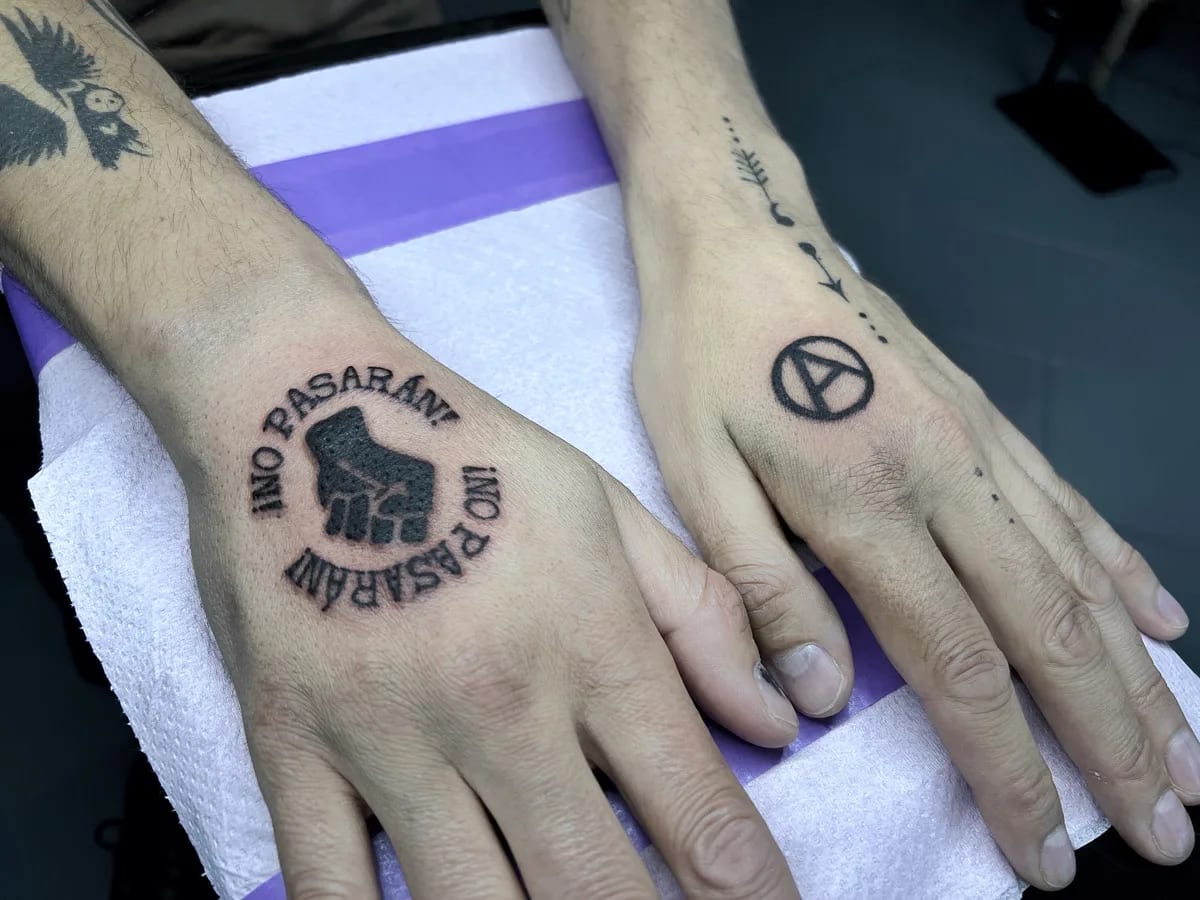
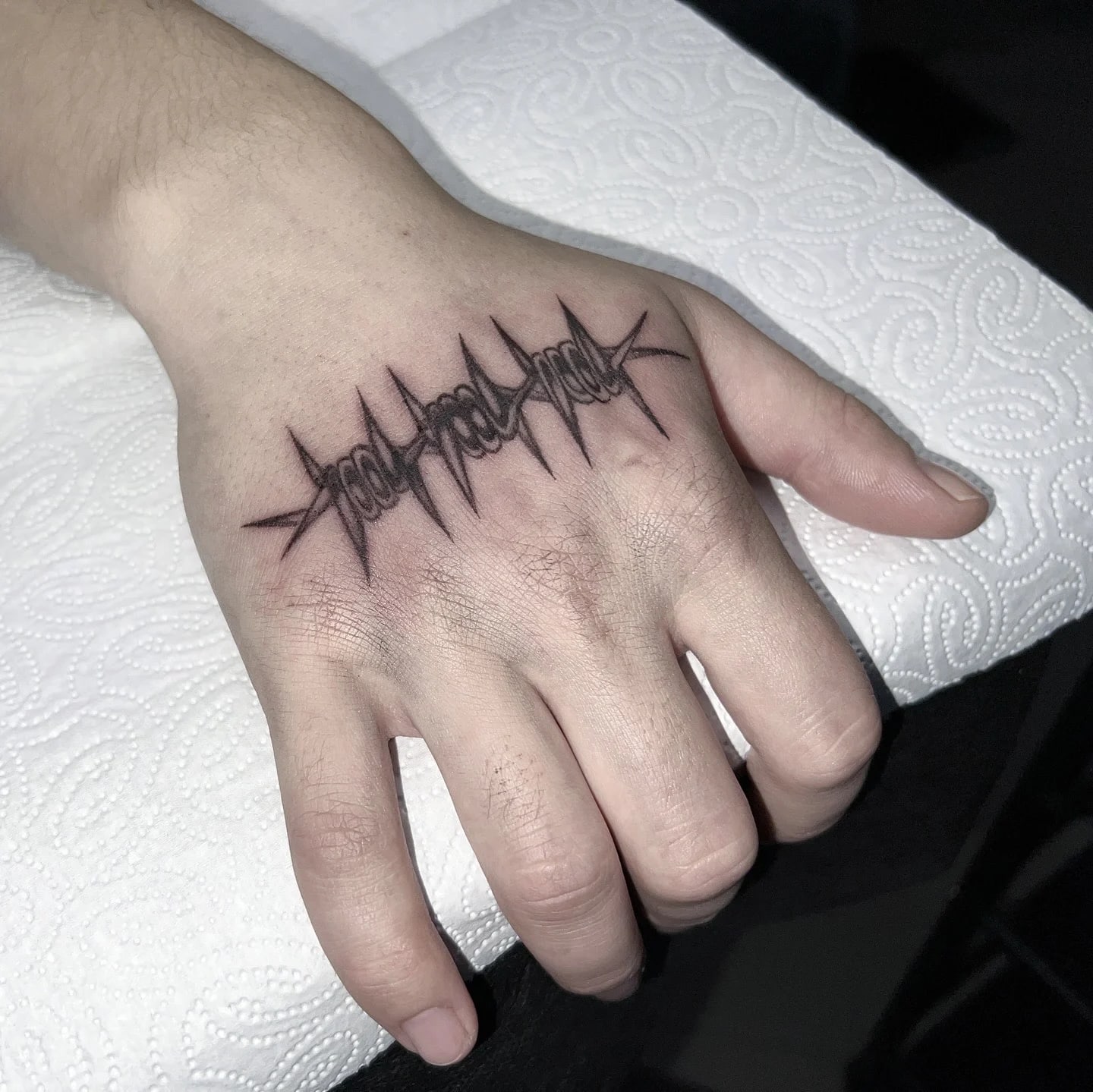
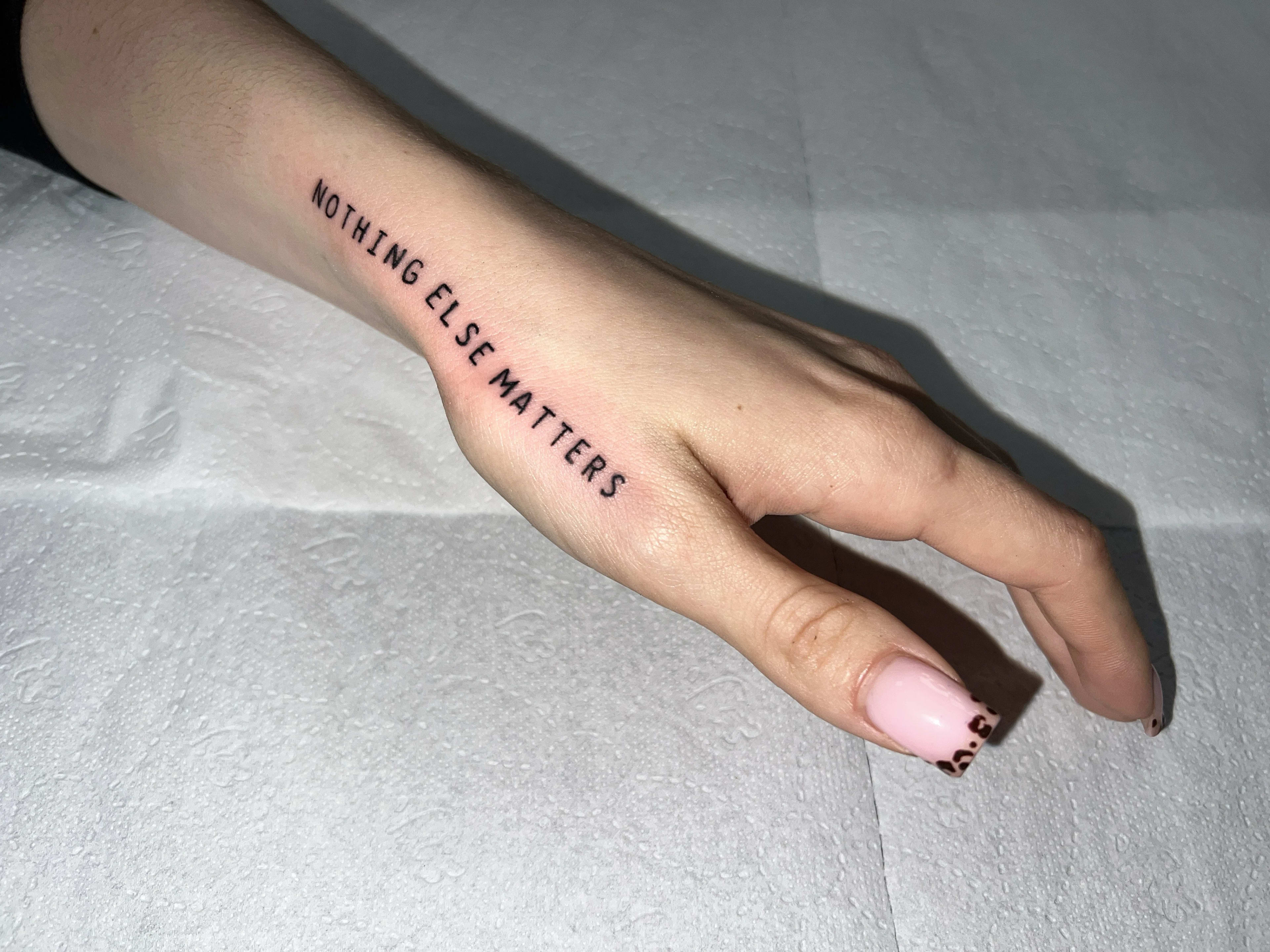

01Anatomy
The back holds ink, the palm barely does
- low
- Skin thickness
- very high
- Bone proximity
- very high
- Nerve endings
For tattooing purposes the hand splits into three areas that behave completely differently. The back of the hand is thin skin stretched directly over the tendons and metacarpal bones — we rate thickness at 2 on a five-point scale and bone proximity at 5. There is no layer of muscle to cushion the needle.
Fingers offer even less material: narrow surfaces curved in two directions, with joints that bend several thousand times a day. The sides of the fingers hold ink worst of anywhere on the body.
The palm is its own category and we say so plainly: palmar skin is built differently from the rest of the body, sheds constantly and holds practically no pigment. A tattoo on the palm breaks up into patches within a few months in most cases. We do not refuse on principle, but we do not promise durability this skin does not have.
We rate nerve ending density here at 5 out of 5, and that is no accident. The hand is a precision instrument — the body packed it with sensors more densely than almost any other surface, to make grip and touch recognition possible. The same density that lets you feel the texture of paper is what makes the needle so audible here.
02Pain
Nine out of ten — tied for the highest on our list
- 9/10
- Pain
- very high
- Nerve endings
- very high
- Bone proximity
The hand scores 9 out of 10 and shares that position with the foot and the ribs. All three causes stack here at once rather than cancelling out: maximum nerve density, bone directly under the skin, and the absence of any fatty layer.
The sensation differs from the forearm — it is nothing like scratching. Over the metacarpal bones a vibration appears that carries through the whole hand, and at the fingers it becomes a sharp, pinpoint burn. Sessions are short not because the projects are small, but because few people tolerate longer ones without losing their calm, and a tense hand makes even work harder.
The practical consequence: we work in shorter blocks and plan breaks more often than anywhere else. A typical hand session runs one to three hours and rarely benefits from being extended. Better to come back than to finish on an exhausted hand — muscle tremor genuinely degrades a line.
One thing worth hearing early: this is not a placement for a first tattoo. Not because you need to prove something first, but because it helps to know how your skin reacts and how you react before stepping onto the hardest ground.
03Composition
The design radiates outward, it does not run in a line
- radial
- Design flow
- yes
- Movement zone
The hand has no long axis to carry a motif along. It has a centre and five directions spreading out from the wrist — which is why the compositions that work here are radial, or symmetrical about the middle of the back of the hand.
Motifs built around a single centre do best: mandalas, rosettes, geometric ornament, forms closed inside a circle or a diamond. A design with a clear top and bottom only looks right in one hand position — and you view your hand from every angle, in every orientation.
We treat fingers as separate fields, not as an extension of the back of the hand. A motif crossing from the back onto a finger breaks at the joint and after a year reads as two different tattoos. Where continuity is wanted, we run it along the side rather than across the bend.
The joints are a movement zone and the biggest compositional unknown. The skin over them folds and stretches every time you close your fist, so precise detail placed exactly on a knuckle disappears into a crease. We design so the joints fall in the gaps of the pattern rather than at its centre.
04Healing
Ten to twenty-one days under constant load
- 10–21 days
- Healing
- ~14 days
- Epidermis turnover
- very high
- Friction
Healing usually takes ten to twenty-one days — shorter than the forearm, and that is not good news. The shorter timeline comes from the same accelerated skin metabolism that later pushes the pigment out.
The problem with healing a hand is not the duration but the fact that you cannot set it aside. We rate friction here at 5 out of 5: you wash your hands more than a dozen times a day, you grip, you open doors, you hold a phone, you put your hands in pockets. Each of those takes off a little fresh epidermis.
Hand aftercare therefore needs more discipline than any other placement, and it needs it for the whole healing period, not just the first three days.
- After every hand wash, dry the tattoo and apply a thin layer of cream — otherwise repeated soaking dries out fresh work more than anything else.
- Disposable gloves for washing up and cleaning for the first two weeks; detergent stings on a fresh tattoo and flushes out pigment.
- No work gloves, no gym and nothing requiring a firm grip for at least ten days — gripping abrades exactly the surface the design sits on.
- Do not put a freshly tattooed hand in your pocket; the fabric rubs with every step, and that is the most common cause of the worn patches we see at check-ups.
- If you work with your hands or in hospitality, book the session so the first week falls outside your schedule. This is the only placement where we ask for that.
05Longevity
Six pieces in ten come back for a touch-up
- 60% of pieces
- Touch-up rate
- ~14 days
- Epidermis turnover
- very high
- Friction
This is the most important number on this page: touch-ups after healing affect about 60% of hand tattoos at Parvata Tattoo. For comparison, the forearm sits at 10% and the back at 8%. A six- and sevenfold difference does not come from technique, it comes from the biology of this specific placement.
The mechanism is simple. The epidermis of the hand renews in about 14 days, twice as fast as on the forearm. Pigment sits in the dermis, but every layer above it is in constant motion, and the body continually removes particles it treats as foreign. Add friction from the outside and the result is worn patches, broken lines and black faded to grey — most often on the sides of the fingers and across the knuckles.
We do not treat this as a failure but as part of the plan. With a hand we assume from the outset that you will come back for a check-up and most likely for a top-up — the terms of which we agree at the consultation, before we start, so there are no surprises. A hand tattoo is not a one-off event; it is something you maintain.
There is sun on top of that: we rate exposure here at 4 out of 5, because hands on a steering wheel and on top of your clothing collect ultraviolet all year round. Factor 50 on a healed tattoo matters as much as on the forearm, only it is harder to keep up, since it comes off with every hand wash.
06Risks
Blowout and blurred detail — the two most likely outcomes
- very high
- Blowout risk
- low
- Skin thickness
- low
- Skin stretching
We rate blowout risk on the hand at 5 out of 5 — the highest of any placement. The skin is thin, and beneath it sit tendons and bone rather than muscle, so the depth window in which the needle works correctly is exceptionally narrow here. Go slightly too deep and pigment spreads along the tissue, leaving the line with a bluish halo.
That risk comes down mostly to experience and pace. On a hand you work more slowly and more shallowly than on an arm, and every pass is treated separately. It cannot be reduced to zero, though — which is why, for projects built on very fine linework, we say plainly that the hand is not a good base for them.
The second risk is blurred detail, and it is unavoidable. A design with a dense mesh of thin lines, small lettering or micro-ornament merges into a patch after a year on the hand. So we design thicker and simpler here than we would on a forearm: a stronger stroke, wider gaps, fewer elements. The design that seems too sparse on paper is usually the one that still looks deliberate two years later.
Skin stretching, by contrast, is a minor issue here (2 out of 5) — a hand does not change in circumference with weight swings the way a stomach or a thigh does. That is one of the few things you do not have to worry about on a hand.
07Styles
What survives on a hand and what falls apart
- low
- Skin thickness
- radial
- Design flow
Choosing a technique for the hand is not a matter of taste but of predicting how the design will look in three years. There is one rule: the stronger the line and the wider the gap, the longer the piece holds up.
Blackwork and ornament built on a clear, heavy line do best — mandalas, geometry, tribal motifs, strong outlines. These designs have margin: even as the line spreads slightly over time, the composition still reads from a distance. Coarser dotwork also copes well, provided the points are not packed too tightly.
Fine line, micro-realism, small lettering and delicate shading we advise against, and we say so openly before there is a sketch. Not because they cannot be done — they can, and on the day of the session they look superb. The point is that these are techniques designed for stable skin, and a hand is not stable. If you have your heart set on a subtle design, we more often suggest moving it to the forearm and putting something on the hand that will actually survive there.
Colour holds worse than black on a hand, and lighter pigments worst of all. For colour work we assume more frequent topping up from the outset.
08Everyday life
You cannot cover this — and that is the whole decision
- very low
- Coverability
- high
- Sun exposure
Coverability on the hand is 1 out of 5, the lowest figure on the entire price list. No item of clothing hides it. Gloves are out in an office job, a long sleeve does not reach, and the hand is the part of you that goes out for a handshake and rests on the table.
So a conversation about a hand tattoo is in practice a conversation about your profession and the next few years. Some industries still react to visible tattoos — medicine, law, parts of corporate life, client-facing work in certain sectors. We do not judge that and we do not talk anyone out of it, but we do ask at the consultation, because we would rather the thought arrived before the session than after.
The other side of the same coin: you see your hand more often than any other part of your own body, in every position and all day long. For many people that is precisely the reason — a tattoo that is hidden from nobody, including you.
One more thing in daily use: sunscreen and moisturiser become permanent rather than seasonal. A hand loses moisture with every wash, and dry skin makes a healed tattoo look more worn than it really is.
09First tattoo
Why we advise against the hand as a starting point
- 9/10
- Pain
- 60% of pieces
- Touch-up rate
- 1–3 h
- Typical session
If this would be your first tattoo, we will say so plainly at the consultation: start somewhere else. This is not a matter of principle or of testing your resolve.
The first reason is practical. With a first tattoo you do not yet know how your skin heals, how you handle a longer stretch under the needle, or how your pigment looks after a month. The hand, at 9 out of 10 for pain and 60% for touch-ups, is the worst possible place to gather that information.
The second reason matters more. A first tattoo is also learning to work with the person making it — agreeing on the design, the size, the direction. That goes far more easily on a forearm, where the session is calm, the outcome predictable, and a misjudged size can be corrected with the next element.
So at a first visit we most often propose the reverse order: start with the forearm or the upper arm, and come back to the hand once the first piece has healed. If you still want it after that experience, you go into it with realistic expectations — and that is the only way a tattoo like this works out.
10Nearby placements
The hand in the scale of the whole arm
- 60% of pieces
- Touch-up rate
- ~14 days
- Epidermis turnover
The hand is the end of the arm and at the same time its most demanding section. The gap against its neighbours is wide enough that it is worth seeing in numbers before you decide.
The forearm begins fifteen centimetres higher and belongs to another world in terms of durability: 10% touch-ups instead of 60%, an epidermis renewing in 28 days instead of 14, pain at 3 out of 10 instead of 9. A single wrist joint stands between them, and on either side of it a tattoo ages completely differently. If you want a design that ages calmly, the forearm will do that for you on its own.
The foot is the only placement with a comparable profile — also 9 out of 10 for pain, also an epidermis renewing in 14 days, and touch-ups even more frequent than on the hand. Anyone considering one should usually read about the other, because the conclusions are identical.
If you are thinking of the hand as the closing element of something larger — a sleeve, or work reaching down from the shoulder — it is worth starting with a view of the whole limb, because the order of sessions matters for the composition.
11Price
What goes into pricing a hand
- 1–3 h
- Typical session
- 60% of pieces
- Touch-up rate
We price a hand tattoo like any other — by working time, not by the legend of a difficult placement. The smallest projects start at Parvata Tattoo from 300 PLN, the rate for a minimalist tattoo. A typical piece on the back of the hand closes within one to three hours.
The real difference against other placements is not in the rate but in the fact that with a hand we plan for a longer relationship. A custom design and the post-healing check-up are included exactly as everywhere else, but for this placement we additionally assume a top-up visit — its scope and terms agreed at the consultation, before the session rather than after the fact.
We give a binding figure only after a free consultation. With a hand that consultation matters more than anywhere else, because half the conversation is not about price but about whether the chosen design suits this placement at all. A deposit of 100–500 PLN secures the date and comes off the final price in full.
Nearby placements
- forearmOne joint of difference, and touch-ups drop from 60% to 10%, pain from 9 to 3. If you are torn between the hand and the forearm, that gap is the whole answer.
- armThe hand is where the arm ends. For anything larger, or a sleeve, it is worth seeing all three sections side by side first and planning the order of sessions.
- footA twin profile at the other end of the body: the same nine out of ten for pain, the same fourteen-day epidermis and touch-ups more frequent still. Anyone considering the hand should know those numbers too.
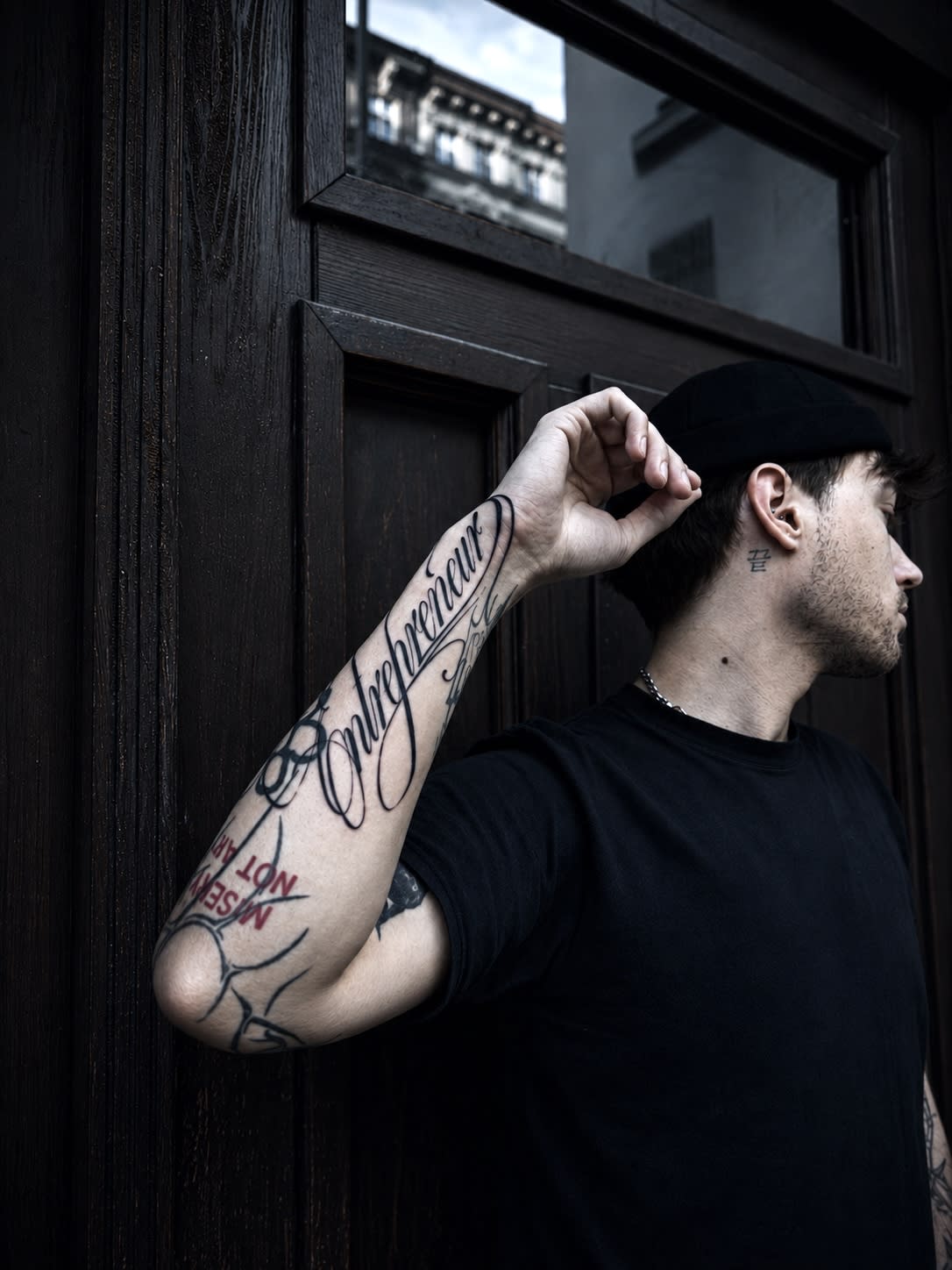
Styles that look great in this spot


Frequently asked questions
Yes, and it is the single most important thing to know before deciding. The epidermis of the hand renews in about 14 days, twice as fast as on the forearm, so the skin removes pigment faster than it can hold it. On top of that comes friction, which we rate at Parvata Tattoo at 5 on a five-point scale: hand washing, gripping, pockets and work all abrade exactly the surface the design sits on. The result is worn patches, broken lines and black faded to grey, most often on the sides of the fingers and across the knuckles. At Parvata Tattoo touch-ups affect around 60% of hand tattoos against 10% on the forearm. We do not treat that as a failure but as part of the plan — with a hand we assume a top-up visit from the start and agree its terms before the session.
We say it plainly: palmar skin is built differently from the rest of the body, sheds constantly and holds practically no pigment. A palm tattoo breaks up into illegible patches within a few months in most cases, regardless of technique and of who did it. At Parvata Tattoo we do not refuse such work on principle, but we do not promise durability this skin physically does not have, and we always say so before the session. If you want a motif in that area, we more often suggest moving it to the back of the hand or to the inner wrist, where the skin behaves predictably. That is a conversation we would rather have over the design than over a touch-up.
On the scale used at Parvata Tattoo the hand scores 9 out of 10 and shares that value with the foot and the ribs. All three causes of tattoo pain stack here at once: we rate nerve ending density at 5 out of 5, the bone lies directly beneath thin skin, and the layer of muscle that would cushion the needle simply is not there. The sensation differs from the forearm — over the metacarpal bones a vibration carries through the whole hand, and at the fingers it turns into a sharp, pinpoint burn. That is why hand sessions are planned short, usually one to three hours, with more frequent breaks than anywhere else. It is not about endurance: a tense, tired hand shakes, and shaking genuinely degrades line quality.
There is one rule: the stronger the line and the wider the gaps, the longer the piece holds up. Blackwork and ornament built on a clear, heavy line do best — mandalas, geometry, tribal motifs and strong outlines. Such designs have margin, so even as the line spreads slightly over time the composition still reads from a distance. Fine line, micro-realism, small lettering and delicate shading we advise against at Parvata Tattoo openly, before there is a sketch. Not because they cannot be executed — on the day of the session they look superb. They are, however, techniques designed for stable skin, and a hand is not stable. Colour holds worse than black here and pale pigments worst of all, so for colour work we assume more frequent topping up.
No. We rate hand coverability at 1 on a five-point scale, the lowest figure on the entire Parvata Tattoo price list — no item of clothing hides it. A long sleeve does not reach, and the hand is the part of you that goes out for a handshake and rests on the table. So a conversation about a hand tattoo is in practice a conversation about your profession and the next few years: some industries still react to visible tattoos, particularly medicine, law and client-facing work in certain sectors. We do not judge that and we talk nobody out of it, but we do ask at the consultation, because we would rather the thought arrived before the session than after. For many people the impossibility of hiding it is the reason, not the obstacle.
We advise against it and say so plainly at the consultation. The reason is not symbolic — it is about information you do not yet have with a first tattoo. You do not know how your skin heals, how you handle a longer stretch under the needle, or how your pigment looks after a month, and the hand at 9 out of 10 for pain and 60% for touch-ups is the worst possible place to gather that experience. The second reason is practical: a first tattoo is also learning to collaborate on design, size and direction, and that goes far more easily on a forearm. So at Parvata Tattoo we most often propose the reverse order — the forearm or upper arm first, returning to the hand once the first piece has healed.
More about the studio
Have an idea for a tattoo in this spot?
Book a free, no-obligation consultation — we will match an artist and design the motif for your body.