17 min readupdated
Tattoo by placement
Forearm tattoo — Wrocław
Your forearm is the one place you look at several hundred times a day — at the wheel, at the keyboard, around a coffee cup. That is unusual: most tattoos are seen in a mirror or in photographs, while this one sits in front of you all the time. It is why the forearm is so often a first tattoo, and why it is so rarely regretted. The decision gets made in full knowledge that you will be looking at it.
It is also the most sun-exposed placement on our price list — 5 out of 5. The skin here is thick and forgiving, the bone lies deep, friction is negligible, so it heals calmly and needs a touch-up less often than almost anywhere else. Which means the whole question of how this tattoo ages is settled not at the needle, but in summer.
- 3/10
- Pain
- 14–28 days
- Healing
- 10% of pieces
- Touch-up rate
- 1–4 h
- Typical session
The first touch-up after healing is included in the price.
over 200 tattoos done5 on Google (40 reviews)
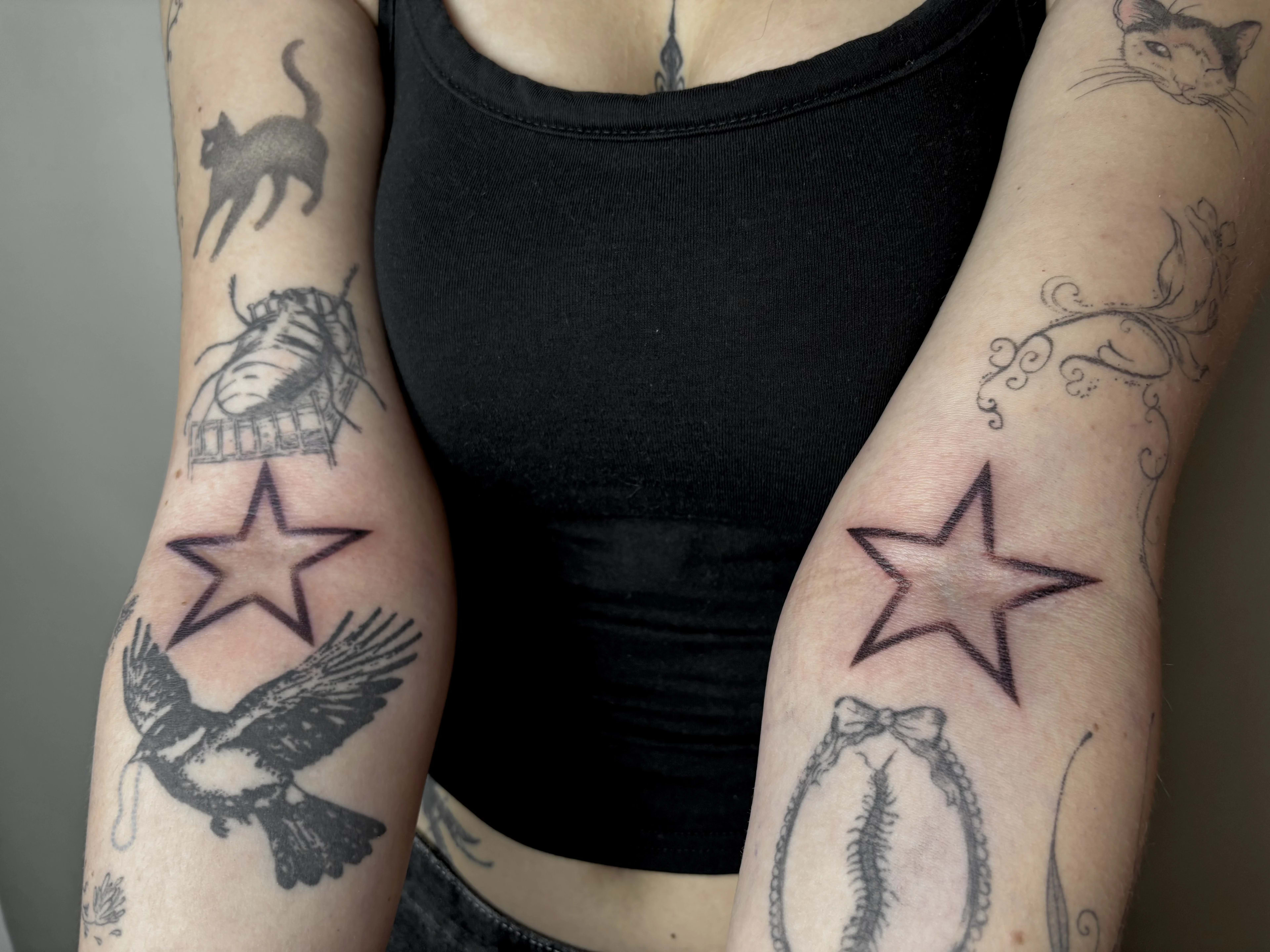
Our work: forearm
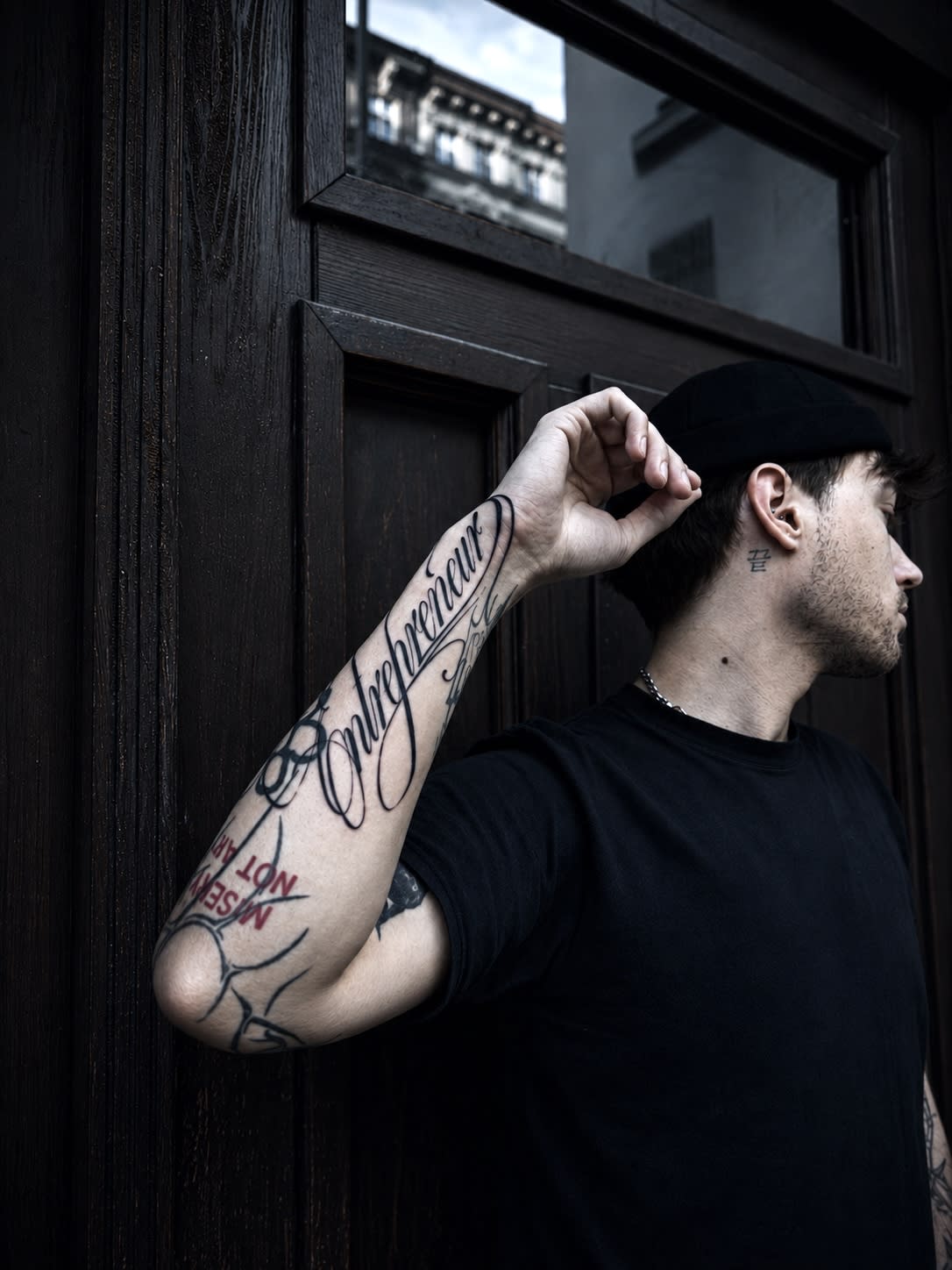

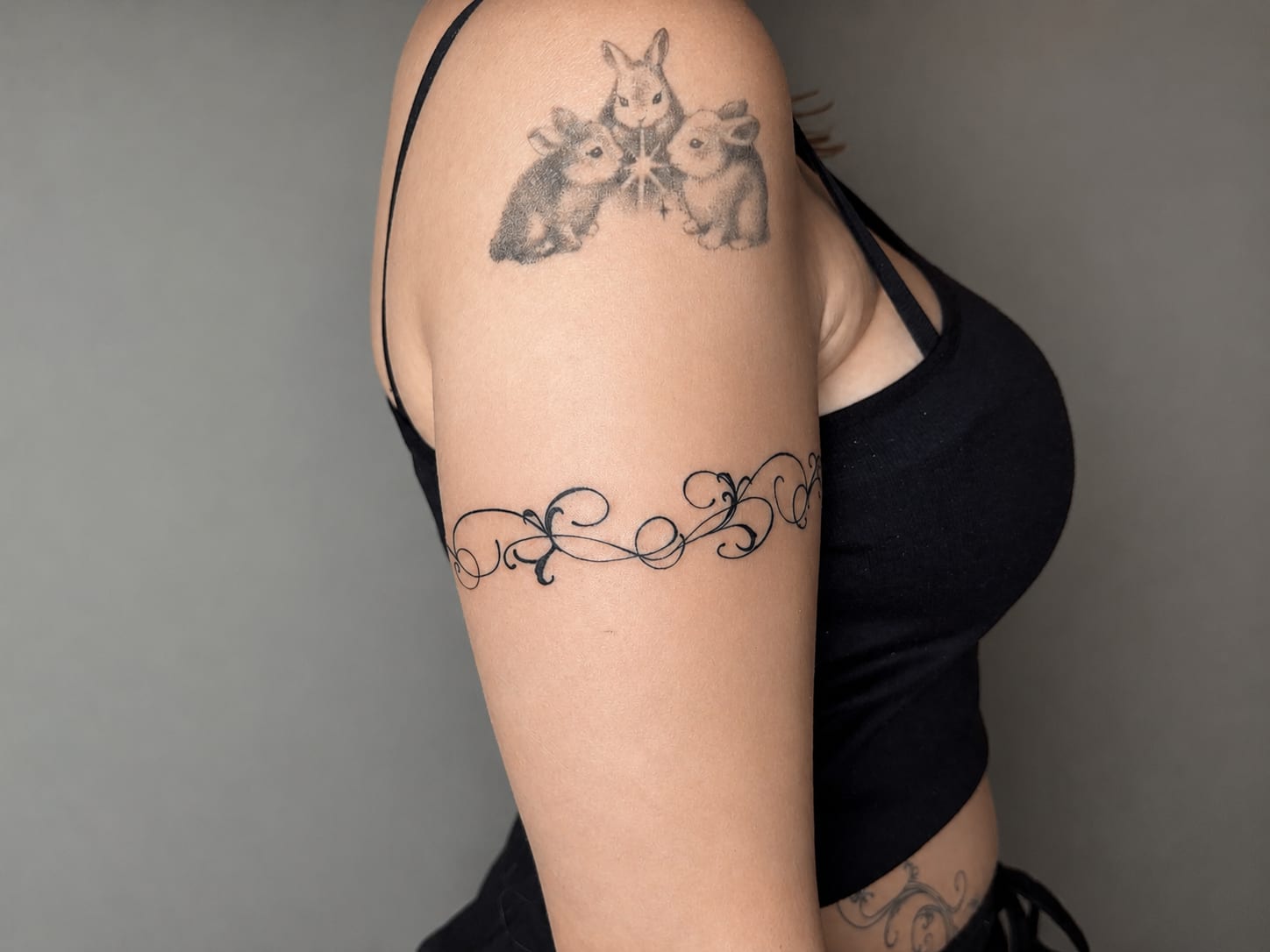
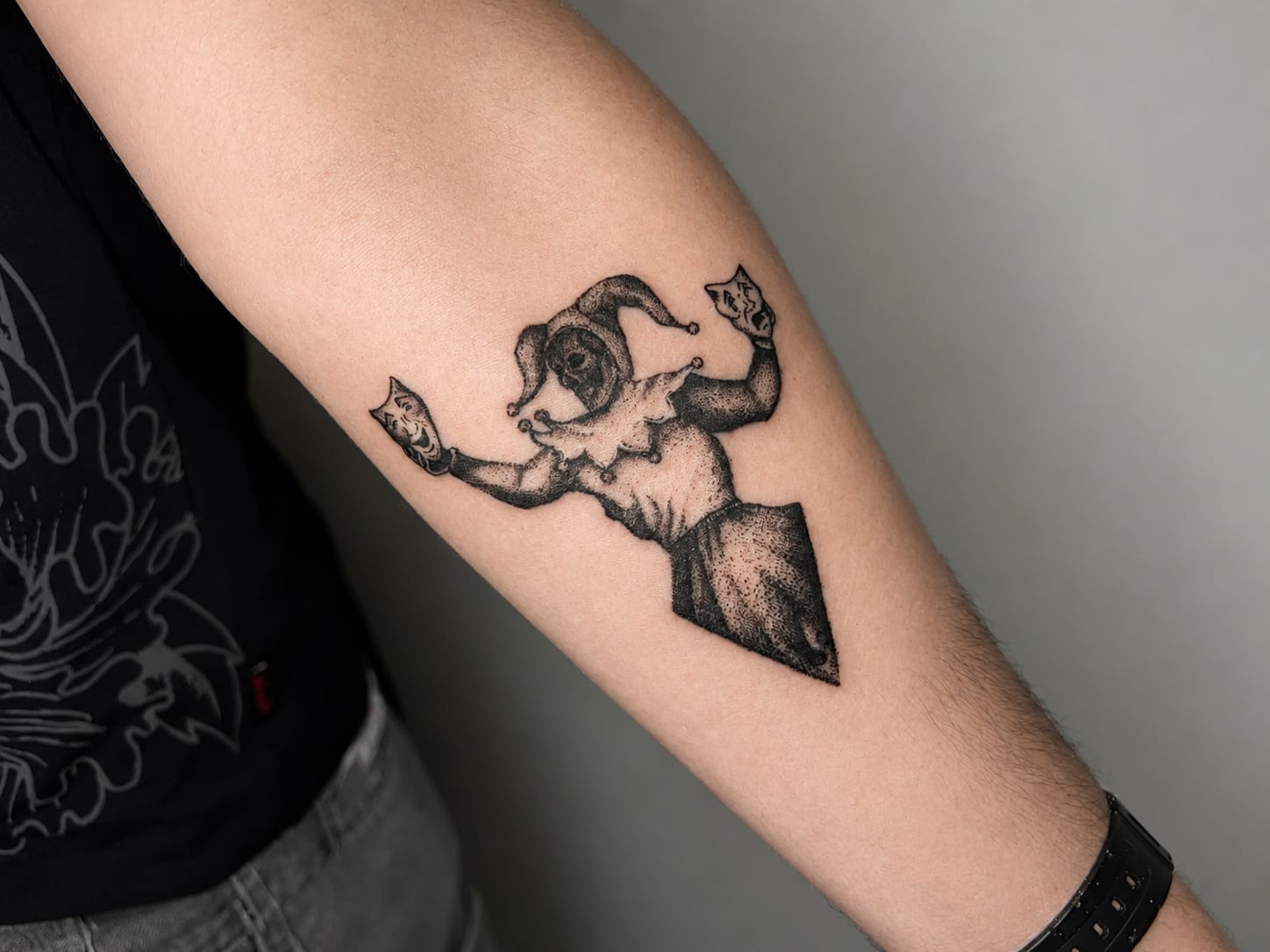
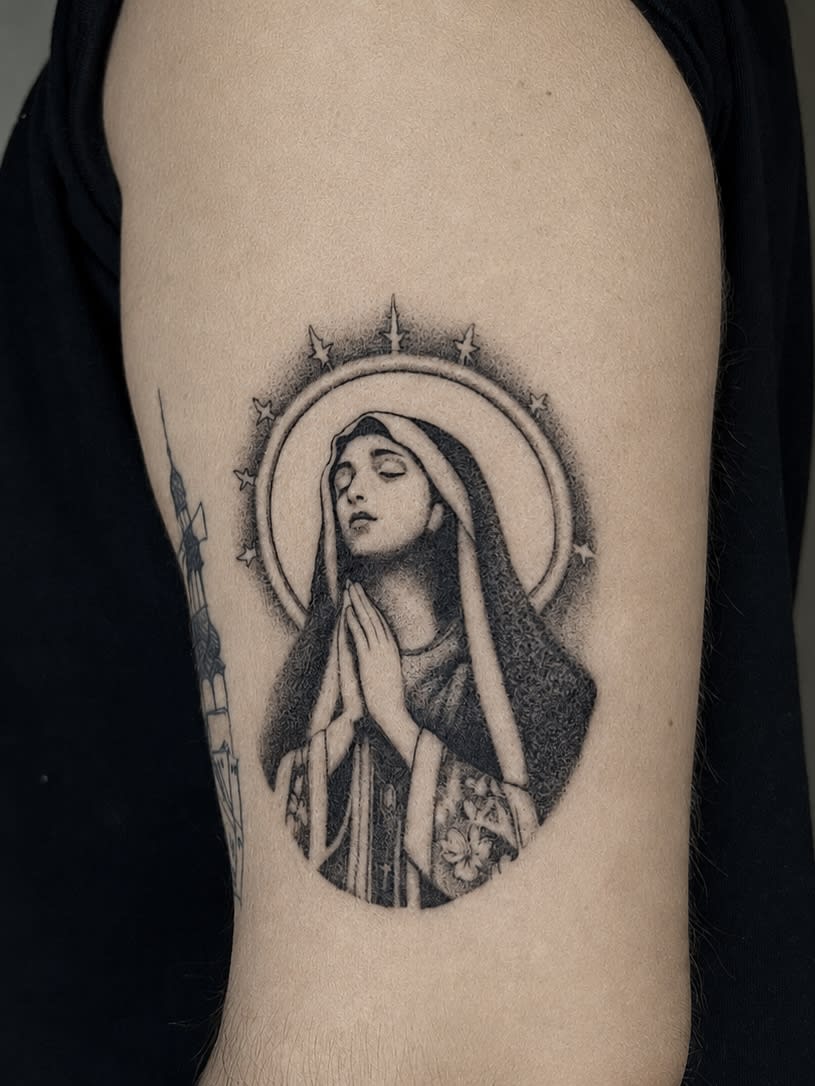




01Anatomy
Two sides, two completely different tattoos
- high
- Skin thickness
- low
- Bone proximity
- low
- Nerve endings
The forearm is a single placement in name only. The outer side — the one on show when your arm hangs down — has thick skin (4 out of 5), muscle underneath and bone tucked well away. The needle works on a stable, forgiving base: lines sit evenly, black goes in without resistance, and larger solid areas do not force constant pauses.
The inner side is another story. The skin is thinner and paler, the vessels sit closer to the surface and there are more nerve endings. For a tattoo that has two consequences, one good and one harder: fine detail holds exceptionally cleanly here, because the pale background gives contrast the tanned outer side cannot match — but the sensation is sharper and fatigue sets in faster during a long session.
In practice this means one thing: before we settle the design, we settle the side. Delicate fine line, micro-detail and thin lettering we tend to suggest on the inside. Heavy black, ornamental work and anything meant to read from across the room goes on the outside. The same motif moved to the other side is often a different project, not the same piece in a new spot.
02Pain
Three out of ten — and why exactly that
- 3/10
- Pain
- low
- Bone proximity
- low
- Nerve endings
- high
- Skin thickness
On our scale the forearm scores 3 out of 10, one of the lowest values on the whole price list. This is not about toughness — it is about structure. Tattoo pain comes mainly from three things: the density of nerve endings, how close the bone sits and how thick the skin is. The forearm comes out mild on all three.
The bone lies under a layer of muscle, so there is none of the vibration that turns a needle prick into a deep thud on ribs or ankles. The skin is thick, so the needle is not working directly above the nerve endings. And those endings are moderate in number — nowhere near the hand, where every millimetre serves precision grip.
People usually describe it as scratching, or a warm burn that fades into the background after a quarter of an hour. There are two exceptions worth knowing about: the area near the wrist and the inner elbow, where the skin thins out abruptly and the nerves run closer to the surface. If the design reaches those spots, we say so in advance and plan a break for exactly that point in the session.
03Composition
A design that flows along the arm
- along the limb
- Design flow
- no
- Movement zone
The forearm is elongated and slightly tapered: wider at the elbow, narrower at the wrist. A composition that ignores this looks stuck on. A composition that uses it looks as though it grew with the arm.
So we run motifs vertically here, along the limb. A branch, a column of lettering, a slender ornament, a vertical scene — anything with a long axis sits naturally. Square or horizontally wide motifs take more work: we either crop them, wrap them, or find them a different home.
The second thing worth thinking about straight away: a forearm rarely stays on its own. Very often it is the first element of something larger — which is why we settle the direction at the first design stage and leave breathing room near the elbow. Empty space is not wasted. It is what decides whether another element can be added in two years, or whether that will have to start from a compromise.
Unlike the wrist or the inner elbow, the middle of the forearm is not a movement zone. The skin does not fold sharply here and does not rub against itself, so the design is not worked by every gesture — one of the reasons a line stays clean here longer than on the neighbouring sections.
04Healing
Two to four weeks, no surprises
- 14–28 days
- Healing
- ~28 days
- Epidermis turnover
- low
- Friction
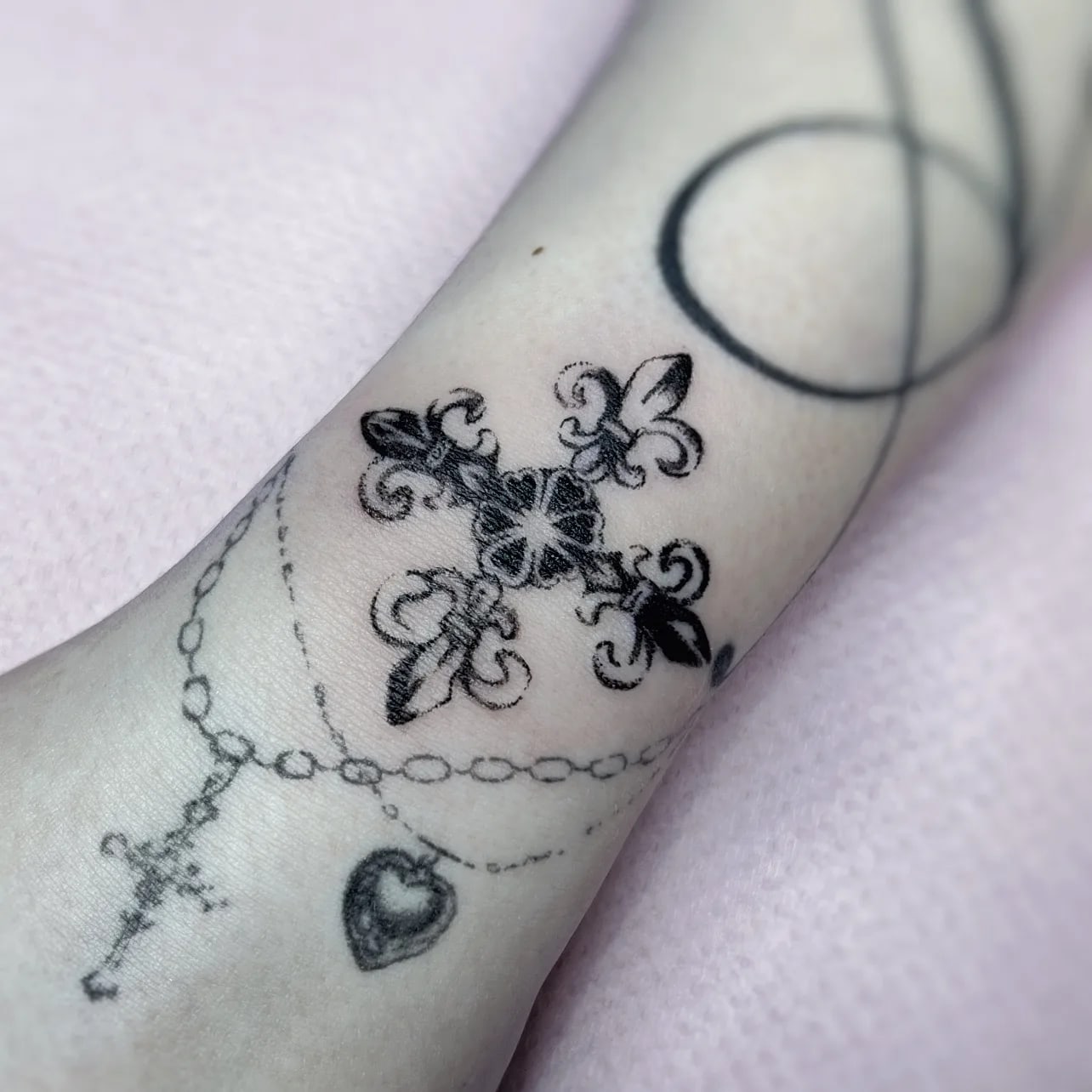
The epidermis on the forearm renews itself in about 28 days, and full healing usually takes two to four weeks. It is one of the calmest processes we see — mainly because friction here is minimal (2 out of 5). Nothing rubs against bedding the way a back does, nothing works with every grip the way a hand does.
For the first few days you wear a second-skin dressing. After that you wash with lukewarm water, dry by patting rather than rubbing, and apply a thin layer of cream. Thin is the operative word: a thick layer does not speed healing, it blocks air exchange and can flush out fresh pigment.
The three things that genuinely get in the way here are a sleeve rubbing the fresh work, a watch strap sitting just above the tattoo, and physical work that makes the arm sweat. All three can be predicted at the consultation, and we then pick a date so the first week falls somewhere quiet.
- Take off your watch and bracelets while it heals — the strap lands exactly where designs most often end, near the wrist.
- Sleep so the fresh work is not pressed into the bedding all night; on a forearm, changing which side you fall asleep on is enough.
- Pools, saunas and long baths are out until it is fully healed — not because of water as such, but because of soaking time and what else is in that water.
- The gym comes back after about a week, but a barbell resting on a fresh inner forearm is a simple way to rub the pigment out.
- Itching in the second week is normal. A pat with an open palm settles it just as well as scratching and does not tear the scab off.
05Longevity
The sun decides how this tattoo will age
- very high
- Sun exposure
- 10% of pieces
- Touch-up rate
- low
- Blowout risk
The forearm has the highest sun exposure of every placement we tattoo — 5 out of 5. You put it out through an open car window, on a terrace, on a bike, with every short sleeve. In total it collects more ultraviolet than your face does, because a face more often ends up in the shade while an arm stays out without a second thought.
Ultraviolet light breaks up pigment particles under the skin. It does not wash a tattoo away overnight — it works over years, quietly, starting with the thinnest lines and the lightest areas. The tattoo does not so much fade as soften: contrast drops, and what was crisp goes gentle.
The good news is that this is the only serious variable. Touch-ups after healing run at about 10% of pieces here — six times less often than on the hand. The skin is thick, blowout risk is low, friction is nil. So if you stay on top of sunscreen, a forearm ages better than most placements on the body.
Specifically: no sun at all on fresh work for the first four weeks, then factor 50 on an exposed tattoo — always, not only on holiday. That single habit is the difference between a piece that looks great for five years and one that looks great for fifteen.
06Risks
What can genuinely go wrong
- low
- Blowout risk
- low
- Skin stretching
- high
- Skin thickness
A blowout is what happens when pigment spreads under the skin and a line picks up a bluish halo. It occurs when the needle goes too deep — easiest where the skin is thin. On the forearm the risk is low (2 out of 5), because the layer is thick and forgiving. It does rise near the wrist and on the inner side, and those are the two places where we slow down.
Skin stretching is also a minor concern here. A forearm does not change in circumference the way a stomach or thigh does through larger weight swings, so the composition keeps its proportions for years.
That leaves one risk technique cannot solve: detail that is too fine. Every line spreads slightly over time — that is normal physiology, not a mistake. A design where two strokes are a hair apart merges into a single smudge after five years. So when we design, we leave wider gaps than the sketch appears to need. Drawing on paper and drawing in skin are two different media.
07Styles
The techniques a forearm carries best
- high
- Skin thickness
- along the limb
- Design flow
Thick, even skin and an elongated shape make the forearm one of the most versatile placements there is. There is practically no technique that cannot be done here — only techniques that come out exceptionally well.
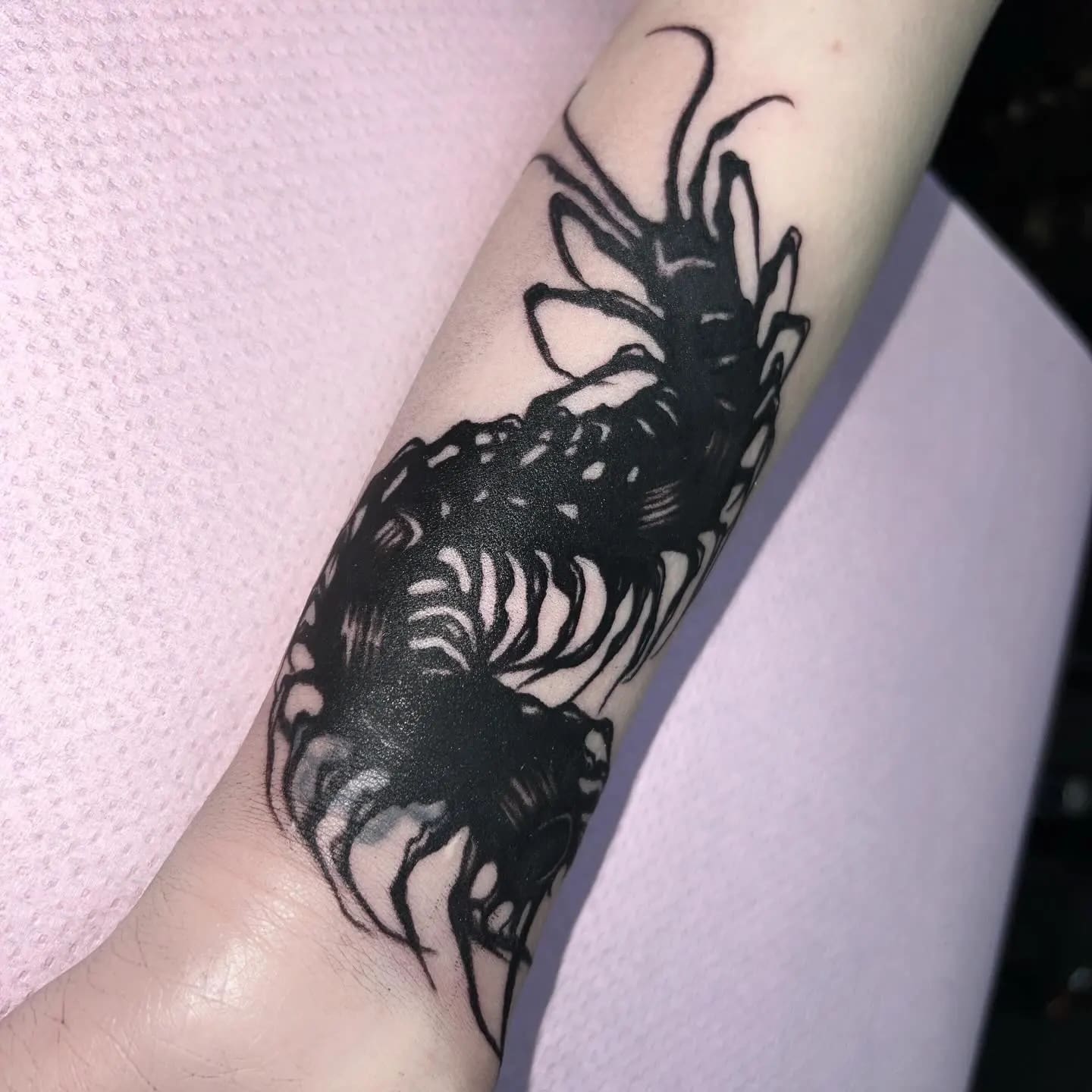
Fine line and micro-realism hold their own on the inner side, where paler skin gives contrast and lets us go thinner on the stroke. Blackwork, ornamental work and dotwork sit on the outside: there is room for solid areas, and dense black looks strongest here. Vertical lettering uses the shape directly — a column of text along the radius is one of those layouts that simply works.
Realism calls for more thought. It comes out beautifully, but it needs surface area: a portrait or an elaborate scene on a small forearm forces simplifications that cannot be undone later. For projects like that we more often suggest moving up to the upper arm, or splitting the work across two sessions.
08Everyday life
People see it at work — better to think that through first
- low
- Coverability
- very high
- Sun exposure
Coverability on the forearm is 2 out of 5, the lowest score among placements that can be hidden at all. A long sleeve handles it, but a short sleeve, a polo shirt, summer and most workwear do not. That is not a flaw, it is a fact to weigh before the session rather than after.
In practice the question is where your tattoo ends. If being able to cover it matters to you, we plan the edge of the design to sit under a shirt cuff — and we raise that openly at the consultation, before there is a sketch. It is one of the most common things we adjust at the design stage.
Outside work, a forearm is easy to live with: it does not get in the way of sport, does not rub against equipment, does not call for new habits. The one habit that does become permanent is sunscreen — and that is the same bottle you already use on your face.
09First tattoo
Why this is the most common choice for a first tattoo
- 3/10
- Pain
- 1–4 h
- Typical session
- 10% of pieces
- Touch-up rate
The forearm wins this category not through fashion but through a stack of small things. Pain at 3 out of 10 means a first session does not turn into a test of character. A typical project closes inside one to four hours, so there is no need to plan a day off or come back in a month. Healing is predictable and touch-ups are rare.
On top of that comes something harder to measure: you see the result. A back piece is something you view in a mirror after the session, or in a photo your partner took. This one is right in front of you immediately and throughout healing — which makes the first fortnight considerably easier, when the skin looks different from how it will end up and it is easy to worry unnecessarily.
If this is your first time, one piece of advice from experience: do not start at maximum size. Begin with a project that closes in a single session, see how your skin heals, and only then decide about expanding. A forearm is ideal for that, because it leaves room in both directions.

10Nearby placements
The forearm and the rest of the arm
- 10% of pieces
- Touch-up rate
- low
- Coverability
The forearm is the stretch from elbow to wrist — one third of what we colloquially call the arm. Neighbouring placements matter here in practical terms, because these sections differ more than you would think.
The sharpest contrast is with the hand, a placement some fifteen centimetres away. Touch-ups after healing run at about 10% of forearm pieces and 60% on the hand — six times more often. The epidermis of the hand renews twice as fast, friction is at its maximum and the skin is thin. Same limb, two different worlds in terms of durability. If you are torn between them, that is not a matter of taste but of how often you want to come back for a touch-up.
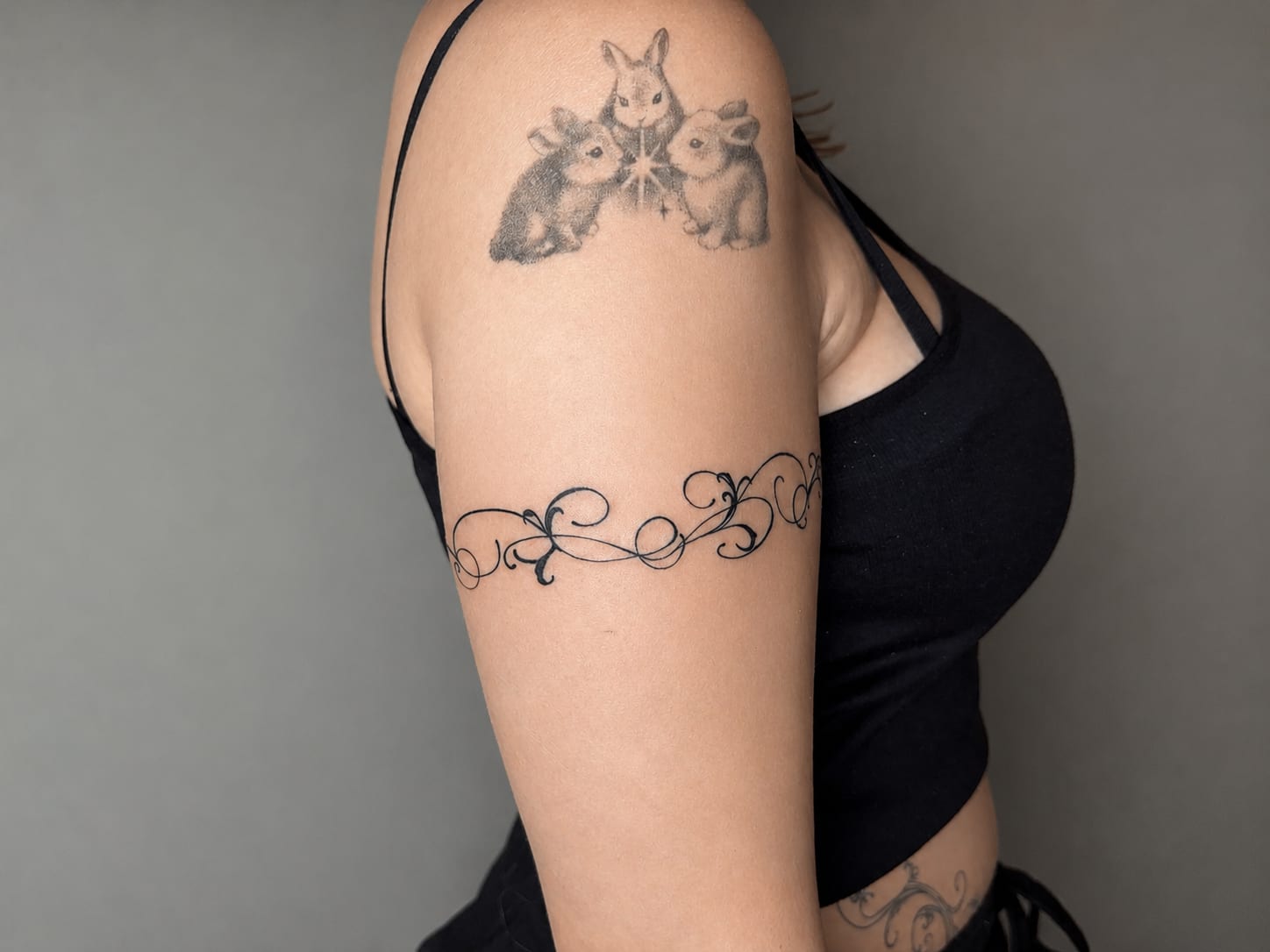
With the upper arm the difference runs the other way and concerns visibility. Pain and skin thickness are nearly identical, but the upper arm hides under a short sleeve (coverability 4 out of 5 against 2 out of 5) and wraps around rather than running straight. The same motif on the upper arm will be more private and composed differently.
11Price
What actually drives the price here
- 1–4 h
- Typical session
- 3/10
- Pain
The price of a forearm tattoo depends above all on time at the skin, not on the placement itself. The forearm carries no difficulty surcharge — it is technically obliging, so the multiplier here matches the simplest locations.
In practice three things decide the figure: surface area, density of detail and technique. A small motif or a short piece of lettering fits into one short session. An ornamental piece or elaborate botanical work running the length of the forearm is usually two to four hours. Realism and dense shading can go beyond that range, and then we split the work.
A custom design is included in the price, as is the check-up after healing. We give a binding figure only after a free consultation, where we can see the skin, the size and your references — because quoting from a description over the internet is guesswork, not a quote.
Nearby placements
- armThe forearm is one of three sections of the arm. If you are thinking about something larger, or a sleeve, start by comparing all three side by side.
- handFifteen centimetres further along, touch-ups come six times more often: 10% on the forearm against 60% on the hand. Worth seeing where that difference comes from before you choose.
- upper armThe same pain level and the same skin, but the upper arm hides under a short sleeve and wraps around instead of running straight. Choosing between them is mostly a decision about who gets to see this tattoo.
Styles that look great in this spot


Frequently asked questions
The price depends on time at the skin rather than the placement itself — the forearm carries no difficulty surcharge at Parvata Tattoo, because it is technically obliging. The smallest projects start at 300 PLN, the rate for a minimalist tattoo, and that usually covers a small motif or a short piece of lettering. An ornamental piece or botanical work running the length of the forearm is most often two to four hours of work, so the figure rises with the time. Large, densely shaded projects generally fall between 1000 and 2000 PLN, while work spread across several appointments is billed per session at 1800 PLN. A custom design and the post-healing check-up are included. We give a binding figure after a free consultation, and take a 100–500 PLN deposit that comes off the final price in full.
On the scale used at Parvata Tattoo the forearm scores 3 out of 10, one of the lowest values on the whole price list. This is not about resilience but about structure: tattoo pain depends mainly on the density of nerve endings, how close the bone sits and how thick the skin is, and the forearm comes out mild on all three. The bone lies under a layer of muscle, so there is none of the vibration that turns a needle prick into a deep thud on the ribs. The skin is thick, which keeps the needle from working directly above the nerve endings. Most people describe the sensation as scratching or a warm burn that fades into the background after a quarter of an hour. Two stretches are noticeably more sensitive: near the wrist and at the inner elbow.
Full healing usually takes two to four weeks, and the epidermis on the forearm renews itself in about 28 days. It is one of the calmest processes among the placements we tattoo at Parvata Tattoo, mainly because friction here is minimal — 2 on a five-point scale. Nothing rubs against bedding the way a back does and nothing works with every grip the way a hand does. For the first few days you wear a second-skin dressing, then wash with lukewarm water, dry by patting rather than rubbing, and apply a thin layer of cream. Thin matters here: a thick layer does not speed healing, it blocks air exchange and can flush out fresh pigment. Three things genuinely get in the way — a rubbing sleeve, a watch strap above the design, and physical work that makes the arm sweat.
Yes, and it is the single most important variable for this placement. The forearm has the highest sun exposure of any location on the Parvata Tattoo price list — 5 out of 5. You put it out through an open car window, on a terrace, on a bike and with every short sleeve, so in total it collects more radiation than your face, which more often ends up in the shade. Ultraviolet light breaks up pigment particles under the skin: it does not wash a tattoo away overnight, it takes away contrast over years, starting with the thinnest lines and lightest areas. The piece softens rather than disappears. Protection is simple and comes down to two things: no sun on fresh work for the first four weeks, then factor 50 on an exposed tattoo all year round, not only on holiday.
Partly — and it is better to think it through before the session than after. We rate forearm coverability at 2 on a five-point scale, the lowest among placements that can be hidden under clothing at all. A long sleeve handles it completely, but a polo shirt, a short sleeve, summer and most workwear do not. In practice the question is not whether you can cover it but where the design ends. If being able to conceal the tattoo matters to you, we set the boundary of the project so it sits under a shirt cuff — and we say so plainly at the consultation, before there is a sketch. It is one of the most common adjustments we make at the design stage. Beyond the clothing question a forearm is exceptionally easy to live with.
These are two different placements despite the shared name, and the choice is better made on the design than on habit. The outer side has thick skin, rated 4 on a five-point scale at Parvata Tattoo, muscle underneath and bone tucked well away — the needle works on a stable base, so heavy black, blackwork and ornamental pieces come out best here and read from across the room. The inner side has thinner, paler skin, vessels closer to the surface and more nerve endings. Fine detail holds exceptionally cleanly there, because the pale background gives contrast the tanned outer side cannot match, but the sensation is sharper and fatigue sets in faster during a longer session. Blowout risk also rises there, which is why we slow the pace on the inner side.
More about the studio
Have an idea for a tattoo in this spot?
Book a free, no-obligation consultation — we will match an artist and design the motif for your body.